
21 years on, Ghana’s school placement system is still testing the patience of parents and students
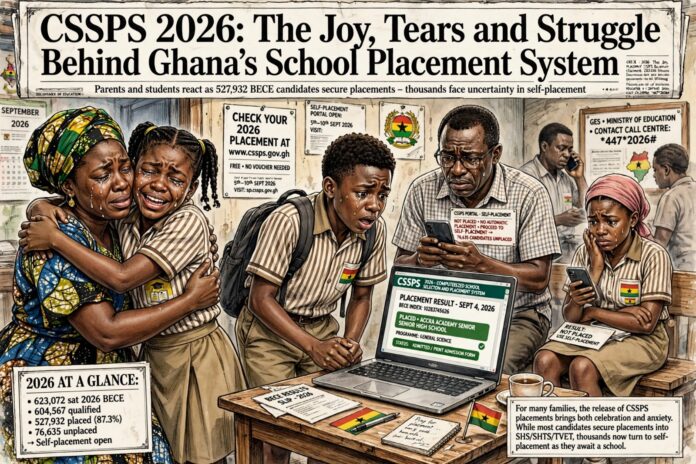
At 10 p.m. on September 4, 2026, thousands of Ghanaian families reached for their phones, entered examination details and waited anxiously for a message that could shape the next three years of their children’s lives.
For some, the screen brought celebration.
For others, it brought confusion, disappointment and a frantic search for answers.
The Computerised School Selection and Placement System (CSSPS) had once again opened its doors.
And, as has become an annual ritual, Ghana was soon divided between parents celebrating coveted placements and others asking the same difficult question: How did my child end up here?
The 2026 exercise has placed 527,932 candidates into Senior High Schools, Senior High Technical Schools and Technical and Vocational Education and Training institutions.
That represents about 87.3 per cent of the 604,567 candidates who qualified for placement after the 2026 Basic Education Certificate Examination (BECE).
But behind those numbers is another figure that has become central to this year’s debate: 76,635 qualified candidates were not automatically placed.
The reason is revealing.
According to the Ministry of Education, 313,283 candidates selected Category A schools as their first choice, competing for just 76,417 declared vacancies.
The Ministry says the challenge is therefore not necessarily a shortage of spaces in the secondary education system, but a mismatch between where vacancies exist and where students want to go.
And that mismatch is where the annual CSSPS drama begins.
When a dream school becomes a disappointment
For many BECE candidates, school selection starts months before placement.
Parents discuss schools with friends. Teachers offer advice. Children dream about uniforms, houses, campuses and traditions.
The names of highly subscribed schools dominate conversations.
But when the placement results arrive, dreams can quickly collide with reality.
A candidate may have performed strongly but still miss out on a preferred school because thousands of other students are competing for limited vacancies.
This is one of the fundamental realities of CSSPS: good grades alone do not guarantee admission to a particular school.
Placement takes into account academic performance, programme choices, school preferences and available vacancies.
(CSSPS)
The result is that two students with seemingly similar grades can receive different outcomes depending on the schools and programmes they selected.
For disappointed parents, however, the explanation is often difficult to accept.
The question is simple:
“If my child performed well, why didn’t he or she get the school we selected?”
The self-placement scramble
For candidates who are not automatically placed, the next option is self-placement.
The official CSSPS portal allows an unplaced candidate to select a school and programme with available vacancies.
The process requires the candidate to log in, select a region, choose an available school, select an available programme and residence type, and submit the application.
On paper, it is a practical solution.
In reality, it can become another source of anxiety.
Vacancies are limited, preferred schools may no longer be available, and families have to make decisions quickly.
For parents without reliable internet access or adequate digital skills, the process can also be intimidating.
This is particularly important in a country where access to technology and reliable connectivity is not uniform.
The system may be digital, but the people using it do not all begin from the same starting point.
The human cost of placement
For some families, the placement challenge is not simply about getting a school.
It is about distance, accommodation and money.
A student placed far from home may mean additional transport costs. A boarding placement comes with expenses for school items, transportation and other requirements.
Even after securing a placement, parents must still navigate the admission process.
This year, however, the Ministry says the CSSPS has been upgraded to allow parents and guardians to complete parts of the admission and enrolment process online and download relevant documents without necessarily travelling to individual schools.
The Ministry says the move is intended to reduce the financial and logistical burden on families.
That is a welcome development.
But for many families, the bigger question remains: What happens when the placement itself is disputed?
GNAT HALL: where frustration meets the system
In Accra, the answer has been playing out at the National Placement Resolution Centre at GNAT Hall.
The centre has witnessed large numbers of parents and candidates seeking assistance with placement problems.
Reports from the facility describe long queues, hours of waiting and growing frustration among people seeking answers to their individual cases.
Parents have called for additional resolution centres and more personnel to reduce congestion.
The situation exposes one of the biggest weaknesses in the current model.
A system designed to digitise school placement still depends heavily on physical intervention when things go wrong.
And when thousands of people need human assistance at the same time, even a well-intentioned resolution mechanism can quickly become overwhelmed.
The Ministry has acknowledged the challenge.
It says it plans to digitise the placement complaints process from 2027, allowing parents and candidates to submit and resolve concerns through the CSSPS portal rather than relying so heavily on physical resolution centres.
That could represent one of the most significant changes to the placement process since its introduction.
So, has CSSPS achieved its purpose?
The answer is complicated.
There is no doubt that CSSPS has transformed school placement.
It has replaced a system that could be vulnerable to human discretion with a computerised process designed to match candidates to schools based on defined criteria.
It has also expanded the ability to process hundreds of thousands of candidates.
But efficiency is not the same as perfection.
After more than two decades, the recurring complaints suggest that the conversation must move beyond whether CSSPS can place students.
The bigger question should be:
Can CSSPS place students in a way that is transparent, understandable, accessible and trusted by the public?
A system can successfully place more than half a million students and still leave thousands of families frustrated.
That is the paradox Ghana must confront.
The real problem may be the choices we make
The 2026 figures offer an important lesson.
More than 313,000 candidates selected Category A schools as their first choice, while the declared vacancies in those schools stood at just 76,417.
Meanwhile, Category B and C schools had significantly larger numbers of declared vacancies.
This raises a difficult but necessary question:
Are Ghanaian families placing too much emphasis on a relatively small group of schools?
For years, school reputation has been heavily associated with a limited number of institutions.
The consequence is predictable: thousands of candidates chase the same schools while other institutions struggle to attract students.
Perhaps the solution is not simply to increase vacancies in the most popular schools.
Perhaps Ghana must also invest in making more schools equally desirable.
That means better infrastructure, laboratories, libraries, accommodation, teaching resources, sports facilities and, most importantly, confidence in the quality of education being delivered.
Beyond the annual drama
Every September, Ghana has the same conversation.
Parents queue.
Students worry.
Social media fills with screenshots.
Some families celebrate.
Others cry.
And eventually, the country moves on until the next placement season.
But perhaps we should not move on so quickly.
Because CSSPS is more than a computer system.
It is the mechanism through which hundreds of thousands of young Ghanaians begin the next chapter of their education.
For the student who gets the dream school, it can be a moment of triumph.
For the student who does not, it can feel like the end of a dream.
But the school a child attends should not determine the limits of that child’s future.
The real measure of Ghana’s education system should be whether every child, regardless of the school assigned, has access to quality teaching, adequate facilities, opportunity and a fair chance to succeed.
Twenty-one years after CSSPS was introduced, perhaps the question is no longer simply whether the system works.
The question is whether we are ready to make it work better for everyone.
School placement is here again.
The celebrations will fade. The tears will dry. The queues at resolution centres will eventually disappear.
But the lessons must remain.
Ghana should not wait another year to fix the problems we already know exist.