
Every year, thousands of Ghanaian households wait anxiously for one message: their child’s Senior High School placement.
While some families rejoice after the placement, others are thrown into confusion about how the whole system actually works.
Let’s take a look at what CSSPS is, and the persistent problems that continue to trail it.
What is CSSPS?
CSSPS stands for the Computerised School Selection and Placement System. It is the platform the Ghana Education Service (GES) uses to match Basic Education Certificate Examination (BECE) candidates with places in Senior High Schools (SHS), Senior High Technical Schools (SHTS) and Technical and Vocational Institutions (TVET).
The system takes each candidate’s exam results and their list of preferred schools, then places them according to a set of rules. It was introduced in Ghana in 2005 and has been running for over two decades.
How placements were done before CSSPS
Before 2005, Ghana relied on the Manual System of Selection and Placement, or MSSP. Under the old system, heads of Senior High Schools and GES officials converged at regional centres each year to go through candidates’ records by hand, using WAEC results and submissions from Junior High Schools to decide who went where.
The system was slow and inconsistent. It relied on candidates’ actual subject grades rather than a standardised scoring method, which created bottlenecks as officials worked through large volumes of paperwork. It also left considerable room for inequality, favouritism and corruption, since placement decisions were made behind closed doors at regional gatherings rather than through a transparent, rules-based process. By some estimates, only 42 to 46.6 per cent of qualified candidates were successfully admitted into Senior High Schools under that system.
The Ministry of Education and GES introduced CSSPS in 2005 to replace this manual process, aiming for a faster, more transparent and more consistent way to match candidates with schools.
Old complaints that never went away
More than 20 years after its introduction, education analysts and the Education Ministry itself admit that CSSPS still produces recurring errors every placement season.
Oversubscription of “prestigious” schools
Though Ghana has more than 700 Senior High Schools, most parents and candidates compete for a place in fewer than 100 Category A and B institutions. In the 2026 exercise, 313,283 candidates selected Category A schools as their first choice, against only 76,417 declared vacancies. Executive Director of Eduwatch, Kofi Asare, has said this gap between where students want to go and where space actually exists, not a genuine shortage of school places, is what drives most of the annual placement drama.
Candidates placed in schools or programmes they never chose
Another recurring complaint is that some candidates end up in schools or programmes they never selected at all. Education policy analyst Divine Kpe has called for an audit of the placement algorithm, arguing that an automatic placement doesn’t always mean a candidate was correctly matched to a school.
Wrong boarding or day status
Requests to correct a student’s status from day to boarding, or the other way round, are among the most common issues raised at placement resolution centres, alongside disputes over school and programme choice.
Students placed in single-sex schools that don’t match their gender
Complaints about candidates of one gender being placed in a single-sex school meant for the other have persisted for years, pointing to data-entry or system-matching errors rather than one-off mistakes.
Congestion at resolution centres
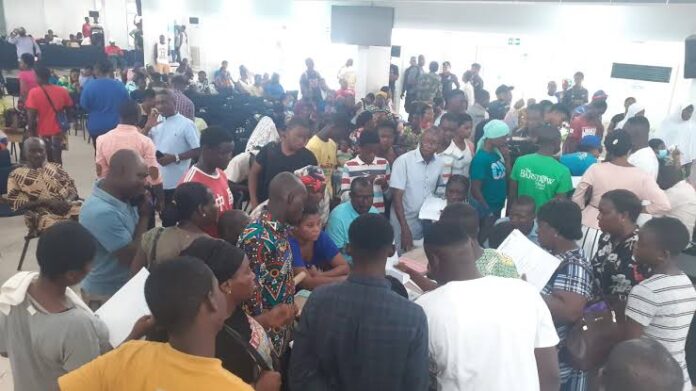
When something goes wrong, fixing it often means physically travelling to a resolution centre. Parents have described queuing from as early as 4 a.m., and in some cases spending the night at these centres while waiting for their child’s issue to be sorted out.
Self-placement frustrations
Some candidates who qualify but aren’t automatically placed still have to contend with self-placement, where they choose from schools with remaining vacancies. By the time a candidate reaches this stage, the options left are often limited or unattractive.
What the Ministry says is really going on
The Ministry of Education maintains that the core issue isn’t a shortage of spaces in the education system overall, but a mismatch between where vacancies exist and where students and parents actually want to go.
Officials have revealed planned reforms are already in motion, including plans to digitise the placement complaints process from 2027, which would let parents and candidates submit and resolve concerns directly through the CSSPS portal instead of relying so heavily on physical resolution centres.
Has CSSPS achieved what it set out to do?
CSSPS replaced a system vulnerable to human discretion with a computerised process built on defined criteria, and it now processes hundreds of thousands of candidates each year far faster than the old system ever could.
But that efficiency hasn’t put an end to the complaints. Some critics say the corruption concerns from the manual era didn’t disappear under CSSPS, but simply changed shape.
After more than two decades, the recurring nature of these problems suggests the real question is no longer whether Ghana has a computerised placement system. It’s whether that system is transparent, predictable and fair enough to match its promise.