
The Ghana Institution of Surveyors (GhIS) has responded to allegations over compensation claims linked to certain road projects, saying it takes the concerns seriously but will not treat every disputed valuation as proof of wrongdoing.
This comes after the Minister for Roads and Highways, Governs Kwame Agbodza, revealed the government’s plans to report two quantity surveyors to the Economic and Organised Crime Office (EOCO) over alleged attempts to inflate compensation claims for properties affected by road projects.
The minister had said some surveyors allegedly encourage project-affected persons to reject government valuations and promise to secure compensation several times higher than amounts assessed by state agencies, adding that the practice had cost the state significant sums and contributed to delays in executing road projects.
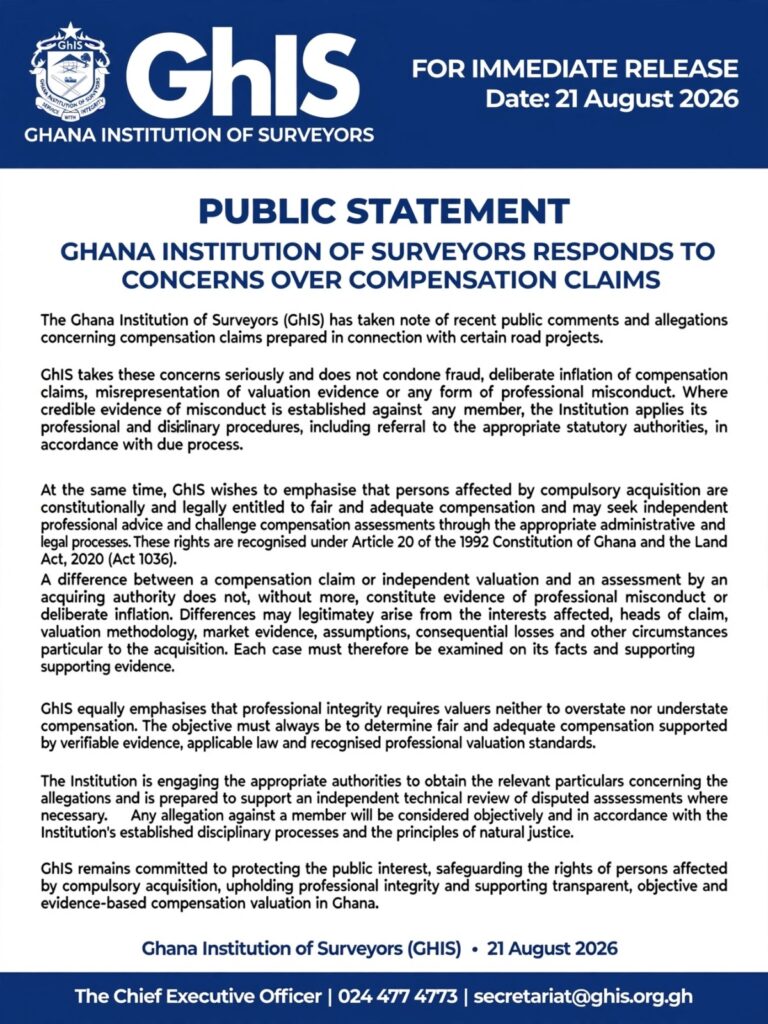
However, in a statement dated August 21, 2026, GhIS said it does not condone fraud, deliberate inflation of compensation claims, misrepresentation of valuation evidence, or any other form of professional misconduct.
“Where credible evidence of misconduct is established against any member, the Institution applies its professional and disciplinary procedures, including referral to the appropriate statutory authorities, in accordance with due process,” the statement said.
At the same time, GhIS stressed that people whose property is compulsorily acquired by the state have a right to fair and adequate compensation, and can seek independent advice or challenge an assessment through the proper channels.
“Persons affected by compulsory acquisition are constitutionally and legally entitled to fair and adequate compensation, and may seek independent professional advice and challenge compensation assessments through the appropriate administrative and legal processes,” it said, citing Article 20 of the 1992 Constitution and the Land Act, 2020 (Act 1036).
The Institution said a gap between a landowner’s claim and government’s own valuation does not, by itself, point to fraud.
“A difference between a compensation claim or independent valuation and an assessment by an acquiring authority does not, without more, constitute evidence of professional misconduct or deliberate inflation,” GhIS said, adding that such differences can arise legitimately from factors including the interests affected, the type of claim, valuation methods used, available market evidence, assumptions made, and other case-specific circumstances.
“Each case must therefore be examined on its facts and supporting evidence,” it said.
GhIS also reminded valuers of their professional duty to keep compensation figures accurate.
“Professional integrity requires valuers neither to overstate nor understate compensation. The objective must always be to determine fair and adequate compensation supported by verifiable evidence, applicable law, and recognised professional valuation standards,” the statement said.
The Institution said it is engaging the relevant authorities to get more details on the allegations and is prepared to support an independent technical review of any disputed assessments.
“Any allegation against a member will be considered objectively and in accordance with the Institution’s established disciplinary processes and the principles of natural justice,” it said.
GhIS said its position is aimed at protecting the public interest, defending the rights of people affected by compulsory land acquisition, and promoting transparent, evidence-based compensation valuation in Ghana.
ALSO READ: