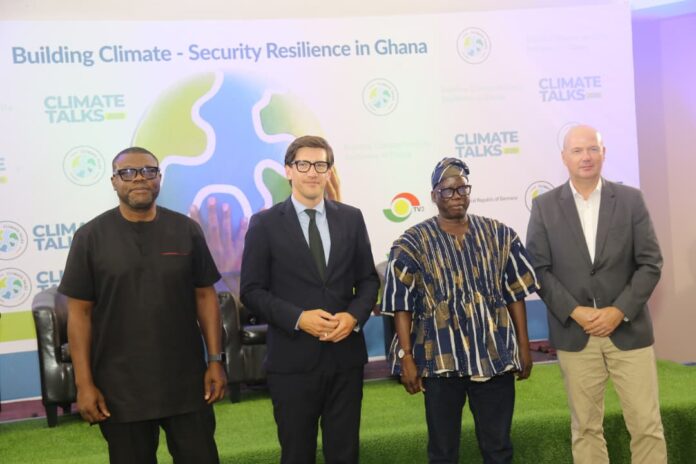

Amidst challenges of extreme weather and climate across the globe, the German Embassy in Accra has convened experts in Bolgatanga to address how these challenges amplify the scale and complexity of human mobility across the Sahel in particular.
Joined by experts from Ghana Immigration Services (GIS), United Nations Refugee Agency (UHCR) and the community, the dialogue explored responses to these emerging security risks.
Held under the theme “Climate-Driven Migration and Its Impacts in Ghana’s Upper East Region,” the Climate Talks 2026 dialogue focused on how environmental stress and the resulting movement of people impact the livelihoods of people in Northern Ghana.
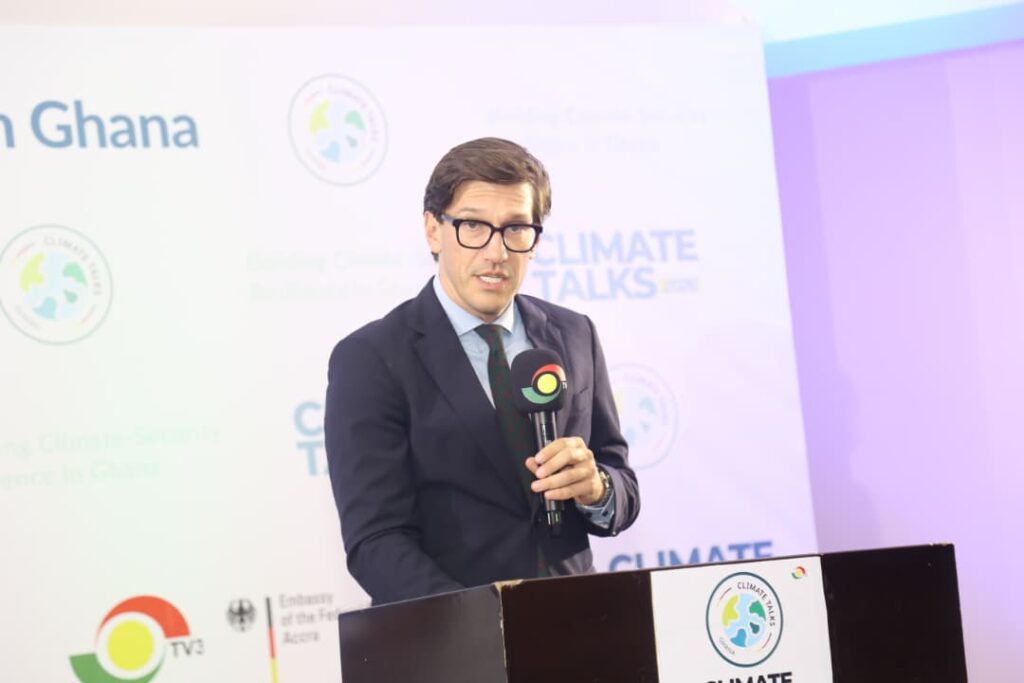
Opening the event, German Ambassador to Ghana, H.E. Frederik Landshoeft, underscored the increasing relevance of climate change as a security concern for the future.
“Ghana’s Upper East Region has longstanding social and cultural ties with neighbouring countries.
However, climate change, environmental degradation, and recurring droughts are placing growing pressure on livelihoods across the Sahel,” Ambassador Landshoeft stated.
“These environmental challenges often interact with conflict, economic hardship, and political instability, prompting many people to seek safety and opportunities elsewhere.”
The Ambassador commended ongoing efforts to balance humanitarian protection, sustainable development, and regional security. He noted that with the right policy frameworks, displaced populations can make meaningful contributions to their new environments.
One such example are bylaws gazetted in Upper West, drawn up together with all stakeholders. Once potential conflicts are prevented, the potential of migration comes to the fore: Refugees and migrants often bring valuable skills, knowledge, and labor that support local economic growth in sectors such as agriculture, trade and service delivery, benefiting both host and displaced communities.
Participants emphasized that with the right policy frameworks and social inclusion, displaced populations can make meaningful contributions to host communities, bringing valuable skills, entrepreneurship, and labor to support local economic growth in agriculture and trade.
A central theme of the discussion was the necessity of strengthening community resilience and social cohesion.
Experts noted that supporting the sustainable management of natural resources is essential to reduce competition over land, water, and grazing areas.
Furthermore, creating targeted economic opportunities for women and young people is seen as a key strategy to reduce vulnerability to exploitation and promote lasting peace: “To have lasting peace, we must first build strong communities.
This means managing our land and water fairly and creating real opportunities for women and young people so they aren’t left behind. When local people lead the way in finding solutions, the community stays united, even when climate change makes life harder.”
“Together, we can build a better understanding of the challenges we face and the solutions that already exist within our communities,” Ambassador Landshoeft concluded. “Resilience starts with knowledge, grows through communication, and succeeds through coordination.”
Acknowledging the global nature of the climate crisis and Germany’s own responsibility as an industrial nation, the Embassy continues to foster a partnership based on solidarity.
Through Climate Talks 2026, the German Embassy aims to foster evidence-based dialogue and practical solutions to emerging climate-security risks.
Ambassador Landshoeft reaffirmed Germany’s commitment to a partnership based on solidarity. Germany remains dedicated to supporting peacebuilding, conflict prevention, and sustainable development in Ghana.
Through the “Climate Talks 2026,” the German Embassy aims to continue fostering evidence-based dialogue and practical solutions to emerging climate-security risks.