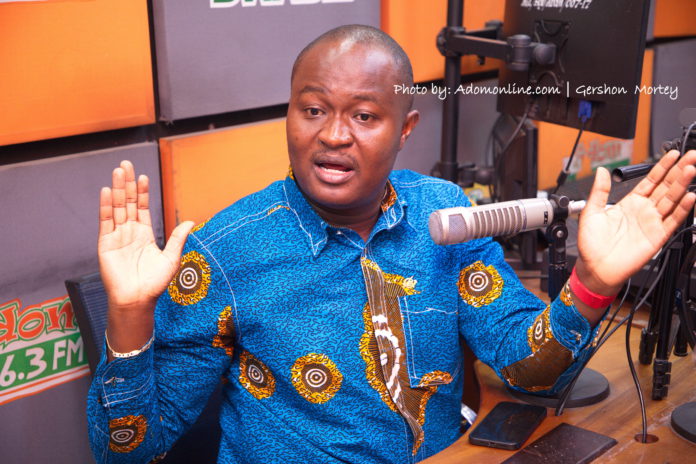

Lawyer and New Patriotic Party (NPP) communicator Kwasi Kwarteng has criticised Chief Justice Paul Baffoe-Bonnie over his recent comments on the performance of state-owned enterprises (SOEs).
According to Mr Kwarteng, the Chief Justice’s remarks amounted to an inappropriate political comparison between two administrations and were inconsistent with the restraint expected of the head of the Judiciary.
Speaking on Adom FM’s Dwaso Nsem, Mr Kwarteng said the issue should not be reduced to whether the Chief Justice’s comments were truthful, but whether they were appropriate given the stature of his office.
“What he said is not the matter of truth. Let’s not try to water it down to that level,” he said.
He argued that the Chief Justice’s reference to Ghana’s performance over the “past eight years” amounted to a comparison between two political administrations, which he considers inappropriate for the head of the Judiciary.
“What he did is a commentary of political comparison of two political parties, which is a no-go area,” Mr Kwarteng stated.
He explained that the controversy was primarily an issue of ethics and the moral standards expected of persons who occupy high public offices, rather than whether the comments could attract legal sanctions.
“Ethics is not something a person can be arraigned in court when frowned upon, but it is moral standards. Right is right and wrong is wrong,” he said.
Mr Kwarteng argued that the Chief Justice’s assessment should not be defended simply on the basis of whether his statements were accurate.
He said a proper assessment of Ghana’s progress should instead examine specific sectors and social challenges.
“Let’s go sector by sector. Tackling galamsey and other social issues, then you know you are now Afrobarometer,” he said.
He described the Chief Justice’s comments as inappropriate and urged supporters of the governing National Democratic Congress (NDC) to acknowledge that he may have erred.
“It is so low that nobody should defend it,” Mr Kwarteng said.
“He mispoke, and we should admit it. And at best, that is the defence the NDC can give,” he added.
Mr Kwarteng stressed that occupants of high constitutional offices are expected to exercise restraint in their public comments because their words carry the weight and prestige of the institutions they lead.
“There are certain things you don’t do given your position to protect the sanctity of your office,” he said.
Using the example of the Asantehene, Otumfuo Osei Tutu II, he argued that the expectations surrounding high office often go beyond written laws.
“When have we ever seen Otumfuo drinking even water in public?” he asked.
He maintained that the controversy was therefore not primarily about legality or factual accuracy, but about the standards of conduct expected from the head of the Judiciary.
“We are not talking about matters of legality and truth,” he said.
Mr Kwarteng also questioned the basis for the Chief Justice’s assessment, arguing that it appeared to have been informed by what he had heard rather than independently established evidence.
“Even the truth he referenced, it was on hearsay, so even on the prima facie, there is no truth. It was based on speculation. He couldn’t present any fact to support it,” he argued.
He further noted that the Judiciary derives much of its authority from the respect, prestige and sanctity attached to the judicial office, rather than from physical force.
“The Judiciary has no arms or ammunition, or do they have soldiers working there? But they thrive on orality and sanctity, and there is prestige and status that comes with the office and that is why they are respected,” Mr Kwarteng said.
Also read: