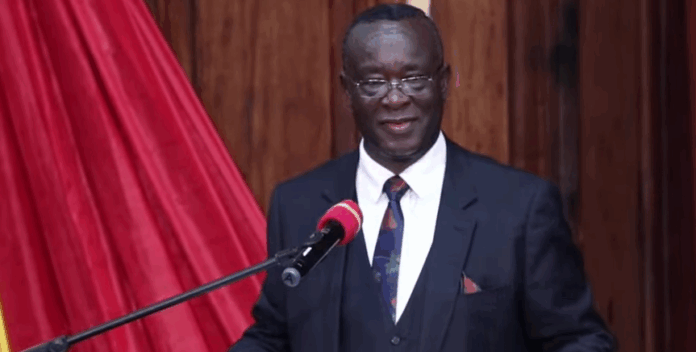

The Ghana Catholic Bishops’ Conference has dismissed calls for the resignation of Chief Justice Paul Baffoe-Bonnie over comments he made during separate visits to the Social Security and National Insurance Trust (SSNIT) and the Minerals Income Investment Fund (MIIF).
While acknowledging concerns over the perception of judicial impartiality, the Bishops described demands for the Chief Justice to step down as disproportionate to the issue at hand.
In a statement issued on Sunday, September 6, the Conference said there was nothing inherently wrong with the Chief Justice visiting public institutions, reviewing their work or commending them for improvements.
It, however, said the controversy arose from the political interpretation that could be attached to some of his comments, particularly his reference to the “past eight years.”
“In our national context, such a phrase is readily heard as a comparison between the present administration and its predecessor,” the Conference said.
The Bishops noted that while the Chief Justice may have intended to assess institutional performance, the remarks could, at least in perception, be construed as a partisan assessment.
The Conference further pointed to concerns raised by the Ghana Centre for Democratic Development that the comments could give the impression of political endorsement and potentially undermine public confidence in the Judiciary’s impartiality.
However, the Bishops said they had taken note of the Judicial Service’s explanation that the Chief Justice’s remarks were made in good faith and were not intended to undermine judicial independence.
“We receive that clarification in good faith,” the Conference said.
Despite this, the Bishops cautioned that the incident should prompt deeper reflection on judicial ethics and the importance of maintaining public trust.
They stressed that the Chief Justice occupies a unique position because the courts may be called upon to adjudicate disputes involving the government, political parties and state institutions.
“Judicial independence is not only a matter of actual impartiality; it also depends on the visible, unmistakable appearance of impartiality,” the statement said.
The Conference, however, rejected suggestions that the remarks amounted to proof of political bias or that the Judiciary had been compromised.
“Such conclusions would go well beyond the evidence available to us, and calls for his resignation on this basis alone strike us as disproportionate to the offence,” the Bishops said.
According to the Conference, the Chief Justice, like every citizen, is entitled to hold personal views and convictions. However, the high office he occupies requires him to exercise particular caution in his public engagements to avoid creating doubts about his neutrality.
The Bishops suggested that the Chief Justice could have praised the performance of SSNIT and MIIF based solely on their achievements without drawing comparisons between the records of successive administrations.
They also called on both the governing party and the opposition to avoid politicising the controversy.
“The governing party ought not to treat criticism of the Chief Justice as an attack on its own record, nor should the opposition treat his remarks as proof that the courts have been captured,” the statement said.
The Conference ultimately urged all public office holders, regardless of political affiliation, to exercise restraint and protect public confidence in Ghana’s democratic institutions.
Also read:
Read the full statement below: