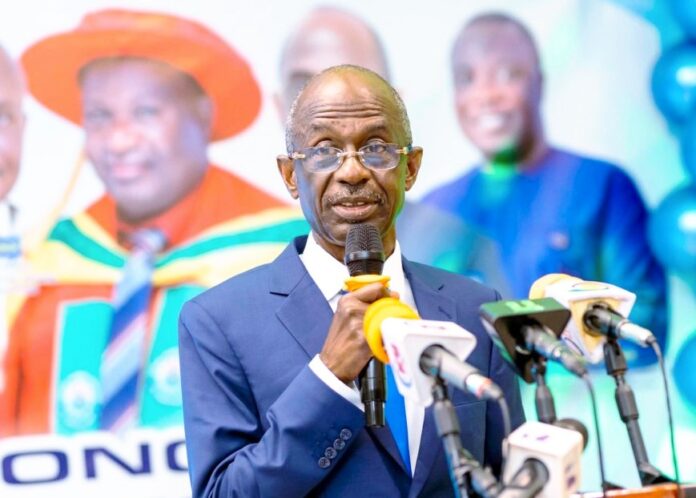

National Chairman of the National Democratic Congress (NDC), Johnson Asiedu Nketiah, has urged journalists to uphold professional independence and ensure that political pressure does not influence the accuracy and fairness of their reports.
He said journalists must give politicians from across the political divide a hearing but should ultimately rely on evidence and verified information when reporting.
Mr Asiedu Nketiah made the call at the 4th Bono Regional GJA Awards held in Sunyani.
He acknowledged that politicians would naturally have different views about how the media reports their activities.
According to him, governments may feel their achievements are not receiving adequate media attention, while opposition parties may also believe the government is not being subjected to sufficient scrutiny.
However, he stressed that such complaints should not become the basis for determining whether a journalist’s report is fair.
«“The complaint of a politician cannot become the measure of whether a story is fair,” he said.»
Mr Asiedu Nketiah urged journalists to distinguish between verified information and allegations, stressing the need to accurately report completed projects and investigate projects that have failed.
He cautioned journalists against presenting unverified claims as established facts merely because they could attract public attention.
«“If somebody makes an allegation and the evidence is not there, do not convert the allegation into a fact simply because it will make an interesting headline,” he said.»
Media credibility
The NDC National Chairman said the credibility of journalists and media organisations largely depended on public trust.
He warned that once that trust was lost, restoring confidence in the media could prove difficult.
He also drew attention to the rapidly changing media landscape, particularly the growing influence of social media, which has enabled individuals, political parties, governments and businesses to communicate directly with large audiences.
Mr Asiedu Nketiah said the emergence of artificial intelligence had further complicated the information environment, as synthetic voices, images and other forms of content could be created and presented as genuine.
Against this backdrop, he said professional journalism remained crucial because journalists have a responsibility to establish the facts and determine what actually happened.
Better working conditions
Mr Asiedu Nketiah also called for improved working conditions for journalists, arguing that media organisations must be adequately resourced to retain competent professionals, conduct investigations and maintain effective regional newsrooms.
He said journalists should be able to build sustainable careers without becoming financially dependent on politicians, businesses or institutions they cover.
He congratulated journalists who were honoured at the ceremony and encouraged them to safeguard the professional reputation they build throughout their careers.