
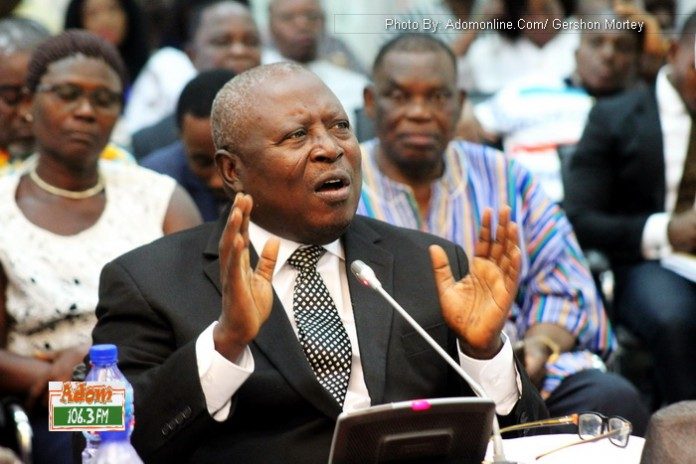

Former Special Prosecutor, Martin Amidu, has raised alarm over what he describes as a growing institutional breakdown between the Office of the Special Prosecutor (OSP) and the Attorney-General’s Department, cautioning that the tension could undermine Ghana’s anti-corruption framework.
His concerns follow a High Court ruling on Wednesday, April 15, 2026, which directed the Attorney-General’s Department to assume responsibility for all ongoing criminal prosecutions being handled by the OSP, pending formal clearance from the Attorney-General’s office.
In a detailed legal analysis, Mr Amidu argued that the Attorney-General’s Statement of Case—filed after seeking an extension of time—appears to largely align with the arguments of the plaintiff challenging key provisions of the law establishing the OSP, rather than offering a neutral defence of the state.
The case, filed in December 2025 by one Noah Ephraem Tetteh Adamtey, seeks constitutional interpretation of aspects of the Office of the Special Prosecutor Act, 2017 (Act 959), particularly whether it improperly grants prosecutorial independence in violation of Article 88 of the 1992 Constitution.
Mr Amidu noted that the Attorney-General failed to respond within the required timeframe and only applied for an extension on April 8, 2026—months after the suit was initiated. The Supreme Court has since granted the request.
He expressed concern that the Attorney-General’s filings appear to favour the plaintiff’s position, describing the stance as one that does not reflect an impartial defence of the state’s interests.
According to him, the Attorney-General, as a constitutional officer of the court, is expected to assist in the fair determination of cases rather than adopt positions that suggest alignment with one party.
He further suggested that the current posture could create the impression of a “collusive action,” raising questions about the ethics surrounding the state’s handling of the litigation.
Mr Amidu also criticised reactions from sections of civil society over the Supreme Court’s earlier decision not to join the OSP as a party to the proceedings, insisting the ruling was consistent with Article 88(5) of the Constitution, which requires that suits against the state be brought through the Attorney-General.
He argued that stakeholders dissatisfied with the process should formally apply to the court as interested parties instead of engaging in public criticism.
On the substantive legal questions, the former Special Prosecutor pointed to what he described as weaknesses in the plaintiff’s interpretation of Sections 3 and 4 of Act 959, arguing that they do not support claims of excessive prosecutorial independence.
He also identified inconsistencies in the reliefs being sought, suggesting that parts of the case may not withstand rigorous legal scrutiny.
Mr Amidu further faulted aspects of the Attorney-General’s response, describing portions of it as contradictory and insufficient in addressing the constitutional balance between the Presidency, the Attorney-General, and the Special Prosecutor.
Beyond the courtroom arguments, he warned that the dispute reflects a deeper institutional strain between the OSP and the Attorney-General’s Department.
“The relationship between the Special Prosecutor and the Attorney-General under this Government has broken down beyond repair,” he said.
“At the end of the day, the Special Prosecutor and the Attorney-General cannot co-exist and cooperate.”
The case is expected to set a significant precedent on the limits of prosecutorial authority in Ghana, with wide-ranging implications for the country’s anti-corruption institutions.
