
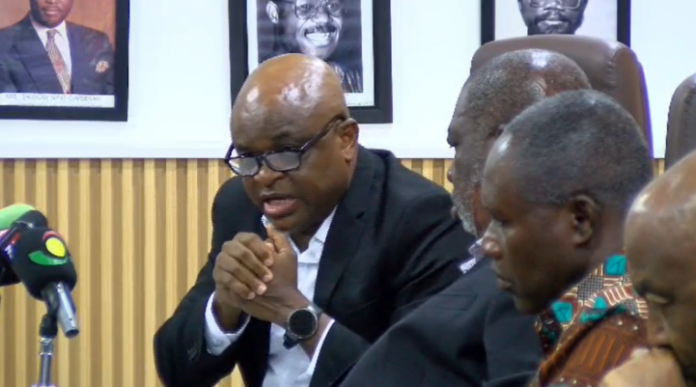

The committee set up to investigate the fire outbreak at the Akosombo Substation has concluded that the incident was caused by insulation failure resulting from ageing infrastructure and not any deliberate human action.
Presenting its findings to the Minister for Energy and Green Transition, John Abdulai Jinapor, on Thursday, Chairman of the committee, Engineer William Amuna, said the fire originated in the changeover section of the low-voltage (LV) panel, where decades-old cables had deteriorated.
According to him, the substation’s original structure dates back to around 1964, and many of the cables had become brittle over time.
“The fire actually started from that changeover area of the LV panel. That building was started, I mean, the first structure came up around 1964 or so.
“Some of the cables have gone brittle. Once they were in metal encasements, there was what we call some kind of fault where the current just flowed because of the insulation of the materials over there,” Engineer Amuna explained.
He said the initial power supply from the powerhouse automatically tripped at 311 amps after detecting the fault. However, a nearby transformer immediately took over the load and continued supplying electricity to the faulted section.
“The second transformer nearby took over and started supplying. So it means it was feeding into the fault,” he said.
Since the transformer was configured to trip only at 450 amps, the fault persisted, generating excessive heat that eventually ignited the cable insulation.
“Within a short time, the insulation, which is like plastic, caught fire,” he said.
Engineer Amuna said the fire spread rapidly because the affected LV panel was interconnected with another panel and surrounded by numerous control cables serving the substation’s 11 outgoing circuits.
“Akosombo Substation is a very big one. It has 11 outgoing circuits. They had a lot of cables in there, and the LV cables were within those cables. They started burning, and within a short time the whole place was ablaze,” he explained.
The committee found no evidence of sabotage or human interference.
“It actually started from insulation failure from some of the cables in the LV panel, and not anybody going to turn something or twist something or whatever,” Engineer Amuna stated.
To prevent a recurrence, the committee recommended both immediate and long-term interventions.
These include an interim arrangement by the Ghana Grid Company (GRIDCo) and the Volta River Authority (VRA) to transfer protection and control functions from the damaged station to the Akosombo Power Plant.
“We are expecting that by the end of August, this interim arrangement should be in place so that we can transfer the protection and control functions back to that arrangement being undertaken by GRIDCo and the VRA,” he said.
The committee also proposed the construction of a new permanent control building to replace the ageing facility. Engineer Amuna said the proposed facility would be modelled after the modern Pokuase Substation.
“So hopefully we should have a state-of-the-art permanent control building. I expect that such a building could come up within 18 to 24 months,” he said.
Receiving the report, Minister Jinapor assured the committee that its recommendations would be fully implemented. While commending engineers for restoring power after the incident, he stressed that any negligence identified would be addressed.
“Let me assure you that we will take this report seriously. We will digest all the contents of the report and implement it to the letter,” he said.
“Yes, it is true. The engineers did a good job in restoring power. But that is not to say that if somebody is found culpable, that person will not be held to account. That is the call of duty,” he added.
The minister described the incident as a wake-up call for the energy sector, underscoring the need for improved maintenance practices, stronger emergency response systems and increased investment in electricity infrastructure to enhance the resilience of the national grid.
The fire outbreak, which occurred on April 23, disrupted operations at the Akosombo Substation and affected power supply to several parts of the country, according to GRIDCo.
ALSO READ:
Wontumi seeks plea deal in GH¢30m Exim Bank fraud trial — AG notifies High Court
