
Six years after a shattering set of SSSCE results left him hawking clothes and shining shoes, Dr George Asiamah returned to the classroom, driven by a chance encounter and a piece of advice from a stranger, and emerged with straight As.
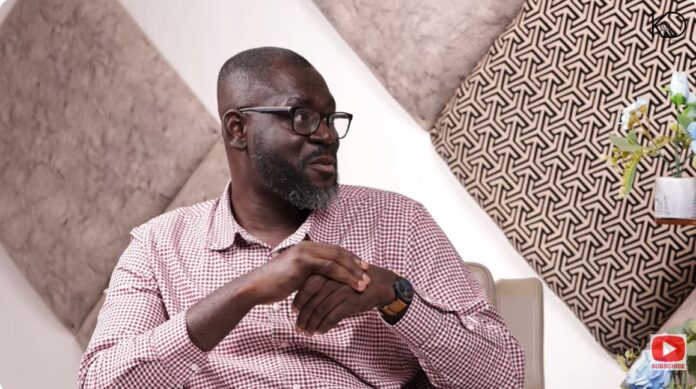
Speaking to Kafui Dey, Dr Asiamah said the decision to return to education came from an unlikely source.
The owner of a shop where he worked at Kantamanto at the time had a niece studying at the University of Cape Coast who always questioned him during her visits about his career ambitions, planting the idea of returning to school.
The final push, however, came when a neighbouring shop owner brought him her son’s results to help her advise the boy to pursue a diploma at a polytechnic.
The son, Kofi, had one weak grade, which was preventing him from gaining admission to the University of Ghana. Dr Asiamah, who had assumed top grades were reserved for students at prestigious schools, was surprised to find that Kofi, someone he did not consider more intelligent than himself, had scored mostly As. “I said, if Kofi has been able to do it, why not me?” he said.
Kofi went on to gain direct admission to the University of Ghana that same year.
Determined to try again, Dr Asiamah returned to Kumasi in March 2008, about six years after his SSSCE, initially planning to rewrite only the subjects he had failed. However, an encounter with a stranger while buying forms at the WAEC office in Kumasi changed his plans.
The stranger told him that universities would not accept results split across different sittings, and urged him to register for every subject at once. “He told me, the way I look at you, I can see you’re a sharp guy. Make wild,” Dr Asiamah recalled, a phrase that became the title of a chapter in the book he later wrote about his life.
Acting on the advice, he registered for all seven subjects, giving himself eight months to prepare.
With only informal remedial classes run by university students to rely on, and finding them irregular, Dr Asiamah said he largely taught himself, often stepping in to tutor his peers when the organisers failed to show up. He said he remembered almost nothing from his first attempt in 2003 and effectively started from scratch.
When the results came out, he had transformed his grades entirely, turning his previous Es into As and his Fs into passes, with his lowest grade a B3. “That’s the product of determination,” he said.
He said he checked his results alone at an internet café rather than through a headmistress this time, feeling a mixture of nerves and relief. His mother, the same person who had seen his original results, was overjoyed. “She saw the dedication, and she could see it had paid off,” he said.
Dr Asiamah chose to study Economics at the Kwame Nkrumah University of Science and Technology (KNUST), partly to experience life outside the Ashanti region, where he had spent most of his education, and partly because limited finances made KNUST’s proximity to home a safer option than the University of Ghana.
He kept his shoeshine past hidden throughout his time at KNUST, telling even his closest friends only shortly before graduation, and said it remained largely unknown until he wrote his book.
“It’s part of what has made me who I am now. People may see the Oxford pictures, but I think what really made me was the box. The resilience I built, which has pushed me to wherever I am now, was actually from the shoeshine box,” he said.