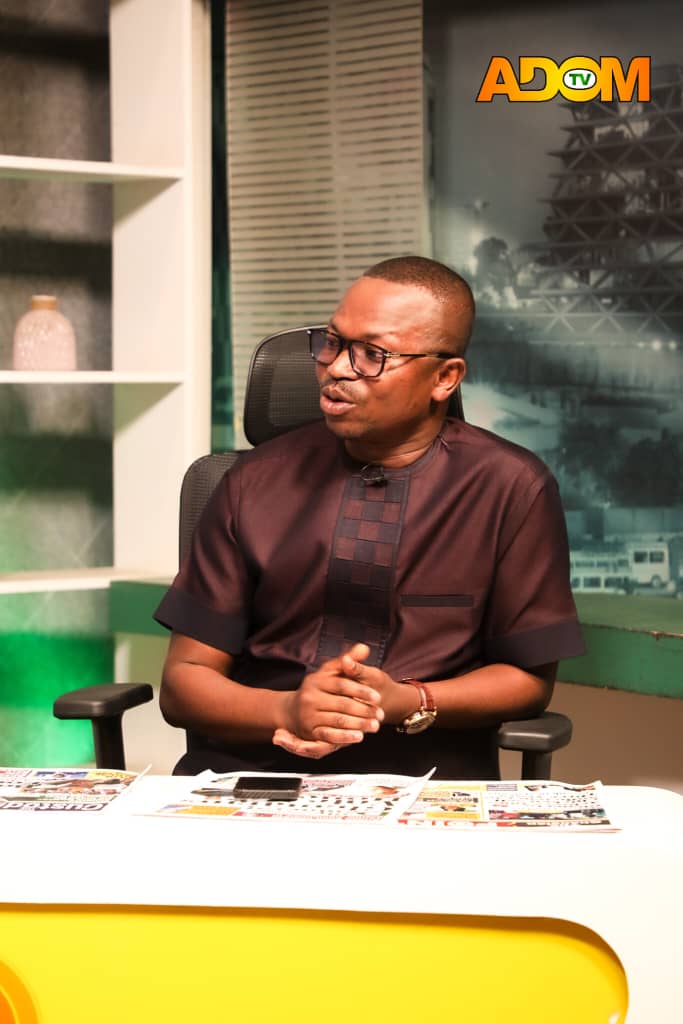

The Chief Executive Officer of the National Entrepreneurship and Innovation Programme (NEIP), Eric Adjei, has defended Chief Justice Paul Baffoe-Bonnie’s comments on the performance of state-owned enterprises (SOEs), insisting that he spoke as a Ghanaian citizen expressing his honest assessment.
His comments come amid criticism of the Chief Justice after he questioned what Ghana had been doing over the previous eight years while commending recent improvements recorded by some state institutions.
During a tour on Wednesday, the Chief Justice expressed satisfaction with work being done at the Minerals Income Investment Fund (MIIF) and said information gathered during an earlier visit to the Social Security and National Insurance Trust (SSNIT) had strengthened his positive assessment of some state institutions.
Speaking on Adom FM’s Dwaso Nsem, Mr Adjei said the Chief Justice was entitled to express his views as a Ghanaian citizen and should not be criticised simply for making an observation.
“I think where the NPP is offended is the fact that he said certain things didn’t go well in the last eight years,” he said.
Mr Adjei argued that if the Chief Justice’s comments were based on developments he had observed, there was nothing wrong with him acknowledging them.
“When we say someone has integrity, you should be able to see truth when you do. Maybe people are offended because of the comparison,” he stated.
He maintained that the Chief Justice’s remarks should be viewed within the context of his rights as a citizen rather than interpreted as a partisan political statement.
“The Chief Justice spoke in a just manner as a citizen of Ghana,” Mr Adjei said.
“It was free speech, and we are now criticising the free speech,” he added.
Mr Adjei further challenged critics to identify which part of the Chief Justice’s assessment was factually inaccurate.
“What the man said, which of them is not true?” he asked.
He also questioned the argument that Justice Baffoe-Bonnie, because of his position, should have refrained from commenting on the country’s affairs.
“The argument that given his personality, he shouldn’t have made those comments, is he not a citizen?” he asked.
According to Mr Adjei, developments in the country affect every Ghanaian, including members of the Judiciary.
“When the nation goes bad or well, it affects them too,” he said.
He clarified that his defence of the Chief Justice should not be interpreted as an assertion that the previous government deliberately undermined state-owned enterprises.
“I am not saying he ran down the SOEs under the previous government,” he said.
Mr Adjei maintained, however, that the Chief Justice had made his observation and that political actors were free to interpret it differently.
“He has spoken, and whether we want to hear it or not, he has spoken. He spoke in a just manner,” he said.
He added that political leaders may attach different meanings to the Chief Justice’s remarks, but that should not take away his right to speak his mind.
“Shouldn’t he say the truth when he sees it? We as politicians can have a lot of interpretations of the statement,” he said.
The debate follows recent discussions over the performance of Ghana’s SOEs, particularly after the State Interests and Governance Authority (SIGA) reported improvements in the financial and operational performance of several state-owned enterprises.
Also read: