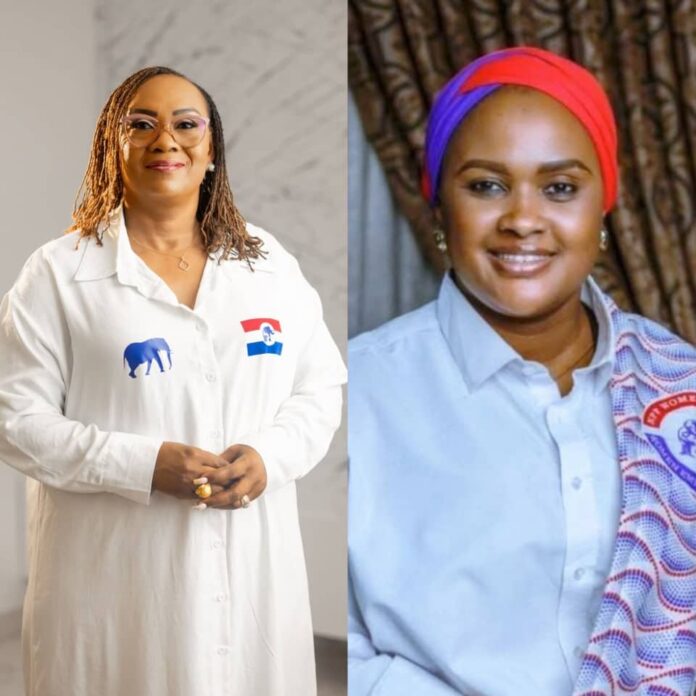

The contest for the National Women’s Organiser position of the New Patriotic Party (NPP) has entered a new phase following the withdrawal of Perpetual Ekua Lomokie Akwada, leaving former Awutu Senya East MP Mavis Hawa Koomson and the party’s current Deputy National Women’s Organiser, Hajia Safia Mohammed, as the two prominent contenders.
The race is shaping up as one of the most closely watched battles in the party’s ongoing reorganisation ahead of the 2028 general elections.
It is not simply about who replaces the current National Women’s Organiser, Kate Gyamfua. Increasingly, it is a debate about what kind of leadership the NPP’s women’s wing needs after the party’s defeat in the 2024 general elections — and which candidate can best translate the organisational strength of its women into electoral gains in 2028.
Akwada’s withdrawal, announced on Tuesday, August 25, came barely days after the close of nominations for the NPP’s national executive elections and has transformed what was initially a three-way contest into a two-horse race.
In her statement, Akwada said her decision followed “deep reflection, prayer, consultations and careful consideration” of the circumstances surrounding the contest.
She thanked the women, delegates, friends, colleagues and members of her campaign team who supported her, insisting that withdrawing from the election did not amount to abandoning her commitment to the empowerment of women or the development of the NPP.
She also urged party members to place the broader interests of the NPP above individual ambitions and work towards unity, renewal and victory.
Her exit leaves delegates with a clear choice: a former parliamentarian and minister with significant political experience, or a party insider who has been working within the NPP’s women’s structure as deputy.
And that is what makes the contest between Koomson and Safia particularly significant.
From three candidates to two
Until Akwada’s withdrawal, the National Women’s Organiser race had three prominent names: Koomson, Akwada and Safia Mohammed.
The NPP subsequently indicated that picking nomination forms did not automatically constitute a valid candidature, with aspirants required to properly file their documents and undergo vetting.
Akwada’s decision has now removed one of the candidates who had positioned herself as a younger and fresh voice for the party’s women.
Her campaign emphasised grassroots mobilisation, women’s empowerment and a new approach to organising the party’s female base.
Her withdrawal could therefore have consequences beyond simply reducing the number of candidates.
The immediate question is where her supporters will go.
Will they divide between Koomson and Safia? Will one candidate succeed in attracting a significant portion of them? Or will some remain undecided until the final stages of the contest?
Those questions could become increasingly important as the two remaining campaigns intensify their engagement with delegates.
Hawa Koomson: The heavyweight challenger
For Koomson, the contest represents a new chapter after a lengthy career in frontline politics.
She served as Member of Parliament for Awutu Senya East and held ministerial positions under the previous NPP administration.
Her parliamentary and executive experience gives her a national political profile built over years of electoral and government experience.
Koomson has also entered the race with considerable confidence, publicly expressing belief in her chances of winning while framing her campaign around rebuilding and strengthening the NPP’s women’s structures ahead of the party’s next electoral battle.
Her candidature has generated significant attention within the party, partly because of her political stature and partly because she is not coming into the race as an unknown organiser.
She knows electoral politics, the parliamentary environment and the workings of government. She also has experience engaging with the grassroots.
Those credentials could appeal to delegates looking for a National Women’s Organiser who can operate at both the grassroots and national political levels.
The poll factor
Koomson also has an important advantage in the form of an earlier delegate survey.
A survey published in June 2026 by the Daily Graphic reported that Koomson had the support of 65.5% of delegates sampled in a poll conducted between March 11 and 22.
Her closest contender in that survey was then former Tourism, Culture and Creative Arts Minister Catherine Afeku, who recorded 14.2%.
But there is a major qualification.
That survey was conducted before the present contest took its final shape and, importantly, before Akwada’s withdrawal.
It should therefore not be interpreted as a current prediction of a Koomson-Safia head-to-head contest.
Nevertheless, it provides Koomson with a powerful campaign narrative — that she entered the race with substantial delegate support.
The real test will be whether that support has remained intact as the field has changed.
Safia Mohammed: The insider with a different proposition
On the other side is Hajia Safia Mohammed, who brings a fundamentally different proposition.
Unlike Koomson, Safia is not entering the race from outside the current national women’s leadership structure.
She is the Deputy National Women’s Organiser, giving her direct experience of the work, challenges and organisational demands associated with the office she now seeks to occupy.
That could become one of the most important arguments of her campaign.
The position of National Women’s Organiser is not simply ceremonial. It requires constant interaction with regional and constituency structures, coordination of women’s activities, mobilisation for elections and maintaining the party’s presence among female voters.
Safia can therefore make the case that she already understands the machinery from within.
She knows the structure. She knows the organisers. She understands the expectations attached to the position and has been part of the national women’s leadership team.
The challenge for Safia, however, is equally obvious.
If delegates believe the NPP needs a major change in its approach to grassroots mobilisation after its 2024 electoral defeat, they may ask whether continuity is enough.
Her task will therefore be to present herself not merely as the candidate of experience, but as the candidate capable of changing how that experience is deployed.
Two candidates, two narratives
The contest can increasingly be understood through two competing narratives.
Koomson represents political weight and tested leadership. Her campaign can point to years in Parliament, government and electoral politics.
Safia represents institutional experience within the Women’s Wing. Her strongest argument is that she has been directly involved in the national women’s organisational structure and understands the work from close range.
That creates an intriguing choice for delegates.
Do they want a former minister and parliamentarian who can bring political clout to the position?
Or do they prefer someone who has already been working within the women’s leadership structure and can build on that experience?
What does Perpetual Akwada’s withdrawal change?
Akwada’s withdrawal could be more important than the numbers suggest.
She had positioned herself as a fresh, younger voice with experience in the NPP’s youth and women’s mobilisation structures.
Her departure removes that third option and makes the contest much easier to frame: Koomson versus Safia.
But the crucial question is what happens to the delegates who had committed themselves to Akwada.
Akwada has not publicly directed her supporters to either remaining candidate in the withdrawal statement. Instead, she urged party members to prioritise unity, renewal and the NPP’s broader interests.
That leaves considerable room for political manoeuvring.
Both Koomson and Safia will be watching closely. Akwada’s supporters could become a valuable constituency, particularly if the eventual margin between the two leading candidates is narrow.
The bigger issue: rebuilding the NPP Women’s Wing
Beyond the personalities, the election comes at an important moment for the NPP.
The party is in opposition following its defeat in the 2024 general election and is preparing for another attempt to regain power.
That makes the National Women’s Organiser position strategically important.
Women remain a critical component of party mobilisation.
The next Women’s Organiser will be expected to help rebuild enthusiasm among party supporters, strengthen constituency-level structures, attract new members and improve the NPP’s connection with women voters.
But the task has changed.
Political mobilisation is no longer confined to constituency meetings, rallies and door-to-door campaigns.
The Women’s Wing must also engage young women through social media, community networks and digital platforms while responding to economic concerns, employment, education, healthcare and other issues that shape voting decisions.
The next National Women’s Organiser will therefore need to combine traditional grassroots mobilisation with modern political communication.
That could become a major test of whoever wins.
The 2028 question
Ultimately, the race is about much more than who occupies an NPP office for the next four years.
It is about who can help build the women’s mobilisation machine for the party’s 2028 presidential and parliamentary campaign.
Koomson has already connected her candidature to the broader effort to return the NPP to power.
Akwada, before withdrawing, similarly framed her campaign around empowering women and contributing to the party’s 2028 comeback.
Safia will now have to make the same case to delegates.
Why her? Why now? And what specifically will she do differently to help the NPP win back voters?
Those questions will define the campaign.
The battle for the grassroots
For both candidates, the ultimate battlefield will not be social media. It will be the grassroots.
The NPP’s national women’s structure stretches from the national level through regional and constituency organisations.
A candidate may have a strong national profile, but victory requires translating that profile into support among the delegates who will ultimately decide the election.
Koomson’s challenge will be to turn her political stature into a sufficiently broad organisational coalition.
Safia’s challenge will be to turn her institutional experience into a compelling argument for continuity with change.
Neither can afford to take the grassroots for granted.
A contest that could define the next phase of the NPP Women’s Wing
The withdrawal of Perpetual Akwada has simplified the race, but it has not necessarily made the outcome predictable.
If anything, the two-candidate contest could make the battle more intense.
Koomson brings political experience, name recognition and an early polling advantage.
Safia brings institutional experience, familiarity with the Women’s Wing and the credibility of having served as deputy.
The outcome will depend on which candidate can convince delegates that she is best equipped to transform the NPP’s women’s structure into an effective electoral force.
The NPP has scheduled vetting of aspirants for the National Women’s Organiser position for Wednesday, September 2, 2026, as part of the broader vetting exercise for its national executive elections. The party has said the eventual election date will be announced after the completion of the filing, vetting and appeals processes.
For now, the race has entered its most intriguing phase.
Hawa Koomson versus Safia Mohammed.
One brings the weight of a former parliamentarian and minister.
The other brings the experience of an incumbent deputy within the very structure she seeks to lead.
And somewhere between those two propositions lies the question confronting NPP delegates:
Who can rebuild the party’s Women’s Wing, reconnect it with Ghanaian women and help lead the NPP back to power in 2028?