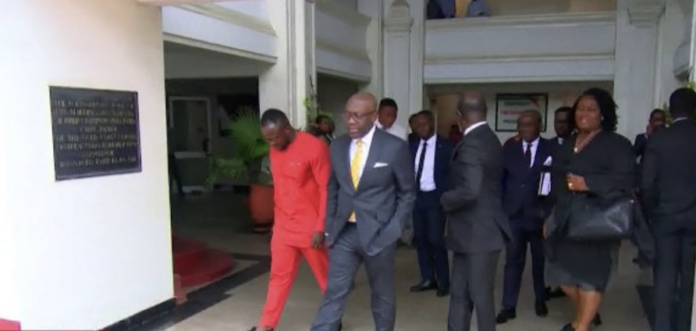

The Supreme Court has dismissed an application by Ofoase-Ayirebi Member of Parliament Kojo Oppong Nkrumah seeking to halt selected criminal trials during the ongoing legal vacation.
Justice Gabriel Pwamang, sitting as a single judge of the Supreme Court, dismissed the interlocutory injunction application on Friday, August 21, 2026.
The ruling clears the way for the affected criminal trials to continue while the substantive case challenging the constitutionality of the Chief Justice’s administrative warrants remains pending.
Oppong Nkrumah filed a substantive suit at the Supreme Court challenging administrative warrants issued by Chief Justice Paul Baffoe-Bonnie directing selected High Court judges to continue hearing criminal cases during the legal vacation.
The legal vacation runs from August 1 to September 30.
The MP argues that the directive violates Articles 17(1), (2), and 296(a) and (b) of the 1992 Constitution, particularly because it singles out certain criminal cases for continuation during the vacation.
He contends that the arrangement amounts to selective justice.
Mr Oppong Nkrumah subsequently filed the interlocutory injunction application seeking to suspend the operation of the warrants until the substantive case is determined.
During Thursday’s proceedings, counsel for Oppong Nkrumah, Frank Davies, argued that allowing the trials to continue could prejudice accused persons, particularly where judges indicate that proceedings may continue even if defence lawyers are unavailable.
He argued that the right to legal representation could be compromised if accused persons were required to conduct their own defence.
“The harm which will be occasioned to the accused is not something that can be quantified by way of monetary compensation. It is something that affects the rights and liberties of the accused persons, and monetary awards cannot compensate for that,” Frank Davies submitted.
The Deputy Attorney-General, Dr Justice Srem-Sai, opposed the application and argued that the applicant had failed to satisfy the requirements for an interlocutory injunction.
He said the court was required to determine whether there was a serious question to be tried, whether refusing the injunction could cause irreparable harm, and where the balance of convenience lay.
Dr Srem-Sai also argued that the application conflated the Chief Justice’s administrative responsibilities with the judicial functions of individual High Court judges.
He maintained that where counsel was dissatisfied with a trial judge’s decision to proceed with a case, the appropriate remedy was an application for certiorari rather than an invocation of the Supreme Court’s original jurisdiction.
Before the substantive arguments on the injunction, Frank Davies objected to the Deputy Attorney-General representing both the Chief Justice and the Attorney-General.
He argued that because the Chief Justice was being challenged over an administrative decision, he ought to have separate legal representation.
Justice Pwamang dismissed the objection on Thursday.
The judge held that the Chief Justice had been duly served with the court processes and had indicated his representation, adding that the Attorney-General’s authorisation of legal representation did not diminish the Attorney-General’s own standing as a defendant.
He indicated that the full reasons for that decision would be contained in his ruling on the injunction application.