
What if the University of Ghana, Legon, had never been built in Ghana?
It sounds almost unbelievable today. The familiar green campus, Balme Library, the various halls, the legendary “Legon” experience and the thousands of graduates who have passed through its gates have become such a fixture of Ghanaian life that it is difficult to imagine the country without its premier university.
But 78 years ago, that possibility was very real.
On August 11, 1948, the University College of the Gold Coast was formally established by ordinance by the British. That institution would eventually become the University of Ghana.
But the story of its birth was not simply a British colonial government deciding that the Gold Coast needed a university. In fact, the British had a very different plan, and Ghanaians were not having it.
Did you know Ghana had to fight for its university?
In the 1940s, the British government was examining the future of higher education in its West African colonies. The Asquith Commission and later the Elliot Commission were set up to consider how university education should be organised in the region.
The Elliot Commission produced majority and minority reports. The minority position argued that establishing only one university for the entire British West African region was more economically feasible.
The British government initially accepted that position. The chosen location? Ibadan, Nigeria.
That would have left the Gold Coast without its own university, so the people heavily rejected the idea.
Prominent nationalists, including Dr J.B. Danquah, Sir Arku Korsa, Nanka-Bruce and others, pushed back against the colonial decision, arguing that the Gold Coast had both the resources and the capacity to establish and sustain its own university.
This is where the Asantehene Otumfuo Sir Osei Agyeman Prempeh II had to step in.
The local leaders convinced the Gold Coast Cocoa Marketing Board to secure a massive grant of £897,000 specifically to establish the university. This money came directly out of the surplus funds generated by local cocoa farmers, meaning ordinary Ghanaian farmers literally funded the nation’s highest intellectual institution.
According to the University of Ghana’s official history, this campaign persuaded the British government to review its position and give the go-ahead. This is what makes August 11 more than just a date on an academic calendar. It represents a moment when the Gold Coast’s determination helped change a colonial education plan.
And then came Balme
Once the institution was approved, the British appointed David Mowbray Balme as its first Principal. Balme would become one of the most important figures in the university’s early history. The University of Ghana describes him as a farsighted and courageous leader who laid the foundations for the institution that exists today.
But, another issue presented itself; location.
The university college initially opened on the premises of Achimota College. It shared facilities, classrooms, and administrative offices there while its permanent site was being developed.
David Mowbray Balme selected the Legon Hills (about 12 kilometers north of Accra) for its permanent home because the elevated land provided a cool breeze and a serene, isolated environment perfect for academic contemplation.
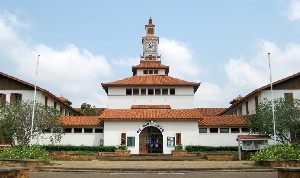
Balme hired British architects Harrison, Barnes & Hubbard who designed the iconic white-walled buildings with red-tiled roofs, in a way that mimicked traditional Cambridge/Oxford courtyard styles with Mediterranean and tropical architecture.
However, it’s logo, a blue shield with three “AYA” (ferns) standing upright in the top half and “DWENINMENTOASO” (ram’s horns) in the middle of the bottom half, all embossed in gold, was designed by a Ghanaian, A. M. Opoku.
It took only 90 students for the school to kick into full effect. Among them were just 2 women. Today, that number sounds almost amusing when compared with the scale of the institution.
The University of Ghana currently has 63,646 undergraduate students and 9,509 graduate students, according to its official profile. From 90 students to more than 70,000 undergraduate and graduate students combined. Now that is growth.
So, how did it become University of Ghana, Legon?
From its establishment, the University College of the Gold Coast was an affiliate of the University of London. It could teach courses leading to University of London external degree examinations, while London retained final approval over courses and examinations and awarded the degrees.
That arrangement lasted for years, then Ghana’s political independence changed the picture. The institution’s name changed with the country.
From it’s inception 1948–1957 (Colonial era), it was mainly known as the University College of the Gold Coast.
After Ghana gained independence in 1957, it became the University College of Ghana.
Then came the big moment. On October 1, 1961, it attained full sovereign university status under Act of Parliament—Act 79—allowing it to award its own distinct degrees separate from the British. Then the name was officially changed to the University of Ghana.
And who became its first Chancellor? None other than Ghana’s first President, Dr Kwame Nkrumah.
UG was not always the massive institution we know today
Today, the University of Ghana describes itself as Ghana’s premier university and operates a collegiate system comprising four colleges: Basic and Applied Sciences, Education, Health Sciences and Humanities. It also hosts major research institutions including the Noguchi Memorial Institute for Medical Research and the West African Centre for Cell Biology of Infectious Pathogens.
But the original university was much smaller and had a more limited academic focus. Its beginnings were rooted in areas including liberal arts, sciences, law and agriculture.
Over the decades, that academic footprint expanded dramatically. The institution grew from a small university college into a major centre of scholarship, research and public life.
And perhaps one of the most fascinating things about UG-Legon is how many areas of Ghanaian life its alumni have gone on to influence. If you start listing prominent Ghanaians who have passed through its gates, you could spend a very long afternoon.
The campus has its own celebrity status
For generations of Ghanaians, “Legon” has become more than the name of a university. It’s an identity, almost like a rite of passage.
It is the place parents dream of sending their children, the place students dream of getting into and the place alumni can spend years reminiscing about.
“Legon” can mean the university, the experience, the memories or simply a particular chapter of someone’s life.
Deservedly so, because it is ranked the best university in Ghana and West Africa. In the continent as a whole, it ranks among the top 13 universities among 1,504 institutions globally.
Safe to say, the anti-colonial leaders were right; the fight was very much worth it.
Had the British government’s original plan prevailed, the story of higher education in Ghana could have looked very different. Maybe individuals would still be traveling to Ibadan, Nigeria to access higher education. Thankfully not! In all, Happy birthday, University of Ghana.