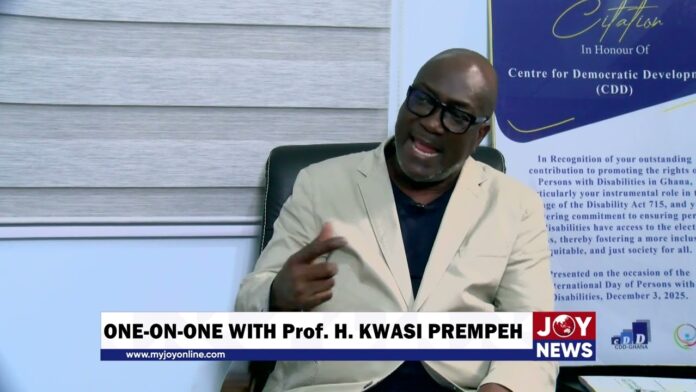

Executive Director of the Ghana Center for Democratic Development (CDD-Ghana), Prof. H. Kwasi Prempeh, has criticised the delegate system used by Ghana’s major political parties, arguing that it gives an unfair advantage to wealthy aspirants while making it difficult for young people, women and less financially endowed members to compete for leadership positions.
He made the remarks in an interview with Accra-based Woezor TV while discussing the Supreme Court’s ruling on the legality of political parties’ delegate systems.
Prof. Prempeh said concerns about the system existed long before the court’s decision and were mainly centred on its impact on internal party democracy and corruption.
According to him, limiting the selection of party candidates to a relatively small group of delegates has made internal elections increasingly vulnerable to the influence of money.
He explained that the arrangement has tilted the playing field in favour of aspirants with greater financial resources, making it difficult for young professionals, women and other aspiring leaders with limited means to compete on equal terms.
“So there was a sense that the delegate system had essentially skewed power in the party in favour of those who were better resourced financially,” he said on Sunday, August 2.
Prof. Prempeh further argued that the system has fuelled vote-buying because the small number of delegates makes it easier for aspirants to influence them through gifts and other inducements.
Drawing on CDD-Ghana’s observations of political party primaries over the years, he said the organisation had repeatedly witnessed delegates receiving cash and other items from contestants seeking their support.
“We saw them. At CDD, we have monitored a number of primaries, and Ghanaians are all witnesses to the kinds of items that circulate, commodities that are given to delegates,” he said.
He noted that such practices would be far more difficult under an open primary system where all eligible party members are allowed to vote, as it would be practically impossible to influence an entire party membership across the country.
Prof. Prempeh maintained that beyond limiting internal democracy, the delegate system has entrenched the influence of money in politics and created conditions that encourage corruption, ultimately undermining Ghana’s democratic development.
Also read: