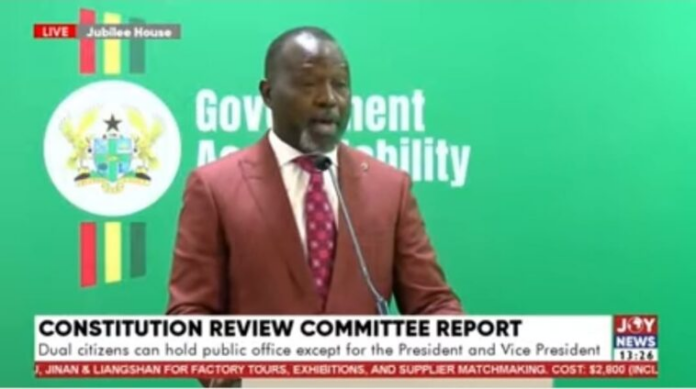

The government has accepted a major constitutional reform proposal to separate the Office of the Attorney-General from the Ministry of Justice, ending the current arrangement where the Attorney-General also serves as Minister for Justice.
Attorney-General and Minister for Justice, Dr Dominic Ayine, announced the proposal on Thursday, July 30, while presenting government’s White Paper on the recommendations of the Constitutional Review Committee (CRC).
Under the proposed reforms, Article 88 of the 1992 Constitution will be amended to remove the requirement for the Attorney-General to be appointed as a Minister of State.
“The government proposes that Article 88 be amended to remove the requirement that the Attorney-General be a minister of state,” Dr Ayine said.
A separate Minister of Justice portfolio will be created to oversee the justice and legal sector, while the Attorney-General will remain the Republic’s principal legal adviser and continue to exercise the state’s prosecutorial authority.
“The Attorney-General will remain the principal legal adviser of the Republic and the repository of the prosecutorial authority of the state but will cease to be a minister of state and a member of Cabinet,” he stated.
Dr Ayine explained that the reform is intended to strengthen the independence of the Attorney-General’s office by reducing its direct connection with the executive.
To further safeguard the office, the government has proposed granting the Attorney-General the same terms and conditions of service as a Justice of the Supreme Court.
“To guarantee the prosecutorial independence of the office, a new clause will be inserted in Article 88 to give the Attorney-General the same terms and conditions of service as a Justice of the Supreme Court,” he said.
He added that future Attorneys-General would enjoy stronger security of tenure, with their removal subject to the same constitutional procedure applicable to Supreme Court justices.
“Whoever is appointed Attorney-General after these amendments come into effect, if you want to remove that person, you have to go through the procedure enumerated under Article 146 of the Constitution,” he explained.
Article 146 provides a process for the removal of superior court judges, including the requirement for a petition and the determination of a prima facie case before further action can be taken.
Dr Ayine described the proposal as one of the most significant institutional reforms contained in the White Paper, saying it would transform the legal structure of the executive.
“This is a significant restructuring of the legal architecture of the executive and I believe history will judge it kindly,” he said.
Meanwhile, the government has also accepted, in principle, the Constitutional Review Committee’s recommendation to establish an independent anti-corruption body.
However, Dr Ayine said the body would not be created through a constitutional amendment. Instead, government intends to establish a Public Ethics Commission through the Conduct of Public Officers Bill currently before Parliament.
According to him, the proposed commission will have powers to investigate corruption and conflict-of-interest issues involving public office holders and, in certain cases, prosecute offences independently of executive control.
NPP to announce next steps after Sedina Tamakloe-Attionu’s acquittal