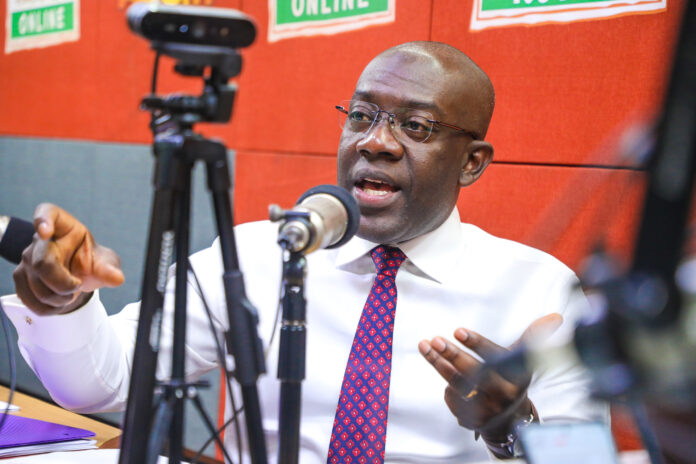

The Ranking Member on Parliament’s Economy and Development Committee, Kojo Oppong Nkrumah, has questioned the implementation of the government’s flagship 24-Hour Economy programme, arguing that the initiative has shown little evidence of progress nearly two years into the administration.
Mr Oppong Nkrumah said Parliament has approved close to GH¢650 billion to support government programmes over the past two years, yet the 24-Hour Economy policy, which was presented as a major job creation and industrialisation initiative, has not translated into visible action.
He made the remarks on the floor of Parliament while seconding a motion for the House to adopt the Economy and Development Committee’s report.
The Ofoase-Ayirebi legislator said the policy was introduced around the concept of “one job, three people, three shifts” — popularly known as the “1-3-3” model — which was expected to promote round-the-clock production and create employment opportunities across the public and private sectors.
Mr Oppong Nkrumah noted that since the National Democratic Congress (NDC) assumed office, the Minority has repeatedly called on the government to submit its major policy documents to Parliament for scrutiny.
He said that apart from the annual Budget and Economic Policy Statements, the 24-Hour Economy policy document remains one of the few major frameworks presented to the House, despite the government approaching its second year in office.
According to him, the government has failed to identify any public institution currently operating under the promised “1-3-3” model.
“For all the stories that were told and all the promises that accompanied the 24-Hour Economy, almost two years after assuming office, there is not one government agency implementing the one-three-three model,” he told Parliament.
He said discussions at the committee level showed that the government is now focusing on two key areas of the programme — the construction of 24-hour markets and the development of incentives to encourage private sector participation.
However, Mr Oppong Nkrumah questioned whether constructing additional markets alone would create continuous economic activity, arguing that many existing markets across the country struggle to attract traders beyond specific market days.
Using his Ayirebi constituency as an example, he said the area already has a modern market that does not operate on a 24-hour basis, adding that similar situations exist in many districts.
He argued that infrastructure development without increased production, expanded economic activity and stronger consumer demand would not automatically result in round-the-clock trading.
The former Information Minister also criticised the government’s admission that the incentive framework for businesses to adopt 24-hour operations is still being developed nearly two years after taking office.
He said the delay raises concerns about the government’s commitment to making the programme fully operational, noting that private businesses require clear fiscal and regulatory incentives before expanding production, introducing additional shifts and employing more workers.
Mr Oppong Nkrumah further argued that the 24-Hour Economy programme has overshadowed the previous administration’s One District, One Factory (1D1F) initiative, which he said had recorded measurable progress.
Citing the National Development Planning Commission’s (NDPC) Annual Progress Report for 2024, published in June 2025, he said the report indicated that at least 150 1D1F projects were operational by the end of 2024.
He stressed that the figures were contained in the NDPC’s own report and were not claims made by the Minority.
Also read: