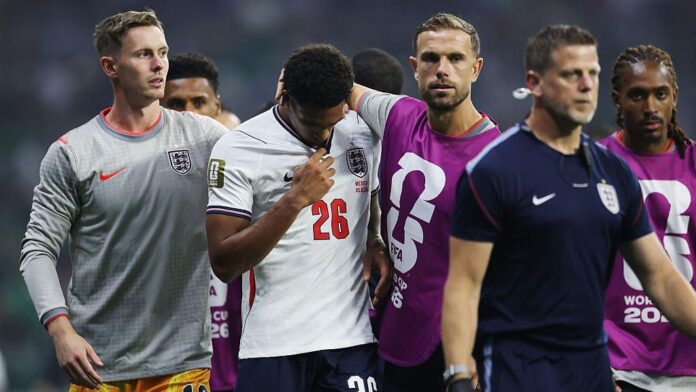

England defender Jarell Quansah has been given a two-match ban for his red card against Mexico.
Quansah was sent off in the 54th minute of the 3-2 win following a high challenge on Jesus Gallardo.
It was classed as serious foul play, meaning the Bayer Leverkusen player was handed an extra match on top of the automatic one-game suspension by Fifa’s disciplinary committee.
Former Liverpool man Quansah will miss Saturday’s quarter-final with Norway (22:00 BST) and a potential semi-final against Argentina or Switzerland.
Quansah, 23, will be available if England reach the final in New Jersey on 19 July.
The Football Association was considering whether to appeal, but under the tournament regulations there is no avenue to contest the ban.
However, BBC Sport has been told the FA made very strong representations to Fifa over the process that reached the Quansah red card decision, arguing that the referee was shown a still image of the tackle and slow-motion replays before being shown the incident in real-time on the pitchside screen, and that this could have resulted in ‘outcome bias’.
In the Premier League, officials are shown incidents at full speed first – though England’s top flight is an outlier.
The ban complicates matters for head coach Thomas Tuchel at right-back.
Quansah filled in against Mexico while England were without the injured Reece James, with Djed Spence only used as a substitute after a minor fitness issue.
However, Tuchel has said he expects James to be available against Norway after missing games because of the hamstring injury he sustained in the second group match against Ghana.
Tuchel’s assistant coach Anthony Barry said the Quansah news was “disappointing”.
“Disappointing, not with the decision, just the fact that we lose a good player,” he added.
“He was excellent in training, and of course we have some injuries in that position, so it looked like a space had opened up for Jarell.
“But the decision’s been made – we won’t waste any more energy on it. Overall for us, we lose a good player for two games, but it’s just another hurdle that we have to overcome.”
Winger Bukayo Saka said the ban was “incredibly frustrating for us, and for him”.
“It is what it is, we are not here to complain, we are here to adapt and to pick a team that is ready to beat Norway,” he added.
Fifa has announced that French referee Clement Turpin, who took charge of England’s 4-2 win over Croatia, has been appointed to officiate the Norway game.
Balogun should have had same punishment
The degree of Quansah’s punishment shows a further inconsistency with the treatment of United States forward Folarin Balogun.
Striker Balogun was sent off for serious foul play against Bosnia-Herzegovina and should also have received a ban for two games.
The 25-year-old was set to miss his side’s last-16 tie against Belgium, but Fifa made the shock decision to ban him for only one match, and suspend it for 12 months.
US President Donald Trump confirmed he called Fifa president Gianni Infantino to request a review of that red card.
In an 871-word statement about the Balogun situation, Fifa said it took the decision “considering all of the specific circumstances surrounding the incident and evidence available”, without detailing what had been taken into account.
That led to widespread criticism within the game, including from Uefa, Belgium and Tuchel.
It led to France submitting a challenge to Michael Olise’s yellow card from their victory over Paraguay, which was dismissed by Fifa.
Did World Cup VAR process affect decisions?
“The process was misapplied by how the VAR was initiated,” said Andrew Giuliani, executive director for the White House Task Force on the World Cup when discussing Balogun.
“Contact fouls, you cannot actually utilise the slow-motion in the VAR, and they did that.”
It is a narrative which has spread across US media and politicians.
For many it has become fact, but it is not true.
VAR protocol says that full speed should be used for the “intensity of the challenge”, and slow motion for the “point of contact for physical offences”.
Rather than saying slow-motion should not be used, it lays out when it should be.
It would be very difficult to judge red cards on replay without the use of slow motion.
As long as the referee is shown the incident in full speed – this was the case for both Balogun and Quansah – the protocol has been followed.
Every competition applies VAR a little differently.
At the World Cup, officials are shown a still image of the point of contact, then the slow-motion replay, and finally full speed.
The Premier League does it in the opposite order, with referees’ chief Howard Webb changing the process after receiving similar feedback.
“We were criticised quite heavily in the early days of VAR for showing things in slow-motion, pausing things, showing the referee at the screen just a freeze-frame of something that looks really bad that when you play in full speed, it looks quite different,” Webb said in December 2024.
“So we’ve said to the VARs, analyse it in full speed. When you get to the screen, show it in full speed, then show it in a slower motion if you need to identify the exact point of contact.”
Same information, opposite order. And no mistake in VAR protocol.