
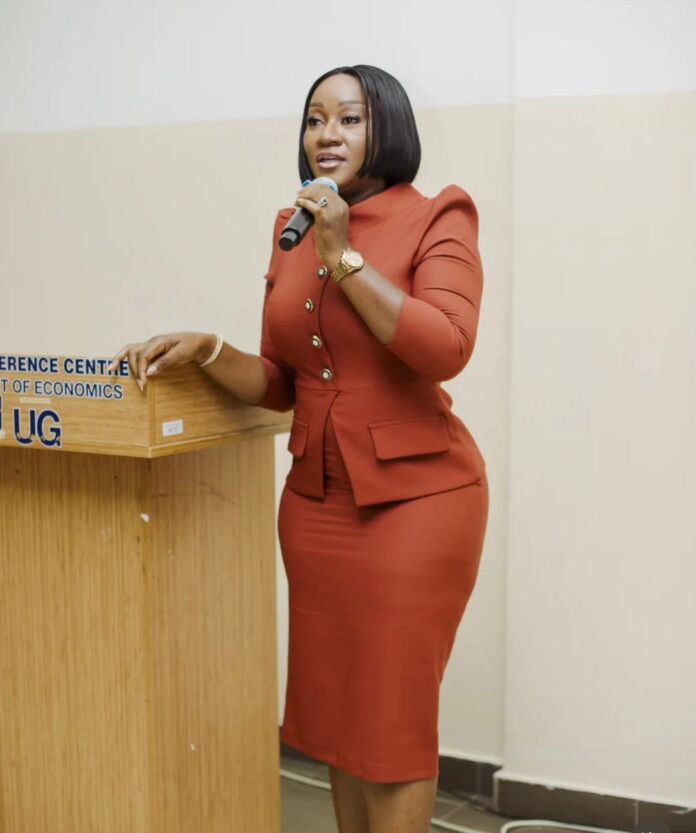

Chief Executive Officer (CEO) of Brain Hill International School, Mary Anane Awuku, has explained why she chose the Cambridge curriculum over the Ghana Education Service (GES) system, highlighting its practical approach and impact on student development.
Speaking on The Career Trail programme aired on Joy Learning TV and Joy News, she noted that although she personally went through the GES system, her experience influenced her decision to explore a different approach to education.
“I also went to a GES school, but the system we went through didn’t give you what Cambridge gives you,” she said.
Mary explained that the rise of international curricula in Ghana is not meant to replace the local system but to complement it, especially in areas where there is growing demand.
“The international schools are gradually coming into our system to also relieve the government a bit. It’s just like having government offices and private organisations. We all support each other,” she stated.
According to her, her decision to adopt the Cambridge curriculum was also driven by the need to respond to growing demand while offering something different to parents.
“It’s a business, so you look at the area where there is high demand, and that is the area I felt could help. That is why I went for Cambridge,” she explained.
She emphasised that one of the key strengths of the Cambridge system is its practical nature, which helps build confidence and develops the overall potential of children.
“It has helped the children. It has built their confidence. It’s taught them a lot. It’s very practical,” she highlighted.
Mary further noted that the system is closely monitored by international regulators, including the British Council, to ensure quality standards are maintained.
“One of our major regulators is the British Council. They come in to check even the teachers you have recruited, their backgrounds, and a whole lot of things to ensure that the children are being developed the right way,” she added.
She clarified that while the Cambridge curriculum includes core subjects such as English, Mathematics and Science, similar to the GES system, it goes beyond traditional classroom learning.
“We also have ICT, Geography, History and various co-curricular activities. That is what makes the current education very important and unique because it brings out the talent in the children,” she explained.
Unlike more rigid systems, she said the Cambridge approach allows students to explore different interests through activities outside the classroom.
“It is not too rigid. There are moments where you step out, you go for swimming, you break into co-curricular classes. Some are learning fashion and design, music, taekwondo, cadets,” she noted.
She added that this holistic approach prepares students not only for academic success but also for life beyond the classroom.
“You are equipped not just for the corporate workspace, but for other areas as well. You are given the foundation to go through it,” she said.
Mary also pointed out that the Cambridge system offers a continuous pathway through to A-Levels, allowing students to transition directly into university.
“The Cambridge system goes all the way to A-Level, so when you finish, you are entering university straight,” she underscored.
Her insights highlight the growing role of alternative education models in Ghana and the increasing demand for systems that combine academic learning with practical and creative development.
ALSO READ:
