
While addressing the people of Burkina Faso on December 31, 2025, President Ibrahim Traoré made a remark intended to leave a lasting impression: “Food self-sufficiency is a daily struggle that we are waging; we can now say that we have achieved food self-sufficiency in Burkina Faso by the year 2025.”
There is, however, a gap between Traoré’s triumphant declaration, official figures, and the reality of people’s experiences.
On social media and in the media, the announcement was immediately amplified, celebrated, and erected as a symbol of the new national sovereignty.
But two weeks before this speech, the president’s office had produced figures that tell a completely different story.
To measure the gap between the proclamation and the reality, we must go back to the Council of Ministers meeting of December 17, 2025. On that day, the Ministry of Agriculture presented the provisional results of the 2025-2026 agropastoral campaign.
The figures are, overall, good. National cereal production is estimated at 7,142,484 tonnes, up 17.63% compared to the previous season and 37.19% compared to the average of the last five years.
The apparent coverage rate of cereal needs stands at 126.6%, compared to 111.5% in the previous season. Non-cereal food crops reached 1,246,132 tonnes, up 27.9% compared to the five-year average. Cash crops other than cotton amounted to 1,353,298 tonnes, up 37%. Forage production exceeded 10 million tonnes of dry matter.
The government attributes these performances to “the multiple forms of state support for farmers and livestock breeders, particularly through the provision of inputs, fertilisers, and equipment”.
But in this same document, the ministry doesn’t hide the grey areas. These are the areas that the presidential address glossed over two weeks later. According to the report, of the country’s 47 provinces, 15 are in deficit, eight are balanced, and only 24 have a surplus.
The growing season was also marked by infestations of fall armyworms on corn and sorghum. Of the 47,213 hectares surveyed, 20,568 hectares were infested, of which 17,724 were treated, leaving 2,844 hectares infested without intervention.

The minister himself did not claim “self-sufficiency”
On the evening of December 17, the Minister of State for Agriculture, Commander Ismaël Sombié, was a guest on the 8 PM news on national television. He was directly asked about food self-sufficiency. His response was cautious and measured: “I think that if we maintain this pace, we are confident we can achieve the food self-sufficiency goal we have set for ourselves. Of course, other aspects will need to be considered, particularly processing and strengthening our achievements in terms of infrastructure and resources.”
For the head of the agricultural sector, food self-sufficiency has therefore not yet been achieved. It remains a prospect to be reached.
Two weeks later, the head of state took hold of some of these figures and drew a conclusion that his own ministers had not dared to formulate.
The proclamation of December 31 also raises a fundamental question: Is this the first time that Burkina Faso has recorded a cereal surplus?
No. Official data shows that this is not the first time. The 2024-2025 season, under the current government, already had a cereal coverage rate of 111.7%. Under the presidency of Roch Marc Christian Kaboré, the 2018-2019 season produced approximately 4.95 million tons of cereals, a 22% increase, with a national coverage rate of 104% and a gross surplus of approximately 194,000 tons. The following season, 2019-2020, reached 5.03 million tons, generating a surplus of 204,000 tons. Of course, these surpluses were not as high as the last season.
Need for intervention revealed to donors
On February 17, 2026, 48 days after the proclamation of self-sufficiency, the government convened an emergency meeting at Ouagadougou City Hall. On the agenda was the need for a request for the international humanitarian community’s contribution to the financing of an emergency plan of 735.1 billion CFA francs to help 4.47 million Burkinabe, described as “vulnerable” and in “need of vital assistance“.
The meeting, chaired by the National Council for Emergency Relief and Rehabilitation (CONASUR) in collaboration with the UN Office for the Coordination of Humanitarian Affairs (OCHA), is an advocacy session to mobilise external funding.
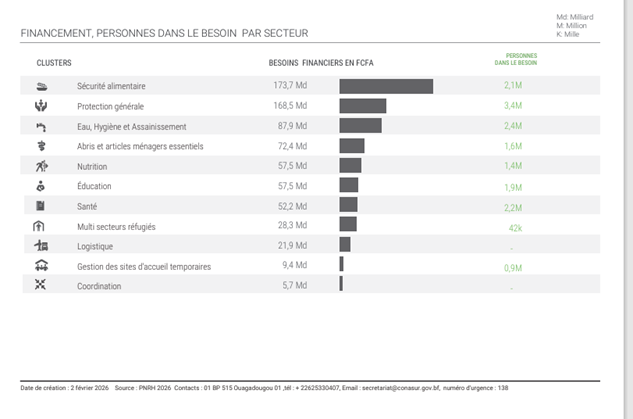
The Minister of Family and Solidarity, Lieutenant-Colonel Passowendé Pélagie Kaboré, announced the figures without mincing words: more than 1.3 million children under five years of age need nutritional support; more than 2.1 million people (almost the equivalent of the population of Lesotho) will need food assistance, and more than 3.3 million people will need protection support.
These data are confirmed by the Burkina Faso Humanitarian Needs and Partner Response Plan (HNRP) 2026 report.
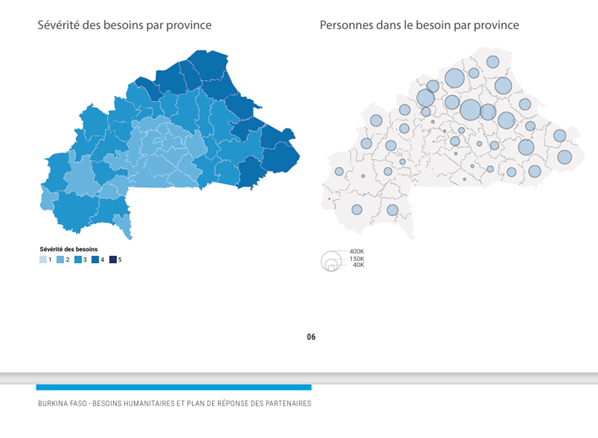
The country’s humanitarian needs, ranked by severity, according to the report HNRP 2026
Behind the grain surplus
The humanitarian response plan helps to understand why a national cereal surplus is not enough to speak of food self-sufficiency.
The April 2025 food security and nutrition analysis establishes that approximately 2.26 million people were in a situation of acute food insecurity, including more than 220,000 in the emergency phase, one step away from famine.
The national average cereal coverage of 111.5% for the 2024-2025 cereal season masks catastrophic regional realities. In the areas most exposed to insecurity, the Yaadga province covers only 57% of its needs, the Liptako province 56%, and the Koulsé province barely reaches 45%.
Physical access to markets exacerbates the situation. Several secondary markets remain closed in areas experiencing security tensions, such as Barga, Kain, Koumbri, Thiou, Tin-Akoff, Oursi, Gorgadji, Dablo, and Bouroum, forcing residents to rely on escorted convoys for supplies. While prices have fallen on average (7% for maize, 15% for millet, and 17% for sorghum), they remain 15% to 17% above the five-year average. In the most isolated areas, the price increases are staggering: +77% for millet in Arbinda, +106% for sorghum in Sebba, and +148% in Kompienga.
The livestock sector has not been spared. Erratic rainfall, degraded pastures, dwindling water sources, and insecurity that disrupts transhumance routes have forced many herders to sell their livestock at rock-bottom prices. Fall armyworms destroy up to 25% of maize crops, granivorous birds ravage up to 80% of rice, millet, and sorghum crops, while peste des petits ruminants (PPR) and foot-and-mouth disease decimate herds due to a lack of access to veterinary services.
In terms of nutrition, the report estimates that 1.38 million people require emergency assistance, of whom 134,701 live in areas where the malnutrition rate exceeds 15% – one and a half times the World Health Organisation’s alert threshold of 10%.
Chinese food donations to a self-sufficient country
Seventy-two days after the proclamation of self-sufficiency, one scene sums up the whole paradox.
On April 10, 2026, in Ouagadougou, Commander Passowendé Pélagie Kaboré, the Minister of Solidarity, Humanitarian Action and Family, received the Chinese Ambassador, Zhao Deyong. The two parties signed the handover agreement for food aid: more than 1,800 tons of rice, with an estimated value of over 1.6 billion CFA francs.
According to a statement from the Chinese embassy, the ambassador “congratulated Burkina Faso on achieving its goal of food self-sufficiency by 2025“. He also presented the country with 1,800 tons of rice.
The minister, for her part, recalled that Chinese food aid “for two consecutive years has helped to improve the living conditions of many vulnerable families” and that by 2025, “nearly 140,000 people had benefited from Chinese support“.
Two days later, on April 12, the same minister received the Indian ambassador, who announced a donation of 1,000 tons of rice and pharmaceutical products, with an estimated value of 125 million CFA francs.
Relative to the scale of needs, the Chinese donation represents approximately 2.1% of the financial need of the food sector alone, estimated at 75 billion CFA francs in priority terms.
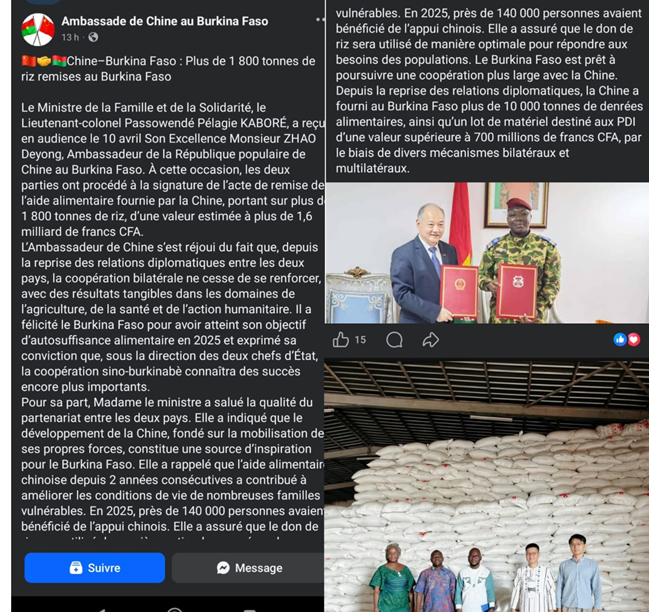
Less than a year earlier, on May 13, 2025, Lu Shan, former ambassador of the People’s Republic of China to Burkina Faso, officially handed over a significant humanitarian donation of 1,629.9 tons of rice. This donation was received by the Minister of Solidarity, Humanitarian Action and Family in the presence of the Minister of Foreign Affairs, Regional Cooperation, and Burkinabè Abroad, Karamoko Jean Marie Traoré. The donation is valued at 1.7 billion CFA francs.
Thus, within the space of a year, Chinese food aid, accepted by the Burkinabe authorities, amounted to 3.3 billion FCFA (3,429.9 tonnes of rice), a sign of the real needs on the ground for humanitarian aid.
These donations come after a note from the Prime Minister, dated November 28, 2025, where he urged all leaders to refuse aid that is degrading and that does not honour Burkina Faso.
“The government now prioritises cooperation that is fully aligned with our national interests and promotes real and endogenous progress (…) It is imperative to break with this vision and refocus partnerships around structuring projects, in line with our priorities and reinforcing the vision of the Comrade President. (…) I therefore urge you to decline any support that would be degrading in nature, contrary to the values of honour and dignity of the Burkinabè people, or that would not be in line with the vision of the RPP (Progressive and Popular Revolution),” he reminded them.
China’s food donation has reignited debates on social media, especially in the comments under the post announcing the operation and on news sites like Lefaso.net.
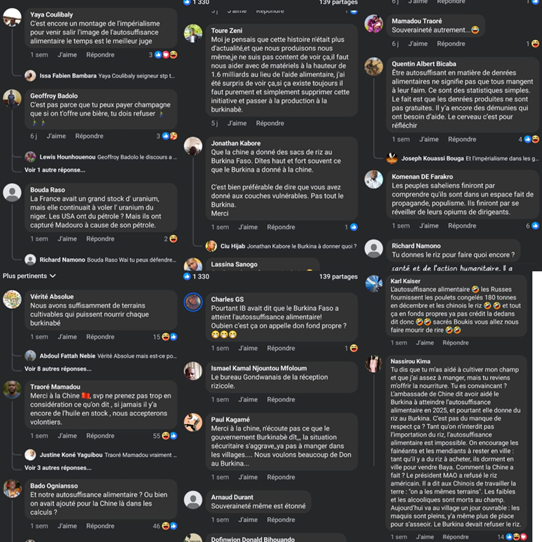
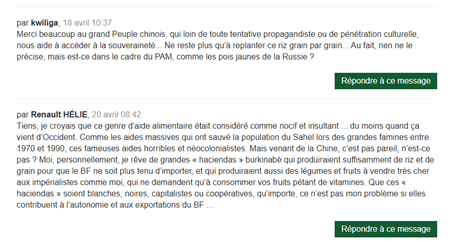
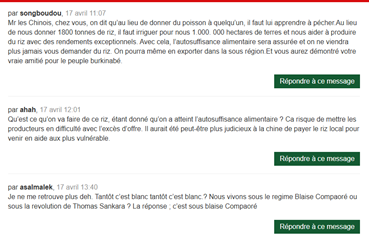
The Chinese rice donation to Burkina Faso sparked a wave of irony on social media, as the transitional government had claimed to have achieved food self-sufficiency in 2025. “And what about our food self-sufficiency? Did we include China in the calculations?” one internet user mocked. Between skepticism and pragmatic gratitude, these reactions reflect the growing distrust among part of the population toward the official narrative.
What people are saying
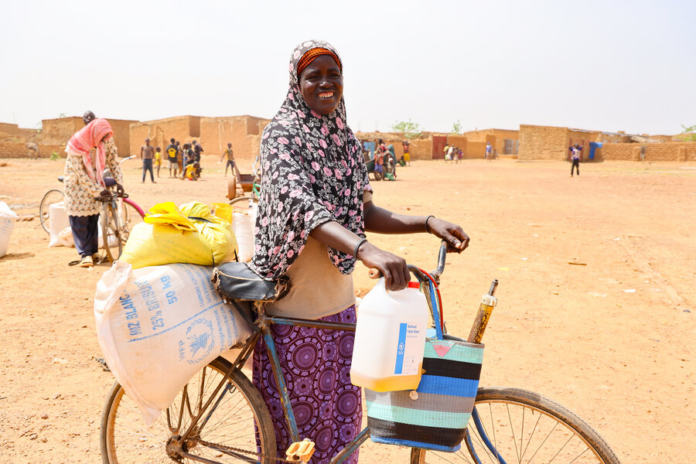
Beyond the figures and diplomatic ceremonies, the HNRP 2026 report is based on 21,619 community feedback and complaints collected between January and October 2025, and on a survey covering 6,214 households in 13 regions and 31 provinces. These populations are not talking about self-sufficiency. They are talking about hunger.
According to the report, the preferred forms of assistance for the affected populations are, first, the free distribution of food, followed by sales at moderate prices, the construction/rehabilitation of infrastructure, essential social services, and agricultural support. “More than 80 percent of households in the Liptako, Sirba, Soum, and Tapoa regions recommend it first, and more than 50 percent in Goulmou, Koulsé, Sourou, and Yaadga, ” the report states.
Food assistance is declared an absolute priority, almost unanimously “among internally displaced and returned persons”, particularly in Soum, Liptako, Tapoa and Sirba.
The main sources of dissatisfaction are insufficient quantities and delays in the delivery of aid.
The actual coverage of food assistance illustrates the extent of the gaps. In the Koulsé, Goulmou, and Nakambé areas, it does not exceed 25 to 55% of surveyed households. In Bankui, Sourou, and Yaadga, it falls to 15-27%. In Guiriko and Tannounyan, it does not exceed 10%. As of September 30, 2025, only 1.4 million people, or 39% of the target population, had actually received assistance.
According to a summary document of the government’s humanitarian response plan, the country needs 173.7 billion FCFA to ensure food security for 2.1 million people and 57.5 billion FCFA to meet the nutritional needs of 1.4 million people. The total of these two needs is 231.2 billion FCFA. In the government’s ranking of humanitarian needs, food security tops the list.
A humanitarian assessment that raises questions
In 2025, more than 155 humanitarian partners mobilised $271.3 million, enabling assistance to 1.7 million people in Burkina Faso. However, the 2025 Humanitarian Response Plan aimed to reach 3.7 million people with a budget of $792.6 million. The result: only 34.2% of the financial needs were met, and only 45.9% of the targeted population was reached.
For 2026, partners have pledged to mobilise $658.5 million. However, a methodological anomaly warrants attention: the decrease in the number of people in need, from 5.9 million in 2025 to 4.5 million in 2026, “does not reflect an improvement in the humanitarian situation,” the report itself acknowledges. Instead, it “results primarily from methodological changes”. Eighteen provinces were excluded from the calculation, even though approximately 500,000 people in need were identified there in 2025.
“Rapid, flexible and predictable funding is essential to save lives and prevent further deterioration of the situation,” UN Resident Coordinator and Acting Humanitarian Coordinator, Maurice Azonnanko, observed in the foreword of the 2026 report.
The essential question remains: does a proclamation of self-sufficiency, even partial, risk drying up the funding on which millions of Burkinabe still depend and which the authorities themselves are seeking through the 2026 response plan?
This article was produced with support from the African Academy for Open Source Investigations (AAOSI) and the African Digital Democracy Observatory (ADDO) as part of an initiative by Code for Africa (CfA). Visit https://disinfo.africa/ for more information.