
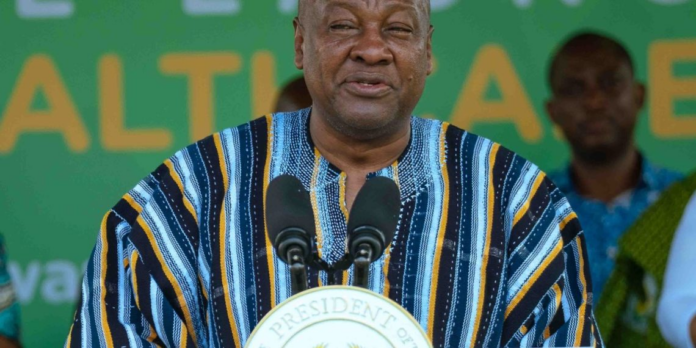

President John Dramani Mahama has assured Ghanaians that recent power outages being experienced in parts of the country are not a return to the prolonged “dumsor” crisis, but rather part of ongoing efforts to improve electricity supply.
Speaking during an inspection of newly acquired transformers for the Northern Electricity Distribution Company Limited (NEDCo), the President explained that the interruptions are necessary to replace ageing infrastructure and stabilise power delivery.
“The outages you are facing are not dumsor. It is to enable you to get better quality and stable power,” he said.
President Mahama disclosed that government has procured 2,500 transformers to be deployed nationwide to address the growing demand for electricity and replace outdated equipment.
He noted that many existing transformers are overstretched due to rapid population growth and expansion of communities, citing an example of a 22-year-old transformer in Nungua-Lashibi that can no longer meet current demand.
According to him, there had not been a large-scale replacement of transformers over the years, making the current intervention necessary.
The President assured that residents would be duly informed ahead of any planned outages during installation works.
He also welcomed the fact that a significant number of the transformers are locally manufactured, describing it as a boost for Ghana’s industrial sector.
Minister for Energy and Green Transition, John Abdulai Jinapor, said the rollout has already begun, with installations underway in Tamale and other parts of the NEDCo operational area.
He revealed that although NEDCo requested 400 transformers, government supplied 500 to support the upgrade.
The minister added that similar works are ongoing in Accra and Tema, with plans to extend to Kumasi in May, including the installation of new substations and additional power cables.
Dr Jinapor appealed to the public to exercise patience, emphasising that the programme is aimed at achieving long-term stability in electricity supply.
He noted that the first phase of the project will run for three months, followed by additional phases over six months and one year to ensure sustained improvements in the power sector.
