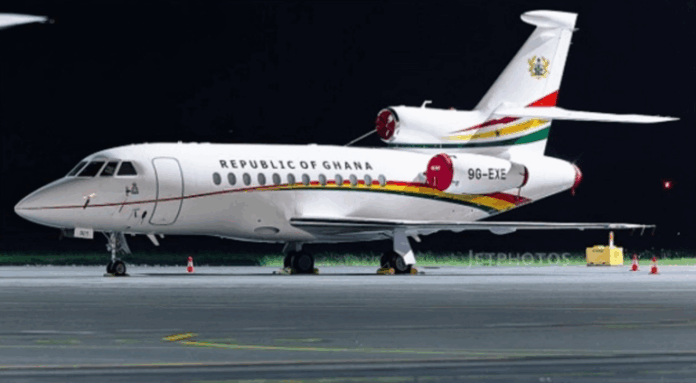

The Executive Director of the Media Foundation for West Africa (MFWA), Sulemana Braimah, has called on political leaders to stop the partisan debate over Ghana’s presidential aircraft and focus on finding a lasting solution.
Speaking on Joy FM’s Super Morning Show on Monday, March 16, Mr Braimah said the discussion about the presidential jet has been clouded by politics for too long, making it difficult for the country to address the real issue.
“I think as a country, we just have to be bold to say, ‘Look, we’ve gotten to the point where we need a befitting aircraft for state officials who would have to travel for purposes of whatever is to the benefit of the state,’” he said.
According to him, the controversy surrounding the aircraft has largely been shaped by political narratives, particularly during the previous administration.
“I think the problem has been the politics about it. In the last regime, there was a lot of politics about the travels of the president,” he said.
He admitted that concerns about the cost of chartering private aircraft during the previous government were valid. However, he said that the situation was sometimes misrepresented in the public debate.
“Yes, we admit it was quite expensive, but the impression was created as though the president had deliberately decided to avoid a well-functioning aircraft that was in a pristine state and rather opted for expensive, luxurious chartered flights. I think the problem has been the politics,” he said.
He pointed out that not every country operates a presidential jet and that its leaders still manage to travel for official duties.
“I don’t think all the countries around us have presidential jets. Does it mean their presidents don’t travel? Their presidents do travel,” he said.
“We don’t want to create the impression that without Ibrahim Mahama’s aircraft, our president cannot travel. I think it is still possible for the president to travel,” he added.
He said that Ghanaian presidents have used commercial flights before, citing an example involving President John Mahama.
“I don’t think that President Mahama hasn’t had an occasion of travelling on a commercial flight before. There was a trip he did to the Middle East some time ago, and we were told that contrary to speculation, the president actually travelled by Emirates airline,” he said.
He said that while commercial travel remains an option, the real concern in recent years has been the cost of chartered flights.
“The challenge with the previous regime, I believe, was the nature of aircraft and the cost the state was carrying, about 14,000 to 15,000 dollars an hour. That is extraordinarily significant,” he said.
He also questioned earlier claims by some politicians that the presidential jet was in excellent condition. He referred specifically to remarks made by the current Foreign Affairs Minister, Samuel Okudzeto Ablakwa, who had raised concerns about the use of chartered aircraft during the previous administration.
“At some point, we need him to tell Ghanaians whether he was simply doing politics with the situation,” he said.
He said it would be important for the minister to clarify whether his earlier concerns were about the cost of chartered flights or the decision not to use the presidential jet.
“Perhaps we need him to tell us whether his concern was really about the type of aircraft that were being rented or the fact that the presidential jet was not being used,” he said.
Mr Braimah questioned what had changed since those earlier claims were made.
“If the presidential jet was indeed in such a pristine state as he talked about, and this was just in 2024, what has happened all of a sudden?” he asked.
He added that the intense political exchanges around the issue have distracted from the need to make a practical decision.
“Sometimes the politics can be needless. The propaganda around issues can be too much. As a country, Ghana is not so poor that we cannot afford a decent aircraft that offers safety for the president and other state officials. It is possible to be done,” he said.
He recalled that a similar controversy surrounded the procurement of the Falcon aircraft during the administration of former President John Agyekum Kufuor. At the time, strong opposition was raised, largely by the then-opposition National Democratic Congress (NDC).
“To the extent that President Kufuor had to say that Ghanaians appear to know the cost of everything but the value of nothing,” Braimah said.
The aircraft was eventually delivered in 2010 when the NDC was in power and was later used for many presidential trips, including during the presidency of John Mahama after the death of President John Evans Atta Mills.
Mr Braimah said the country must now take an honest look at the current situation.
“I think it’s time for us to say, ‘Look, we are at a point where as a country we don’t have an aircraft that is airworthy enough to guarantee the safety of the president’s travel, and we should be able to procure one for the state,’” he said.
He also suggested that cutting government waste could make such a purchase possible.
“The waste that is happening, even under this government, if half of it is cut, we can easily buy a decent aircraft for the state,” he said.
He acknowledged that political opponents may point to past criticisms, but insisted that the country must move beyond partisan arguments.
“NPP at this stage would be right if they say, ‘You guys were criticising us, now you want to go for it.’ But again, that is still politics,” he said.
He urged political actors to be frank about the issue and resolve it once and for all.
“For me, the politics is enough. Let us confront the issues, deal with them and settle it once and for all,” he said.