
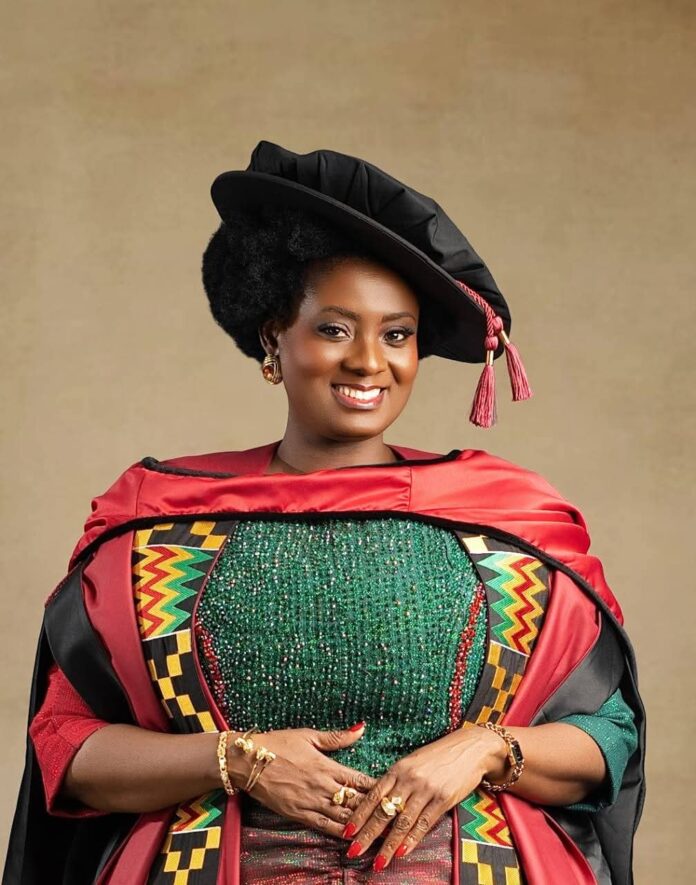

Former Deputy Minister of Communications, Victoria Hamah, has offered a wide-ranging reflection on her public life, politics and scholarship, arguing that her decade-long career has been unfairly defined by controversy rather than substance.
In a Facebook post titled “From Storming Seas to Calm Shore: My Doctoral Journey Through Power and Gender,” Hamah contends that the challenges she faced as a student leader, gender activist and deputy minister were less about competence and more about how power responds when women refuse to diminish themselves.
According to her, the sustained scrutiny of her confidence, appearance and authority reflects deeply entrenched gender norms within Ghana’s political culture. She described the institutional response to her public controversy as “swift and moralistic,” adding that accountability was selectively enforced while deeper structural contradictions remained unexamined.
Hamah said her exit from executive office marked not a retreat but a renewal. She turned to academia as a continuation of political engagement, culminating in a doctoral dissertation titled “Gender Asymmetry in Ghana’s Parliamentary Committees: A Critical Analysis of Women’s Representation and Legislative Influence.” The research, she explained, examines how institutional design, political culture and power relations constrain women’s legislative influence.
She stressed that the work is not autobiographical but a rigorously grounded political intervention informed by empirical analysis and lived experience.
Beyond scholarship, Hamah highlighted her leadership of the Progressive Organisation for Women’s Advancement (POWA), which she said was established to protect and promote women’s participation in politically hostile environments through advocacy, mentorship and leadership development.
Positioning herself as a scholar-practitioner, Hamah said her focus is transformation rather than redemption—shaping governance debates, influencing policy and mentoring women leaders.
“Falling is not synonymous with failure,” she wrote, adding that exposing what systems prefer to hide can itself be a form of power.
She expressed hope that her journey would inspire young women to challenge persistent myths about women’s capacity to succeed in politics, arguing that such beliefs endure because of structural barriers rather than a lack of ability.
