
In a republic, the question is never merely whether something can be done. The question is who may do it, under what law, and within what limits. That is the architecture of constitutional democracy.
The Constitution guarantees life, liberty, dignity, equality, and protection from degrading treatment. These are not seasonal rights.
They do not dim when a uniform appears. They bind the Executive, the Legislature, the Judiciary and “all other organs of government.” The military is not exempt from constitutional gravity. It is held by it.
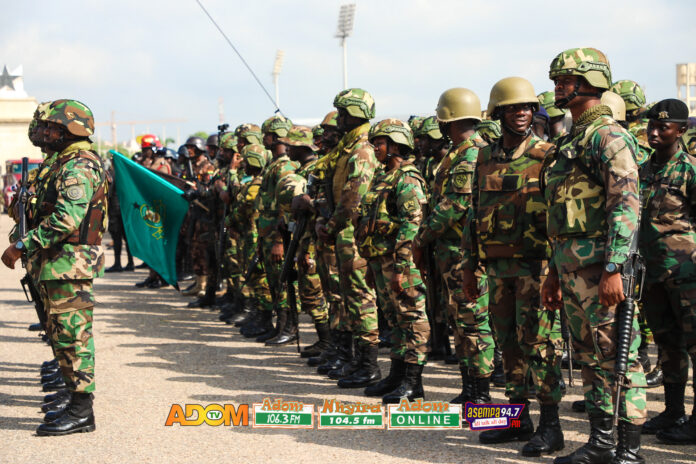
And yet we are confronted with an uncomfortable contemporary reality: soldiers appearing in land disputes, in property conflicts, in operations that blur the line between national defence and civil contestation. Journalists covering such events report assaults. Investigations are promised internally. Statements are issued. The machinery of reassurance turns. But the deeper question remains stubbornly unanswered.
Where is the threshold?
At what point does a civilian land disagreement metamorphose into a matter of national security? What transforms a property dispute into a theatre for military presence? Who decides? On what written authority? Under which published instrument? For how long? With how many troops? With what oversight?
The Constitution is meticulous about many things. It speaks clearly about the supremacy of law, about enforcement, about judicial remedies. It provides mechanisms for challenging unconstitutional acts before the Supreme Court. It contemplates subsidiary legislation laid before Parliament. It insists on accountability. Yet nowhere do we find a transparent, publicly articulated constitutional doctrine setting out the precise threshold for internal military deployment in civilian disputes.
Silence in law is never neutral. It creates space. And space invites discretion.
Now, discretion is not evil in itself. Government cannot function without it. But discretion without defined limits is like a river without banks. It floods. It spills. It reshapes the terrain in ways never contemplated by its designers.
Every constitutional democracy recognises that in extreme circumstances — insurrection, terrorism, catastrophic breakdown of public order — military assistance to civil authorities may be necessary. No serious jurist denies that. The State must preserve itself. But necessity in constitutional theory is not a mood; it is a legal category. It requires clarity. It demands evidence. It must be publicly defensible.
If ten soldiers may be deployed for a certain condition, what justifies one hundred? If a pickup truck is permissible, what authorises an armoured tanker? If a minister’s letter suffices, why not a telephone call?
Here lies the danger — not dramatic coups or overt authoritarianism — but the slow lowering of the threshold. What begins as exceptional becomes routine. What begins as security assistance becomes administrative convenience. And what begins as convenience becomes gradual normalisation.
When force becomes ordinary, liberty becomes fragile.
One must also confront the uncomfortable sociology of power. Ghana, like many societies, contains asymmetries — of wealth, influence, access. In land disputes especially, documentation may be unclear, ownership contested, political connections potent. In such an environment, the absence of a defined legal threshold creates a temptation: the temptation to convert public force into private advantage.
It is here that constitutional principle meets human vulnerability. If the trigger for military deployment is opaque, those with proximity to executive authority may influence its use. The poor litigate; the powerful deploy. That is not rule of law. That is the shadow of feudalism wearing modern insignia.
The Universal Declaration of Human Rights reminds us that human beings are born free and equal in dignity and rights, and that these rights must be protected by the rule of law to prevent recourse to rebellion against tyranny. The wisdom is subtle. It is not only tyranny that breeds instability; it is perceived injustice. When citizens cannot see the law that governs force, they cease to trust that force.
The Inter-Parliamentary Union’s Human Rights Handbook articulates the State’s obligation to respect, protect and fulfil rights. Respect means refraining from unjustified interference. Protect means preventing third-party abuse. Fulfil means creating conditions in which rights can flourish. Military deployment in civilian space engages all three obligations simultaneously. It can protect, yes, but it can also intimidate. It can deter violence, but it can also chill expression. It can stabilise, but it can also distort.
The Ghanaian Constitution provides that rights are enforceable by the courts. But enforceability presupposes intelligibility. A citizen cannot meaningfully challenge a deployment if its legal basis is undefined or concealed within administrative practice. One cannot litigate against fog.
Some may argue that publishing detailed thresholds risks operational rigidity. But constitutional clarity is not rigidity; it is legitimacy. It does not weaken security; it strengthens it. Soldiers deployed under transparent, democratically sanctioned authority operate with moral confidence. Soldiers deployed under ambiguous instruction carry the burden of doubt.
Oversight, then, must be more than ceremonial. An internal probe by the deploying institution may be administratively convenient, but independence is the oxygen of credibility. Where allegations of abuse arise, investigation must be external, findings public, remedies tangible. Accountability that is invisible to the citizen is indistinguishable from impunity.
There is, finally, a deeper constitutional philosophy at stake. Lord Denning often wrote of the majesty of the law restraining power. Lord Steyn reminded us that even parliamentary sovereignty is bounded by fundamental principles of the rule of law. Their shared insight was simple yet profound: unchecked power, even when well-intentioned, corrodes the constitutional order.
The military is one of the Republic’s most respected institutions. Precisely for that reason, it must be shielded from politicisation and instrumentalisation. The Armed Forces defend the Constitution; they must never become its ambiguous footnote.
If internal deployment is truly necessary in a particular circumstance, let the law say so plainly. Let the criteria be explicit. Let the authorising authority be clear. Let Parliament be informed. Let duration be limited. Let review be mandatory. Let investigation be independent. Let the public know not only that force was used, but why it was justified.
A republic worthy of its Constitution does not fear defining the moment when it unsheathes its sword. It understands that clarity is not weakness but strength.
For in the end, the question is not whether Ghana has soldiers. It is whether Ghana has limits.
And a law without limits is no law at all.
Kelvin Gyimah
Executive Director
Rights Accountability Network – Africa (RANA)