
For twelve years Philip Quansah drove a trotro through Accra’s traffic, breathing in whatever came through the window. He didn’t think much of the catarrh (sinus congestion), the coughs, the headaches. They were just part of the job.
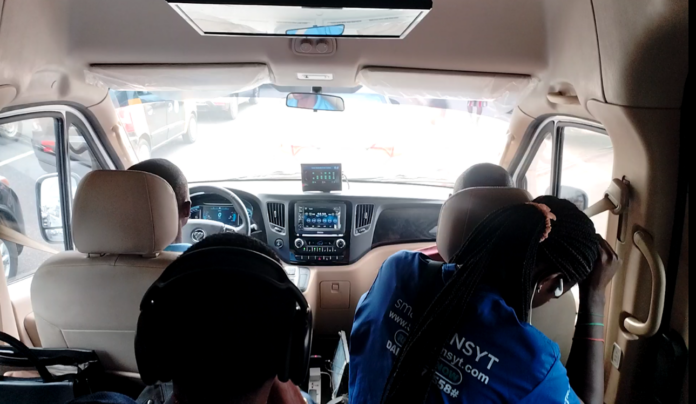
Six months ago, he had the chance to switch to driving an electric shuttle. The engine barely makes a sound. There is no exhaust. And for the first time in over a decade, Philip says, his body stopped hurting.
“The moment you move the car, you won’t hear any noise, any smoke, everything is cool,” says the now 44-year-old. “So, I feel more comfortable than using trotro.”
Philip is one driver on one route. But what his body absorbed over those twelve years is, in effect, the public health crisis the whole country is now racing to confront.
Road transport is the single largest source of air pollution in Accra, responsible for roughly 40 percent of the dangerous fine particles that enter people’s bloodstream and exacerbate illnesses that are exploding in number including diabetes, heart disease, stroke and cancer. Trotros are the main source of transport for Accra’s commuters.
Vehicles that run by burning fossil fuels – diesel, petrol or gas – emit a range of dangerous chemicals into the air that hurt people as well as the climate. That is made worse in Ghana by the absence of one small device. Many second-hand trotros imported into Ghana arrive without a catalytic converter – the part that filters toxic gases from exhaust before they reach the air.
Some are removed by drivers who wrongly believe it boosts engine power. Others are stolen for the valuable metals inside. Either way, without it, an engine burns dirtier and pushes far more toxic particles into the air around it.
Reporting from hospitals across Accra shows a marked rise in air pollution-related illnesses, with patients increasingly presenting with respiratory conditions such as catarrh, asthma, and chronic coughs linked to dust, vehicle emissions, and smoke exposure.
Replacing Ghana’s fossil fuel vehicles with electric has been a major push for clean air advocates sounding the alarm about the country’s growing air pollution problem. Dirty air caused more than 32,000 premature deaths in the country according to the most recent State of the Air Report. And many more Ghanaians are being sickened.
That is part of the reason Ghana’s national Electric Vehicle policy targets 35 percent electric vehicles by 2035 and a full ban on fossil fuel vehicles by 2045.
At the Ghana Private Road Transport Union’s 37 branch in Accra, trotro driver Timothy Abolga has been behind the wheel for twenty years. He suspects the smoke has cost him something even though he has never been tested.
“We don’t go for check-ups as drivers. But I think we inhale it a lot, not just drivers, but even passers-by. I think it has health effects.”
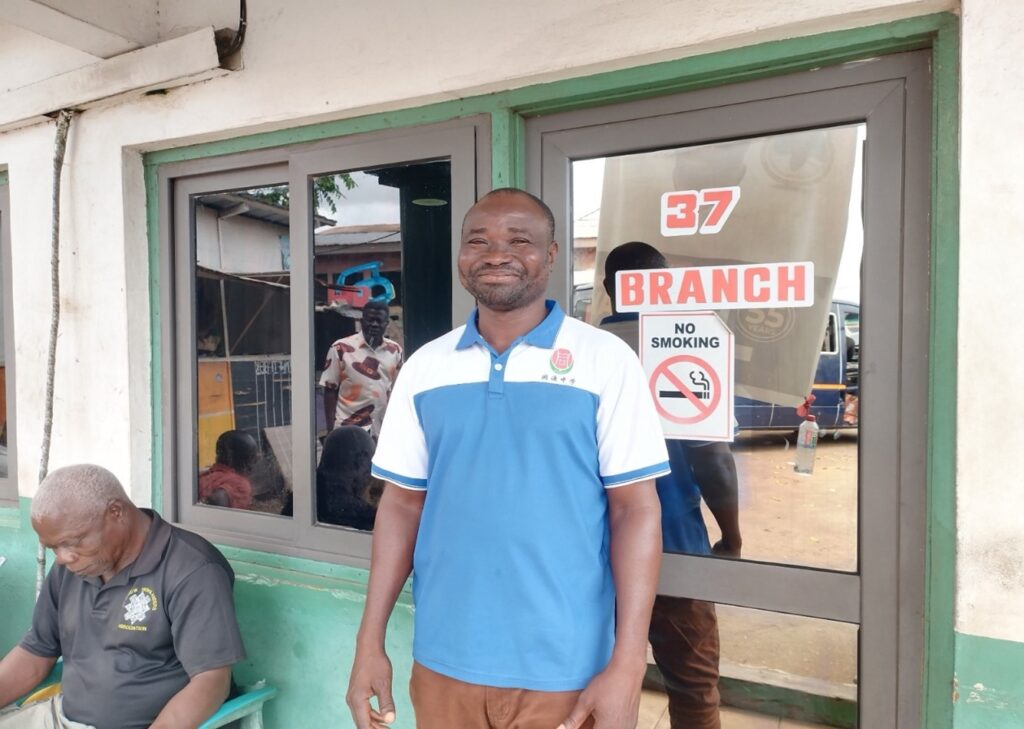
Timothy Abolga is a chief driver at the 37 Branch of the Ghana Private Road Transport Union
When private investors visited the station recently to pitch drivers on buying electric trotros, Abolga was ready. “We told them we are interested.”
His colleague driver, Evans Quansah spelled out the prime concern for drivers here. It all comes down to how affordable the electric transition is.
“If government will include us and employ us to drive EV buses on a work-and-pay basis, we will be happy,” Quansah says.
Ghana’s EV journey
An electric bus has no engine, no fuel tank, no exhaust. A battery stores power and a motor converts it into motion. The hard part is filling that battery, and Ghana’s charging network is not yet up to the job.
Metro Mass, the state bus operator, runs the country’s only government-owned EV charging station, combining grid power with solar so blackouts don’t ground the fleet.
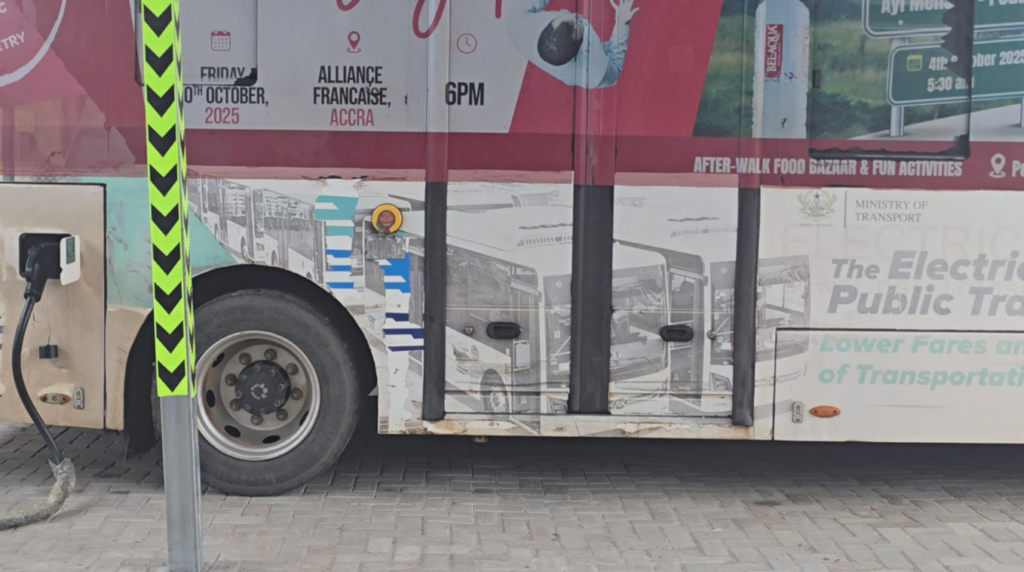
Their buses were built to charge to 220 kilowatts. Haroun Apaw Wiredu, the Deputy Managing Director, says they are getting 160. The reason, he claims, is second-hand chargers bought by the previous government administration in 2024. Buses that should take thirty minutes to charge were sitting on the bay for three hours.
A shortfall in charge capacity translates directly into fewer kilometres covered before the next charge. For commercial drivers, it bites harder. “When it’s raining, most are offline. When you get there, and there are a lot of people, it’s a challenge,” says one commercial EV driver outside the depot, who asked not to be named because he did not want colleagues to know he drives for hire outside his regular hours.
But after that cost is a major advantage. A full charge at a working terminal costs GHC130 and the car will run for as much as 300 kilometres. Filling a petrol trotro will cost more than twice that amount.
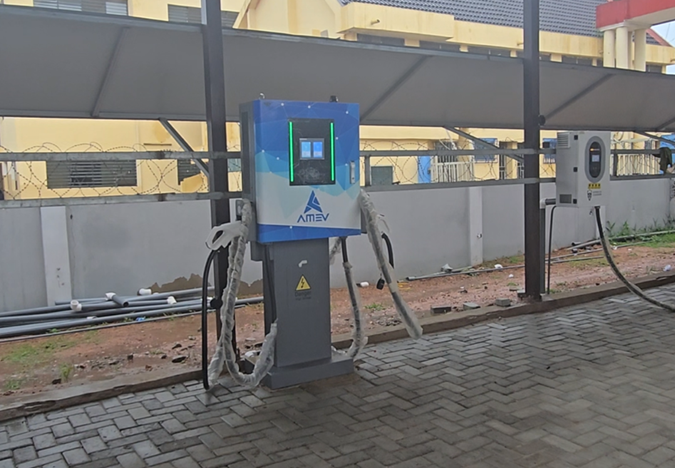
An AMEF charger at the Metro Mass Transit in Accra
The government has been making some steps towards the EV transition but it has been slow. In 2024, the government promised 100 electric buses for Accra. Ten arrived. Of those, only four were running when the announcement was made. Now government has ordered 300 more buses, but they are diesel.
Desmond Appiah of the Clean Air Fund describes it as a missed “opportunity to drive us towards the aspiration we have set for ourselves. This is a little under ten years to go. I would want to see very pragmatic things being done by government.”
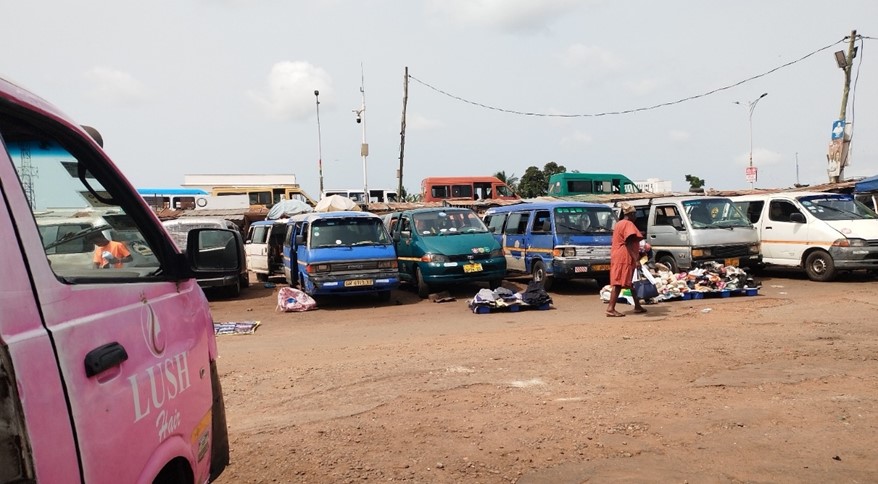
Old polluting trotros wait at the 37 bus station
He recommends that 35 per cent of all government vehicle purchases be electric. He also wants to see the government develop the EV parts industry in Ghana so that the components can be manufactured in Ghana, creating jobs and building the country’s self-reliance.
Metro Mass, for its part, says it is legally bound to serve even the routes private operators won’t touch, and is expecting 100 new electric buses before the year ends.
What Johannesburg already proved
Accra’s transport planners have spent time studying Johannesburg’s Rea Vaya rapid transit in South Africa, which has run dedicated bus lanes since 2010 and saves close to a million tons of emissions a year.
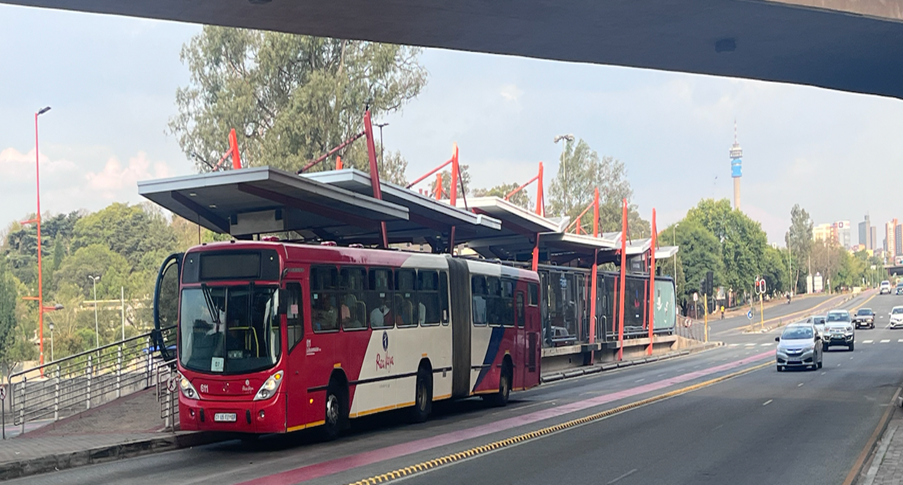
A Rea Vaya Bus in Johannesburg
A New Climate Economy report put its savings at close to $890 million in travel time, road safety and cleaner air within five years of launch.
Alex Johnson, head of Transport at the Accra Metropolitan Assembly, says Accra has drawn directly on that model in designing its own pilot, due to launch on the Kaneshie-to-Accra corridor between September and November this year, using between 10 and 40 buses.
The urgency, he says, is not abstract. Hospitals near Makola market report that seven in ten cases that report there are linked to air pollutants.
The transition to a cleaner Accra is finally gaining speed. But for Philip, for Timothy, and for the seven in ten patients walking into Makola’s clinics with damaged lungs, the country cannot afford any more delays.
This story was produced in collaboration with New Narratives, with funding from the Clean Air Fund. The funder had no say in the story’s content.