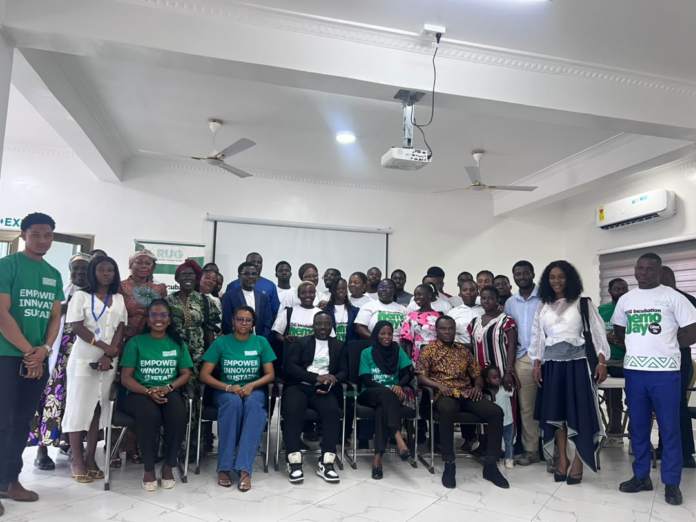

Director of Operations at Recycle Up! Ghana, Gertrude Mawuena Goh, has called for increased government and corporate funding to create more opportunities for young entrepreneurs in Ghana’s circular economy.
She said inadequate funding remains a major obstacle to expanding opportunities for young people in the green economy and urged the government to strengthen its support for organisations developing youth-led businesses in the sector.
Ms Goh made the call at the RUG Incubation Programme Cohort 6 Demo Day held at the KIC Centre of Excellence in Ejisu, under the theme, “Empowering Innovation for Sustainable Business Growth.”
“We want the government to provide us with the network and also the funding support to enable us to build more capacities of the youths in the circular economy space,” she said.
She noted that Recycle Up! Ghana had benefited from some government initiatives, including the NEIP Adwumawura programme, through which the organisation trained some start-ups in the Ashanti Region.
“Through that, we were able to raise some funding to support the work we do, so more of such initiatives that can directly support us will be beneficial,” she added.
Building businesses from waste
The RUG Incubation Programme, which has been running since 2019, targets young people between 18 and 35 years, particularly early-stage social entrepreneurs developing solutions in waste management, the circular economy and green business.
Participants receive training in financial management, fundraising, investor pitching, product and idea validation, business development, legal issues and market development.
Previous cohorts have also benefited from prototype funding and opportunities to pitch their businesses to investors.
Ms Goh said Recycle Up! Ghana’s work seeks not only to improve livelihoods but also to address the country’s growing waste challenge, particularly waste that blocks drains and contributes to environmental degradation.
She said the organisation had so far impacted more than 35,000 people through its various interventions, adding that its work extends beyond business incubation to environmental awareness and behaviour-change programmes.
According to her, Recycle Up! Ghana also plans to expand its incubation programme to reach more young people across the country while strengthening its nationwide waste education campaign.
“Through the nationwide waste education campaign, we visit basic schools and sometimes senior high schools. We have found environmental school clubs, basically teaching them about waste management, which focuses on plastic waste, how they can reduce waste and also empower the schools to segregate plastic waste so that it feeds into the recycling value chain,” she said.
She added that the organisation had also launched a waste management handbook to support its environmental awareness campaigns.
Ecofurn wins Cohort 6 Demo Day
The Cohort 6 Demo Day featured seven start-ups and 13 entrepreneurs who pitched their businesses and products to investors and industry stakeholders.
The start-ups are focused on converting waste and agricultural by-products into products ranging from furniture and cosmetics to animal feed, reusable sanitary products, fabrics, packaging and fruit-based beverages.
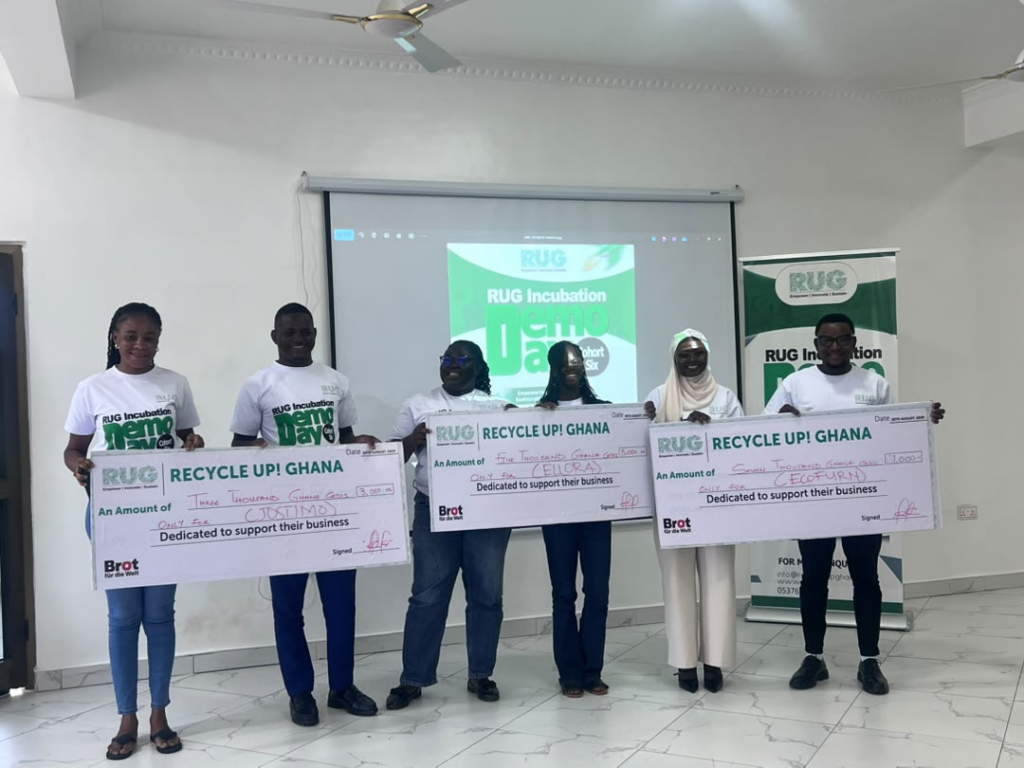
Ecofurn, which repurposes rice husks, groundnut husks and plastic waste into durable, insect-resistant, water-resistant and eco-friendly school desks, emerged as the overall winner and received GH¢7,000.
Ellora Cosmetics, which produces rice shampoo bars, conditioners, and face and body scrubs from waste rice, placed second and received GH¢5,000.
Jostimo, which produces pelletised animal feed from agricultural waste and by-products, placed third with GH¢3,000.
Start-up calls for easier FDA certification
For Ellora Cosmetics co-founder Theodora Dankwah and her partner, Louisa Yeboah, the programme provided an opportunity to move their start-up beyond product development to better understanding their customers and building a sustainable business.
Ms Dankwah said her personal struggle with acne and unsuccessful attempts with different skincare products inspired the development of Ellora Cosmetics.
She said the company uses rice in its products, drawing inspiration from the popularity of rice-based skincare products, particularly in Korea.
“As a start-up, we’ve always been searching for opportunities and how to bring our business into the spotlight, so we saw the RUG Incubation Programme opportunity on LinkedIn and took the chance to apply,” she said.
“It has been an eye-opening journey for us because at first we were going to stores to give them our products, but coming to the RUG Incubation Programme, we learnt that it does not just start from doing the product. It starts from knowing your customers and what they’re going through to come up with your products,” she added.
Ms Dankwah identified regulatory requirements, particularly certification by the Food and Drugs Authority (FDA), as one of the major challenges facing the start-up.
She appealed to the government and relevant stakeholders to introduce a simplified support package for start-ups in the food and cosmetics sectors to make regulatory certification more accessible.
“We’re calling on the government to bring in a small package for us start-ups because even now, if you want to open a bank account, some of the banks require an FDA certificate, especially if you are in the food and cosmetics industry,” she said.
“Looking at the processes that the FDA and the business registration have to go through, it makes it very difficult for us start-ups to acquire that certificate. We call on the government to give us a package that will fasten the process for us,” she appealed.
The other participating start-ups were NafiPad, which produces reusable period pads from natural, breathable and biodegradable fabrics; FIBRELUX, which produces sustainable fabrics from plantain stems; Yarps Food, which processes cassava into shelf-stable flour and converts cassava peels and other waste into biodegradable packaging; and Vitazobo, which processes fruits into tea bags to extend their shelf life and reduce spoilage.
The seven start-ups form part of Recycle Up! Ghana’s broader effort to promote youth-led innovation, waste reduction and sustainable enterprise development in Ghana’s circular economy.