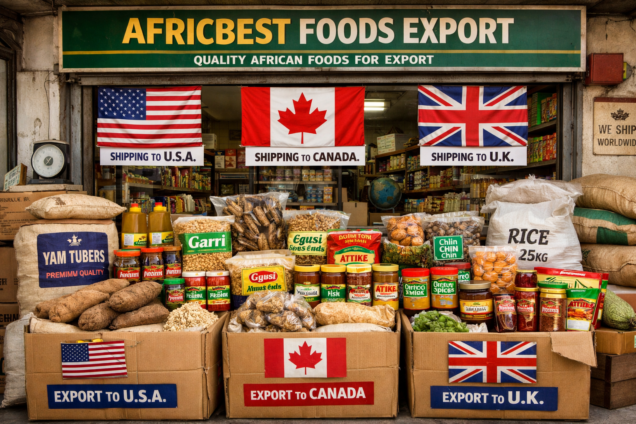

You walk into an African store in Houston, Toronto, London, or New York.
You pick up palm oil, egusi, beans, and garri, the taste of home. The smell of your mother’s kitchen. The memory of childhood.
But here is the question no one wants to ask: Are you eating real food… or something dangerously altered?
Because what happens before that product reaches your hands may shock you.
Across parts of Africa, food adulteration has quietly become an open secret. For economic gain, some sellers mix cheaper substitutes into popular staples to increase volume and profit. Palm oil is sometimes mixed with dyes to deepen its red colour. Ground egusi may be blended with cheaper flours like cassava. Plantain flour can be diluted with lower-cost alternatives. Old stock may be re-dried, reground, and mixed with new batches.
The goal is simple: stretch the product, cut losses, maximise earnings. Now, here is where it becomes concerning for those of us abroad.
Many African stores in the United States, Canada, and the United Kingdom rely on bulk suppliers back home. These consolidators purchase goods from open markets or rural producers, repackage them, and ship them overseas. Once they arrive, some stores remove the original packaging, if any existed and repackage the products under their own brand names.
That is where traceability disappears. In countries like the United States, the Food and Drug Administration (FDA) requires imported food products to be traceable to a registered foreign facility. Proper labelling should include:
- Manufacturer name and address
- Production and expiry dates
- Batch numbers
- Nutritional information
- Airtight, tamper-evident packaging
Similarly, the Food Standards Agency in the UK enforces strict food safety standards. Canada follows comparable regulations through federal inspection systems.
But many rebranded products sold in some African stores do not meet these standards. Instead, what you may find are:
- Loose nylon pouches
- Non-airtight plastic bags
- No manufacturer listed
- No batch numbers
- No expiry dates
- No traceable origin
If a recall becomes necessary, there is no clear chain back to the original source. Accountability vanishes.
The Chemical Risk
Beyond mixing cheaper ingredients, improper chemical use raises deeper health concerns.
In agricultural storage, certain pesticides are legally approved when used correctly, typically applied outside sealed layers of packaging. However, reports and videos circulating online suggest misuse, including applying strong chemicals directly to food storage environments in unsafe ways.https://www.youtube.com/embed/19cnfKkAvHg
Improper pesticide exposure can pose serious health risks, particularly for children, pregnant women, and individuals with chronic illnesses.
For people managing diabetes, adulterated plantain flour mixed with higher-glycemic substitutes can cause unexpected blood sugar spikes. Consumers believe they are eating one thing their bodies may be processing another.
The
Bigger Problem: Store Rebranding
An increasing trend is stores acting as unofficial manufacturers. Bulk items arrive in sacks. They are divided into smaller pouches. A store label is added. The original producer’s identity disappears.
Without original manufacturer information, consumers cannot verify:
- Whether the product was made in a certified facility
- Whether it passed quality inspection
- Whether it can be traced during contamination
- Whether it meets export compliance standards
This is not an attack on African stores. Many operate honestly and responsibly. But the system leaves room for abuse,e and consumers often assume trust where verification is absent.
How
to Protect Yourself
If you buy African staples abroad, consider these precautions:
- Buy whole seeds when possible. Purchase whole egusi instead of pre-ground. Grind it yourself.
- Check for original manufacturer packaging. Avoid store-branded repackaging when the source is unclear.
- Look for proper labelling. Manufacturer address, batch number, expiry date, and nutritional panel.
- Ensure airtight, tamper-evident seals.
- Be cautious with unusually bright colours or altered textures.
- Ask questions. A reputable store should be able to explain sourcing.
Consumers drive change. When people refuse poorly labelled products, stores are forced to improve standards.
This Is About Health — Not Fear
Food connects the diaspora to culture, family, and identity. But nostalgia should not override safety.
The uncomfortable truth is this: if you cannot trace where your food came from, you cannot fully trust what is inside it. And when it comes to what you feed your children, your spouse, or yourself,f uncertainty is not good enough.
Before your next purchase, pause and look closely. Because the question remains:
Can you say with certainty that what
you are eating is exactly what it claims to be?