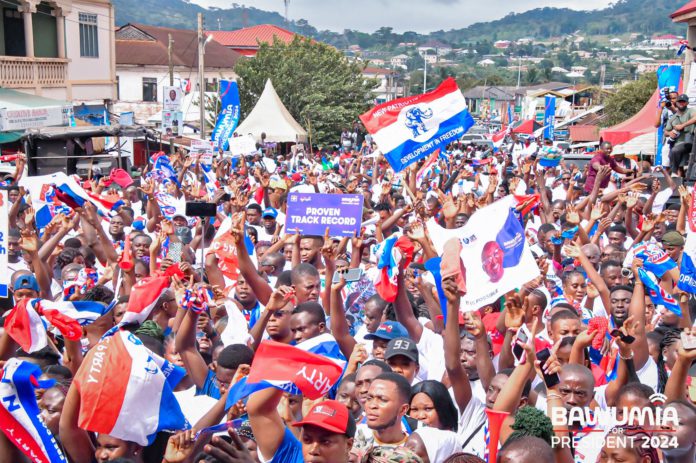

If the New Patriotic Party (NPP) were still in power, the campaign for its October 3, 2026, national executive elections would probably have looked very different.
There would have been giant billboards competing for attention across the major cities. Convoys would have announced the arrival of candidates.
Affluence would have been displayed with little restraint, while campaign investments would have transformed the media landscape into a battlefield of competing messages, endorsements and counter-endorsements.
And, perhaps most predictably, the political temperature within the elephant family would have been considerably hotter.
But the NPP is no longer in government.
And that simple political reality appears to have rewritten the party’s campaign playbook.
With the campaign officially drawing to a close on Friday ahead of Saturday’s national executive elections, the contest has, by comparison, been remarkably restrained.
The insults, accusations, political tantrums and verbal missiles that often accompany high-stakes intra-party contests have been relatively muted.
There have been exceptions.
Supporters of John Boadu and Paul Afoko have exchanged occasional jibes, while supporters associated with Boakye Agyarko have also entered the verbal fray. But these skirmishes have hardly produced the political fireworks that many would have expected from a contest involving the leadership of one of Ghana’s two major political parties.
This is not necessarily because the contenders have suddenly become less ambitious.
It may have more to do with the political environment in which they are campaigning.
Opposition changes the calculus.
The NPP is preparing to elect a new national leadership at a moment when the party’s immediate political task is fundamentally different from what it would have been had it retained power.
The new officers will inherit the responsibility of rebuilding, reorganizing and repositioning the party as an opposition force ahead of future electoral contests.
That reality appears to have shifted the emphasis from extravagant campaigning to organizational credibility, grassroots mobilization, party unity and the ability to work with delegates across the country.
Political scientist Maurice Duverger famously observed that in a competitive party system, opposition has a critical role as a mechanism of criticism and scrutiny. His description of opposition as a force that can provide “precious elements of appreciation” for government captures one important dimension of the political relationship between governing and opposition parties. s
For the NPP, however, opposition is no longer simply a constitutional position.
It has become the environment in which its internal political calculations are being made.
THE BILLBOARDS ARE QUIETER. THE POLITICS IS NOT
The relative absence of extravagant campaign displays should not be mistaken for an absence of intense competition.
Politics rarely disappears.
It simply changes form.
The four-way National Chairmanship contest involving former General Secretary John Boadu, Sammy Crabbe, former National Chairman Paul Afoko and former Energy Minister Boakye Agyarko remains one of the most closely watched contests of the elections. Boadu occupies position one on the ballot, followed by Crabbe, Afoko and Agyarko.
The real contest, therefore, may not be taking place on billboards.
It may be taking place quietly in telephone calls, meetings, regional networks, personal relationships, constituency structures and conversations with delegates.
That is where the election could ultimately be decided.
And that is precisely why predicting the outcome of the chairmanship race is an exercise in political uncertainty.
I will not attempt to predict who will win.
The chairmanship contest is one of those internal party elections that can confound conventional political calculations. Delegate decisions can change in the final hours. Personal loyalties can collide with regional considerations. Long-standing alliances can shift. A candidate’s performance, message or perceived momentum at the venue itself can alter calculations.
Even the most carefully constructed bloc may not remain a bloc when individual delegates enter the voting booth.
WHEN BLOCS MEET INDIVIDUAL CHOICE
I have conducted unstructured telephone interviews with delegates from the sixteen regions.
One observation stands out: delegates do not necessarily see themselves as prisoners of decisions supposedly taken at constituency or regional levels.
They have minds of their own.
This is important.
Political parties may operate through structures, but elections are ultimately conducted through individual acts of political choice.
The assumption that delegates will automatically vote according to a predetermined constituency, regional or factional instruction may therefore underestimate the complexity of internal party elections.
As political scientist Robert Michels argued in his famous analysis of political organizations, parties inevitably develop leadership structures and organizational hierarchies. His “iron law of oligarchy” remains one of the classic propositions in the study of party organization.
But the NPP’s current contest also demonstrates the other side of the equation: organizational structures can influence political behavior without completely eliminating individual agency.
Delegates listen.
They calculate.
They negotiate.
And sometimes, they change their minds.
THE REGIONAL BALANCE QUESTION
Another factor that should not be underestimated is regional balance.
The NPP has historically paid considerable attention to geographical representation in its leadership arrangements. That consideration could again feature in the thinking of delegates as they choose the individuals who will lead the party through its next phase.
This is not necessarily a formal voting formula.
Rather, it is part of the political culture and internal arithmetic of a national party that must maintain connections across Ghana’s diverse regions and constituencies.
The question facing delegates is therefore bigger than who has the loudest campaign machinery.
It is also about who can assemble a leadership team that appears sufficiently representative, inclusive and capable of holding together a party preparing for another national electoral battle.
FROM GOVERNMENTAL POWER TO ORGANISATIONAL POWER
Perhaps the most significant transformation in this year’s contest is the changing meaning of political power.
When a party is in government, access to state power inevitably forms part of the broader political environment within which its internal contests occur.
In opposition, the emphasis changes.
The party must depend much more heavily on its organization, activists, communicators, financiers, grassroots structures and ability to maintain political relevance outside government.
That may explain why this NPP contest has produced less of the conspicuous political theatre associated with previous campaigns.
The party has a different problem to solve.
It is not merely choosing officers.
It is choosing the political managers who will be expected to help rebuild an opposition machine capable of competing nationally.
The NPP says its October 3 elections will produce the national officers who will steer the affairs of the party into its next phase. Current arrangements cover the chairmanship, vice-chairmanship, general secretary ship, organizing, youth, women’s, Nasara, treasury and communications positions.
THE QUIET CAMPAIGN MAY BE THE REAL STORY
There is an irony here.
The quieter the campaign has become, the more consequential the individual delegate may become.
When campaigns are dominated by massive advertising, celebrity endorsements and public political theatre, the ordinary delegate can sometimes disappear beneath the noise.
This time, the noise has been comparatively subdued.
That could make the private conversation more important.
The telephone calls.
The constituency meeting.
The regional relationship.
The personal appeal.
The promise of inclusion.
The question of who can unite competing interests.
The calculation of who can rebuild the party.
And, ultimately, the moment when the delegate stands alone with the ballot paper.
That is where campaign rhetoric ends and political choice begins.
THE ELEPHANT’S NEW POLITICAL REALITY
The NPP’s October 3 national executive elections may therefore be remembered not simply for who wins the various positions, but for how differently the party campaigned while in opposition.
The giant billboards may be fewer.
The political invectives may be quieter.
The display of financial muscle may be less conspicuous.
But beneath the surface, the competition remains intense.
Forty-seven aspirants were vetted for the national executive elections, according to reports, while Dennis Miracles Aboagye is the sole candidate for the National Communications Director position.
That alone tells the story of a party whose internal democracy remains fiercely competitive.
The difference is that opposition appears to have forced the competition into a different register.
Less spectacle.
More organization.
Less public confrontation.
More delegate engagement.
Less display of governmental proximity.
More attention to the grassroots.
Perhaps that is the real meaning of the NPP’s new campaign playbook.
When political power is lost, political parties do not stop campaigning. They simply learn to campaign differently.
And on Saturday, October 3, at the Baba Yara Sports Stadium in Kumasi, more than campaign slogans will be tested.
The NPP’s organizational instincts, regional calculations, delegate loyalties and individual choices will all converge at the ballot box.
The elephant is no longer campaigning from the comfort of government.
It is campaigning from opposition.
And opposition, it appears, has changed the way the elephant campaigns.