
The Noguchi Memorial Institute for Medical Research (NMIMR) has developed what scientists describe as “a ground-breaking research” which can significantly alter HIV care if other tests prove as effective as those conducted in the laboratory.
Developed using two herbal compound extracts from native plants, the therapy is said to have fewer potential side effects and fewer long-term conditions on organs in HIV treatment.
It has a high selectivity index that allows it to target and kill the virus only, leaving all the other cells intact.
This is different from the existing antiretroviral therapies, which target the virus but leave the patient with potential liver and kidney issues that require tests every six months to determine whether those organs have been affected.
“This is going to eliminate the need for that because we have a healthy product.
That’s something I haven’t heard of because instead of using synthesised products, this herbal study or herbal extract of the plant is nature.
The compound exists in the plant, so we do not need to create it,” the lead rapporteur for Track ‘A’ at the 2025 International Conference on AIDS and STIs in Africa (ICASA), Dr Adriel Cyrus Moodley, said.
He disclosed that at the moment, laboratory testing on the compound was complete.
What remained, he added, was to do animal tests and to progress to report on it if similar good results were established along the intervening processes.
Despite being fascinated by the Noguchi Institute research, Dr Moodley was emphatic that antiretroviral therapies (ARTs) currently remained the only way to fight HIV, and were recognised to be cheap too.
He explained that ARTs suppressed viral replication, and although they were good, they came with the burden of taking medications long term.
HIV at this moment remains incurable despite ART advancements.
Synthesised products
“We’re not out here synthesising things with all of the 10,000 side effects that come from making specific molecules.
These are extracts that come naturally.
They are synthesised within the plant itself,” Dr Moodley further explained.
Ghana hosted the 2025 ICASA from December 3 to 8.
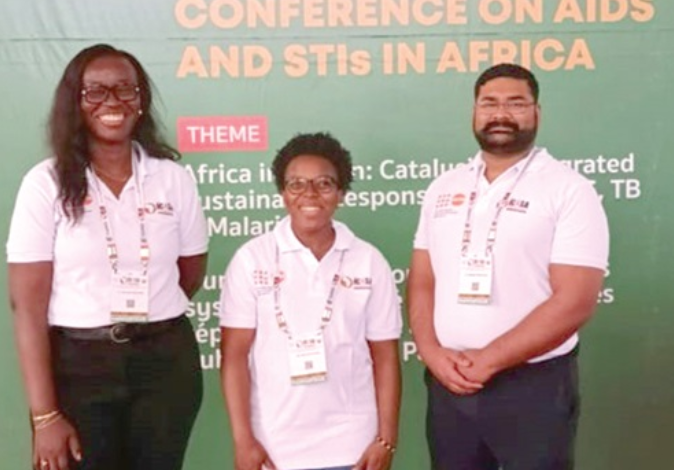
Dr Moodley’s Track ‘A’ team at the 2025 ICASA included Chief Research Assistant, Diana Asema Asare, and Research Fellow, Dr Nana Afia Asante Ntim, both of them from the Noguchi Institute.
Dr Moodley disclosed details of the research in an interview after making a presentation on behalf of the Track ‘A’ group at the conference.
The herbal extracts currently only have code names because the research has not been fully incorporated and published.
Dr Moodley explained that in the case of the synthesised products, scientists sit in a laboratory and decide the kind of drug needed to attack a particular part of the HIV, and consequently make the drug in that specific way.
Unlike the synthetised product, he said, the Noguchi study did not have to create a new product because the compound already existed in the plants.
Strategy
Dr Moodley, who is a general practitioner in his native South Africa, said the Noguchi discovery blocked the HIV and locked it away, unlike the regular antiretrovirals (ARVs), which stopped the virus from replicating.
“That’s awesome! I’ve been treating HIV for 15 years. I’ve never heard of such a thing in my life.
That’s why it’s so exciting,” he said.
Dr Moodley, who described himself as a practitioner raised with a pure science background, stressed the need to return to the herbal method of treatment, but this time to find the active ingredients in herbs and refine them, but not to overdo it so that it turned out to be something else.
Earlier in his presentation, he said it might be, indeed, possible to develop a cure to eradicate AIDS by the 2030 goal.
“It goes without saying that this should be the focus for future research across the multimodal approach for the development of a cure to end AIDS by 2030,” he said.
Other findings done elsewhere in Africa, highlighted in Dr Moodley’s presentation, were the first-ever clinical trial in Africa into HIV; the use of Treg Cells as potential immunotherapy; development in technologies to assist with the detection of TB in HIV co-infection; drug development and co-infections and their immunological effects in people living with HIV.
READ ALSO: