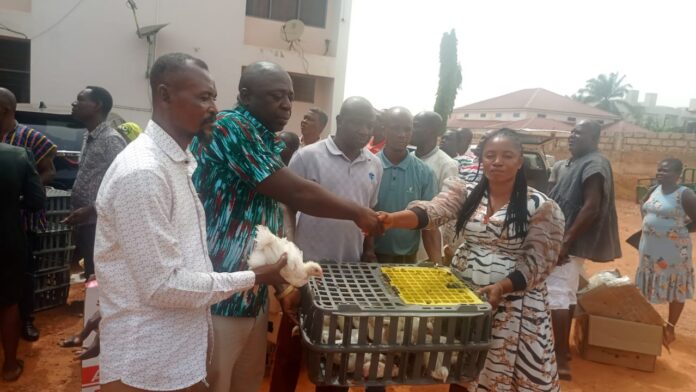

The Kwadaso Municipal Assembly has officially launched the ‘Nkoko Nkitinkiti’ initiative under the government’s Feed Ghana Programme, aimed at boosting poultry production and improving livelihoods in the municipality.
The launch also marked the start of the distribution process for beneficiaries. Prior to receiving the birds, participants attended a three-day capacity-building workshop, gaining hands-on training and essential skills in poultry management to ensure their success in the programme.
Municipal Chief Executive Eric Assibey revealed that the municipality has been allocated 6,000 broiler birds, which will be distributed in phases. The first phase will see 3,000 birds given to 150 residents, with each receiving 20 birds to establish or expand their small-scale poultry businesses.
Mr. Assibey emphasised that the programme is non-partisan, clarifying that beneficiary selection was conducted without political considerations. “This is a government policy meant to benefit all citizens. The selection of beneficiaries was therefore done on a non-partisan basis,” he noted.
He urged participants to fully embrace the initiative and make the project a success, stressing that it would significantly improve the availability and affordability of poultry products in the municipality. “Do not disappoint the government. Make this project a success,” he added.
Mavis Agyeiwaah, the Municipal Agric Director, announced that Agricultural Extension Officers would be deployed across various zones to provide technical support and monitor the progress of the birds.
Dr. Amponsah Asare, a Veterinary Medical Scientist, highlighted the importance of pre-distribution training. He recommended that Metropolitan, Municipal, and District Assemblies (MMDAs) organise workshops to equip recipients with skills in poultry management, disease prevention, and feeding practices to ensure the programme’s sustainability.
Beneficiaries expressed gratitude to the government, specifically praising President John Dramani Mahama for launching the initiative, which they described as a “game-changer” for local farmers and a “step in the right direction” for Ghana’s agriculture sector.
READ ALSO: