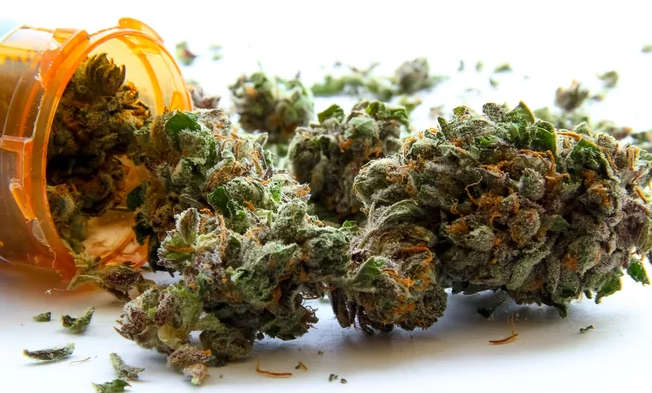

The Narcotics Control Commission (NACOC) and the Council for Scientific and Industrial Research (CSIR) have began a partnership to support the cultivation and development of cannabis with a tetrahydrocannabinol (THC) content of not more than 0.3%.
The partnership will focus on research and the development of medicinal and industrial uses of low-THC cannabis, commonly known as hemp, while ensuring that cultivation remains within Ghana’s legal requirements.
Director-General of NACOC, Major General Maxwell Obuba Mantey, said the Commission would enforce the rules governing the cultivation and use of cannabis within the approved THC limit.
He said Ghana could benefit economically and industrially from the emerging sector if its development was supported by scientific evidence and strong oversight.
Major General Mantey made the remarks during a meeting between NACOC and CSIR to discuss areas of collaboration. He said NACOC would work with CSIR to strengthen testing and traceability along the cannabis value chain, from the selection of planting materials to processing and end use.
Director of the CSIR-Institute of Industrial Research, Dr Francis Boateng Agyenim, said the regulated hemp sector could create opportunities in agriculture, manufacturing and medicine.
He said CSIR’s research had shown potential for hemp cultivation in Ghana and that some varieties could produce high-quality fibre for industrial applications.
According to Dr Agyeinim, hemp fibre could be explored for products such as alternative plastic packaging materials and sanitary products.
The collaboration will include the establishment of model greenhouse farms to demonstrate suitable cultivation methods. NACOC and CSIR will also assess seedlings and conduct soil tests to identify areas best suited for growing low-THC cannabis.
The institutions will further undertake laboratory research into the properties and potential uses of hemp and provide technical support to farmers and other stakeholders entering the sector.
The partnership is expected to provide scientific and technical guidance for Ghana’s regulated cannabis industry while helping to prevent the diversion of legally cultivated cannabis into the illicit market.