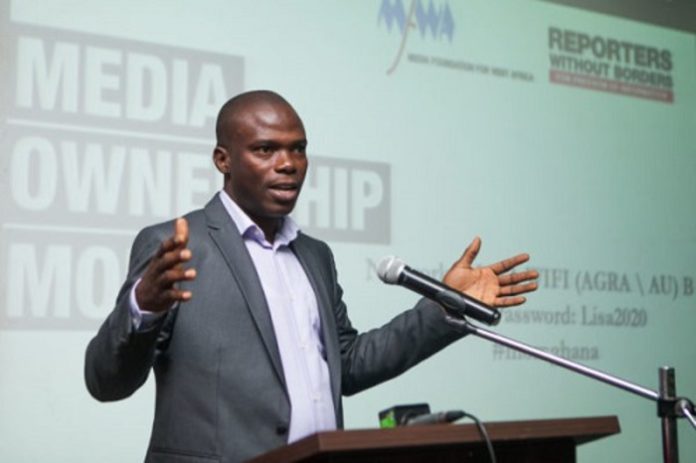

The Media Foundation for West Africa (MFWA) has criticised a High Court ruling that placed a perpetual injunction on freelance investigative journalist Innocent Samuel Appiah, describing the decision as restrictive and troubling for press freedom.
According to MFWA’s Executive Director, Sulemana Brimah, the judgment poses a serious threat to investigative journalism in Ghana and must be challenged.
The injunction, issued by an Accra High Court, bars Appiah from publishing or sharing any allegations concerning a private individual, Cynthia Adjei, who sued the journalist for an alleged breach of her privacy. The ruling effectively prevents him from releasing any investigative findings related to the matter across both traditional and digital media platforms.
The court also awarded GH₵10,000 in costs against the journalist.
Speaking on Joy FM’s Super Morning Show, Mr Brimah described the ruling as “bizarre,” arguing that it sets a dangerous precedent for accountability journalism.
“Investigative journalists will have to stop their work or become employees of the Office of the Special Prosecutor (OSP), EOCO and other state institutions. I think this is a very bizarre ruling, and it stifles journalism,” he said.
He further noted that the injunction is even more restrictive than the content authorisation regime once proposed by the National Media Commission, which the Supreme Court struck down as unconstitutional.
According to him, the High Court’s position effectively prevents journalists from publishing information that may be in the public interest unless it is first submitted to law enforcement agencies.
“The Supreme Court has held that in cases of censorship, journalists have the right to publish. But here, the journalist is being stopped. This ruling essentially says that if you have any information, you must submit it to the authorities,” Mr Brimah explained.
He indicated that the MFWA will support any efforts to challenge the ruling at higher courts, insisting that such a decision is unsustainable in a democratic society.
The case has reignited broader concerns about press freedom in Ghana, particularly the protection of investigative journalists and the delicate balance between privacy rights and public interest reporting.
ALSO READ: