
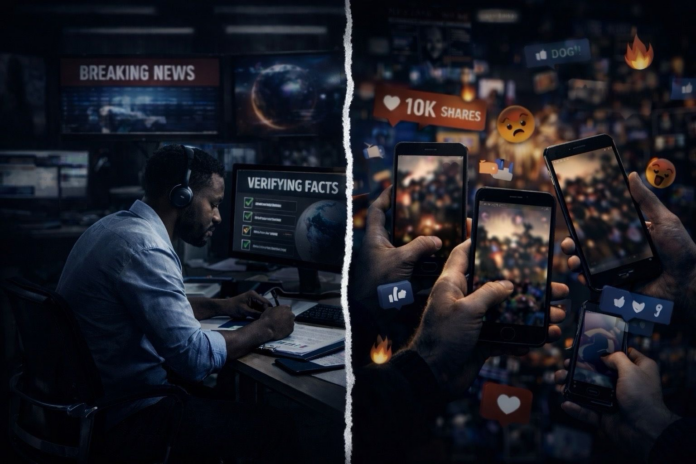

In today’s digital media environment, journalism is no longer defined by accuracy alone; it is competing for attention, where being right is no longer enough.
A verified story can take hours, even days, to report, check, and publish. But it takes only seconds for a misleading version of that same story to capture attention and shape public perception.
That gap between accuracy and visibility is where journalism is now being tested, and increasingly, where it risks losing ground across newsrooms and societies worldwide.
Not long ago, the process was simple: verify the facts, publish the story, and the audience would follow. That reality has changed.
A carefully researched report can now go largely unnoticed, while a short, emotional, or loosely framed version spreads rapidly and reaches far more people. I have seen this happen more than once.
During a recent breaking news situation, I saw multiple versions of the same story circulating within minutes. Some were incomplete, and others were clearly misleading.
In recent years, AI-generated political deepfakes and manipulated election content have shown how quickly false narratives can gain traction before verified journalism even enters the conversation. By the time accurate reporting emerged, many people had already formed firm opinions based on what they saw first, not what was later confirmed.
This raises a difficult question: Is journalism losing ground in the very space it helped build?
This is where the idea of “journalism out loud”, a theme of shaping conversations at the DW Global Media Forum 2026, becomes more than just a concept. It reflects a growing recognition that journalism must adapt not only in what it reports, but also in how it reaches and engages its audience.
The challenge is no longer just misinformation; it is also about visibility.
We are now operating in an environment where attention is constantly shifting. Audiences consume information quickly, often in fragments, and move on just as fast. In that crowded space, journalism competes with everything: entertainment, opinion, viral content, and sometimes pure speculation.
The challenge is no longer just to inform. It is to be seen, to be heard, and to remain relevant.
Based on my experience and analysis, audiences are not necessarily rejecting journalism. In many cases, they simply do not encounter it early enough. By the time verified information reaches them, their understanding of the story has already been shaped elsewhere.
That is the real shift, and it is one being discussed globally among journalists, editors, and media leaders.
The question is no longer only “Did we get it right?”
It is also, “Did it reach the people who needed to see it?”
This does not mean journalism should sacrifice accuracy for attention. But it does require rethinking how stories are presented and shared. Timing, clarity, and format now matter as much as the facts themselves.
At the same time, journalism cannot afford to lose its depth. Once accuracy is compromised, trust begins to erode, and rebuilding it is far more difficult.
The goal is not to be louder, but to be clearer, more present, and more intentional.
Because in a world where attention shapes belief, truth cannot afford to whisper.
Christian Ahiati is a journalist focused on global media trends, digital communication, and the evolving impact of technology on press freedom. His work explores how information is shaped, distributed, and understood in an increasingly complex media environment.
