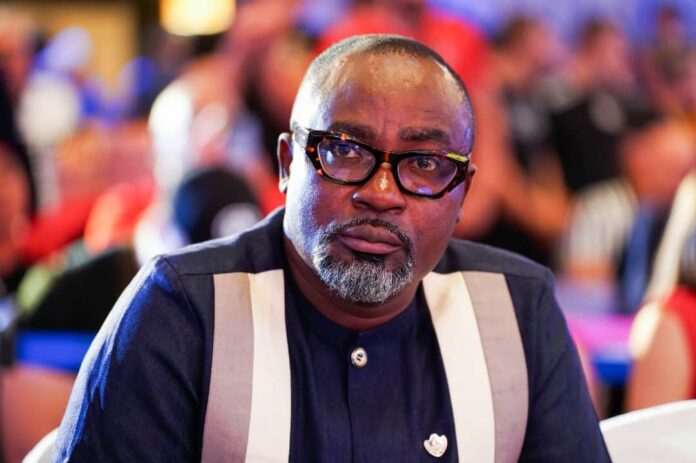

Secretary General of the Sports Writers Association of Ghana (SWAG), Mr Charles Osei Asibey, has challenged sports journalists at the AIPS Africa Congress in Banjul, Gambia, that their mission for the African Sports is to work on revealing the rot within the system while simultaneously protecting the foundation of the house they are trying to clean.
It was a reflective mood as Congress discussed investigative journalism and its impact on sports. The SWAG Secretary, Mr Osei Asibey, after resource persons had delivered their statements, made a contribution that would resonate far beyond the hall. He did not lead with the usual celebrations of athletic achievement; instead, he drove straight to the heart of a professional crisis, declaring that investigative journalism must be impactful, not destructive.
To Osei Asibey, the modern sports journalist holds a power that can either serve as a catalyst for growth or a fuel for institutional collapse, and he challenged his peers to recognise the difference before embarking on any investigative venture.
The experienced SWAG SG argued that while investigative journalism remains vital in exposing the truth, it must be wielded with the precision of a surgeon rather than the recklessness of a wrecking ball. He emphasised that the true measure of a journalist’s work is not the wreckage left behind, but the positive reforms inspired. To him, the mission for the African Sports journalist is to strive to reveal the rot within the system while simultaneously protecting the foundation of the house they are trying to clean.
To illustrate the cost, he recalled the painful lesson of the CAN 2008 ‘Abon Wo Ha’ scandal in Ghana. While the investigation highlighted the rot and the need for accountability, the resulting fallout led to the successive governments backing out of hosting future and major tournaments. This cost Ghana a global disgrace and lost major opportunities to showcase its capabilities by hosting other international events, as hosting those events would have enhanced critical infrastructure projects. This stalled sports development for years. It was a stark example of how, without a focus on being impactful rather than just sensational, the collateral damage can haunt a nation’s progress.
The discourse then moved to the more recent Kwasi Nyantakyi saga, which famously brought Ghana football to a standstill. Mr. Osei Asibey noted that while the investigation successfully exposed corruption, it also acted as a double-edged sword. Sponsorships dried up, local leagues were paralysed, and the national team struggled to recover from the sudden vacuum. He urged journalists to be mindful of this power, ensuring their reporting aims to reform institutions rather than simply annihilating them and leaving a void in their wake.
Expanding his scope, Mr Osei Asibey cited Nigeria’s experience, noting that the country has not hosted a major international games or tournament since the Abuja 2003 African Games. He attributed this largely to a cycle of controversies and corruption allegations that, while often based in truth, were handled in a way that hindered overall development. These regional examples served as a sobering warning that if investigative journalism focuses solely on the “gotcha” moment without considering the long-term health of the sport, it risks creating a state of permanent stagnation.
In sharp contrast, the sports administrator pointed to Morocco as a model of how the media and government can collaborate effectively. By fostering a constructive environment, Morocco has successfully hosted major tournaments like the Africa Cup of Nations, World Cup qualifiers and more. This synergy, he argued, proves that transparency and national interest can coexist, providing a blueprint for how impactful journalism can actually support a country’s global standing.
He looked out at the young journalists in the room, emphasising that the goal should always be to uplift our communities and sports. A purely destructive approach creates a culture of fear where doors are bolted shut, and sources vanish out of self-preservation. True impact requires building long-term credibility. If the media becomes synonymous with tactics that ignore the broader national interest, the very fans and athletes the press seeks to protect will eventually turn away in distrust.
As he neared his conclusion, Mr Osei Asibey called on editors and media houses to prioritise transparency, accountability, and good governance over the short-term high of social media engagement. He urged Congress to reject the “burn it all down” mentality, reminding his peers that they are the custodians of sports history. The value of a story, he insisted, is measured by the positive change it sparks, not by how many institutions it topples.
Charles Osei Asibey called on African journalists to reflect on a renewed sense of responsibility. He concluded that investigative journalism is the lifeblood of accountability, but it must be practised with a sense of duty to the future of sports. “The sports media must remain a flame that provides light for the path forward, rather than a wildfire that consumes the very ground upon which the sport stands.