
Efforts are ongoing to expand further scholarship opportunities for Ghana and other African nationals seeking to train in India.
That’s according to India’s Council for Cultural Relations (ICCR), which presently grants over 4,000 scholarships annually across various schemes for students from around 130 countries. More than a quarter of the total, representing 1,100 slots annually, are dedicated to students from 54 African countries under the India-Africa Scholarship Scheme.
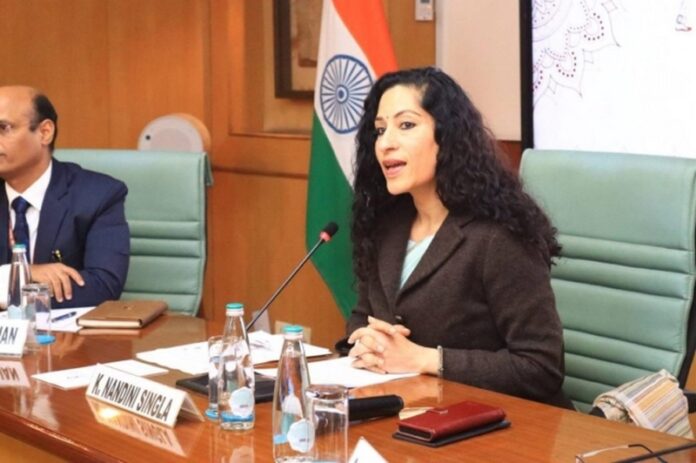
In her briefing to a delegation of 27 distinguished journalists, mainly from West and Central Africa and Oceania as part of their familiarization programme in India, hosted by the XP Division of the Ministry of External Affairs (MEA), Director General of ICCR Nandini K. Singla noted that fostering people-to-people ties through education remains core to India’s values and foreign policy position.
With India’s recent geopolitical rise as the world’s fourth-largest economy, Nandini Singla added that it was time for “brotherly civilisations” – Africa, whose partnership with India has evolved through shared historical experiences and a common development journey to further deepen collaboration to tap into the advancement of India for shared prosperity.
“We are not expecting anything in return..If one part of the world prospers while another remains poor, it eventually affects us all” the diplomat said.
She also explained that currently, amongst the top 10 countries availing the highest number of ICCR scholarships, five are from Africa with a total of 3,020 students from 45 African countries actively pursuing their studies in India under ICCR scholarships, including 727 at Andhra University and 188 at Delhi University alone.
“This is funded by the average Indian citizen,” Nandini Singla stated while adding that “India does not receive overseas development assistance. We stopped taking foreign aid many years ago. What we do in Africa and other developing regions is financed domestically.”
India’s Council for Cultural Relations ICCR has had a longstanding belief that Culture and education are powerful bridges. From its establishment until 1958, the ICCR was under the administrative jurisdiction of India’s Education Ministry.
In April 1970, the country’s Ministry of External Affairs assumed administrative and operational control of the Council in 1970-71 with a view to making the Council an effective instrument of India’s foreign policy.
With 37,000 Africans having received training and education in India over the years under scholarship and capacity-building programmes, this latest bid to support more Africa could lessen the cost burden for many of the countries across the continent which are facing a youth bulge.