
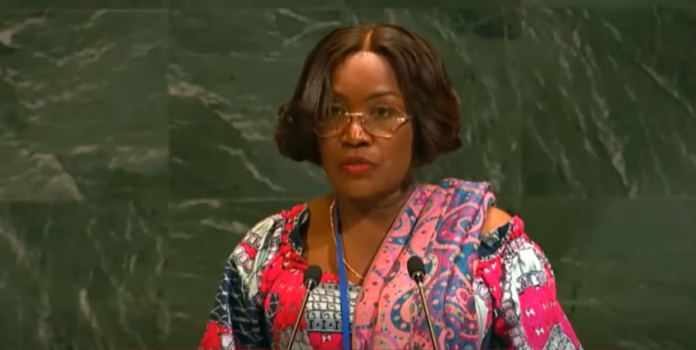

The Director-General of Prisons, Patience Baffoe-Bonnie, has called for a shift in focus within prison systems, stressing that punishment alone is insufficient without meaningful rehabilitation.
She made the remarks during a high-level debate at the United Nations General Assembly (UNGA), held under the theme “A second chance: addressing the global prison challenge” to mark the 10th anniversary of the Nelson Mandela Rules.
“Ghana reaffirms its conviction that imprisonment should be rehabilitative, not punitive. Every individual deserves a chance to rebuild their life through dignity and purpose,” she stated.
Mrs Baffoe-Bonnie highlighted ongoing reforms within the Ghana Prisons Service, noting a transition from a system centred on confinement to one focused on rehabilitation and reintegration.
“Ghana’s Prison Service is undergoing a transformative shift from a model focused on containment to one rooted in correction, care, and a second chance,” she said.
She explained that Ghana is aligning its correctional framework with international standards, including the Nelson Mandela Rules, the Bangkok Rules, and the Tokyo Rules, all of which emphasise humane and rights-based treatment of inmates.
“Ghana views this commemoration not as a ceremonial milestone, but as a timely opportunity to reflect on how we move from commitment to implementation,” she added.
Outlining measures already taken, she noted progress in separating inmates by gender and age, though infrastructural limitations persist.
“We have made progress in separating men from women and juveniles from adults. Nonetheless, limited infrastructure constrains our ability to implement full classification,” she explained.
To address congestion, she disclosed that “three new camp prisons have been established” to ease overcrowding and improve inmate classification.
On food production and skills training, she pointed to the role of prison farms. “Our prison farms currently produce over 40% of daily rations,” she said, adding that with further support, they could double as training centres for inmates.
She also cited improvements in healthcare delivery, including the establishment of a prison health directorate and upgrades to infirmaries. Some facilities, she noted, are now covered under the National Health Insurance Scheme, helping to “reduce out-of-pocket costs for inmates” while ensuring access to healthcare, including mental health services.
Education and vocational training have also been expanded, with inmates being given opportunities to sit for national examinations and pursue higher education through distance learning. “Over 700 inmates have participated in national exams,” she revealed. Skills training in areas such as carpentry, tailoring, welding, and aquaculture is also being promoted to support reintegration.
Mrs Baffoe-Bonnie further emphasised staff development, indicating that officers are receiving training in human rights, conflict resolution, and correctional ethics.
She added that Ghana is collaborating with the United Nations Office on Drugs and Crime to strengthen inmate classification and case management systems.
Despite these strides, she acknowledged persistent challenges. “Challenges remain, including budget shortfalls, overcrowding, and infrastructure deficits, but they do not deter us,” she said.
She noted that plans are underway to refurbish aging prison facilities, construct new ones, and establish an industrial hub within the prison system to equip inmates with practical skills.
On the broader goal, she remarked, “International standards are not ends in themselves, but mirrors reflecting what we aspire to become.”
“Every prison reformed, every life redirected stands as proof of what can be achieved when we move from theory to practice with courage and conviction,” she added.
