
Ghana Water Company Limited has been ordered to pay $235 million to the Spanish owners of the Teshie-Nungua desalination plant, a facility built to end chronic shortages in the enclave and shut since October 2025. The Republic of Ghana is liable for the money under a sovereign guarantee Parliament approved in 2012.
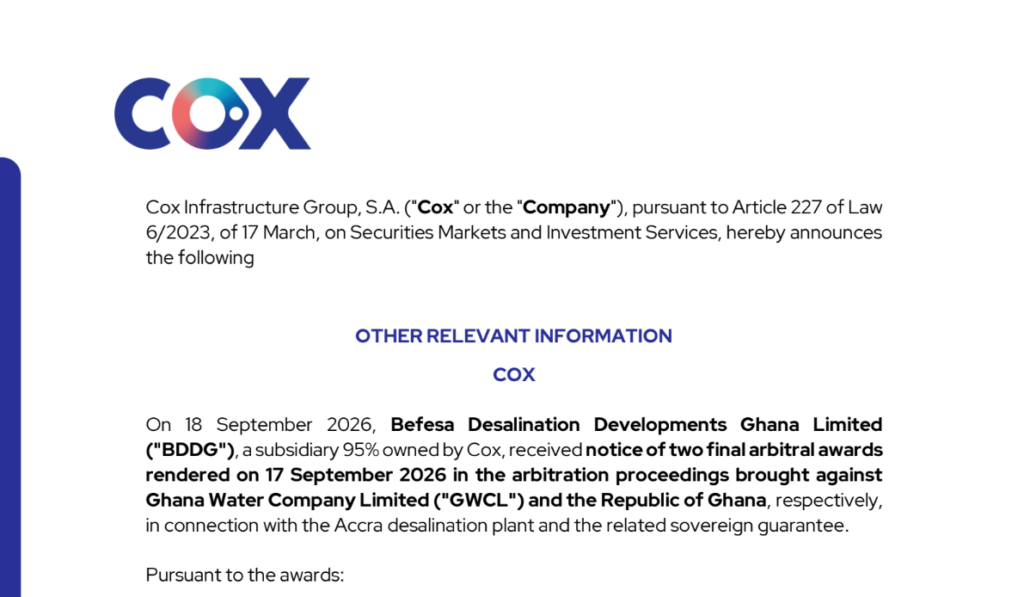
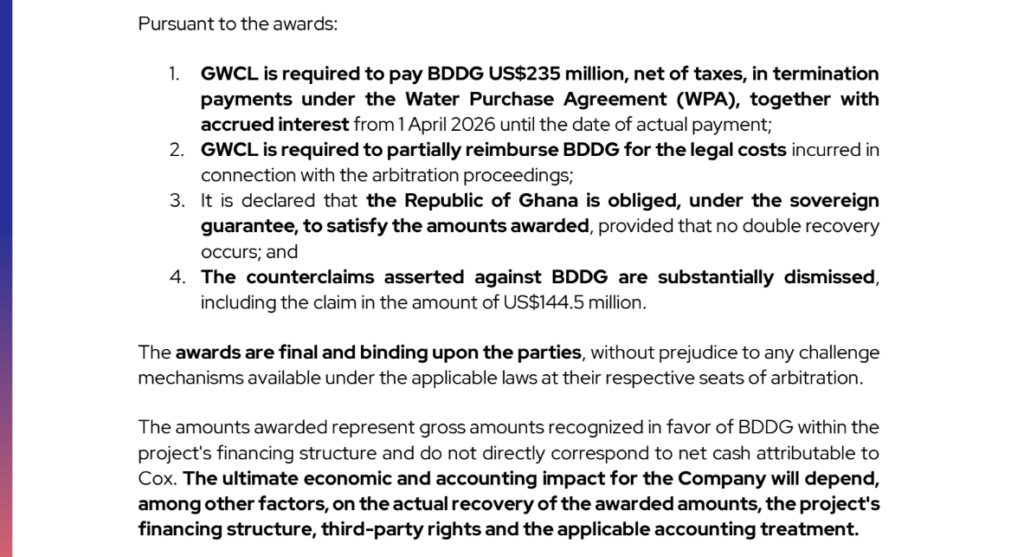
Two final arbitral awards were rendered on 17 September against Ghana Water and the Republic. Cox Infrastructure Group, which owns 95 percent of the plant’s project company, disclosed them to the Spanish securities market on 21 September. The $235 million, net of taxes, covers termination payments under the Water Purchase Agreement, with interest accruing from 1 April 2026 until the money is actually paid. The utility must also partially reimburse the company’s legal costs, and its own counterclaims, including one for $144.5 million, were substantially dismissed.

The award is nearly twice what the plant cost to build. The government’s 2024 report on public private partnerships puts the project at $125 million.
It also arrives six months after the government said the matter was all but settled. Ghana Water says they are yet to take a decision on this judgment.
In March, Works and Housing Minister then Kenneth Gilbert Adjei told journalists during a tour of the Weija treatment plant that a deal was close.
“I know one headache that we are having as a country is the Teshie desalination plant,” he said. “His Excellency the President has directed myself, the Finance Minister and the Attorney General to ensure that we get it resolved. Consultations are ongoing. The owners of the plant were in town. We met them. We are still negotiating. Very soon we will conclude it and the plant will start working.”
Interest on the award began running about three weeks before he spoke. The guarantee that now binds the Republic was not an accident of drafting. Parliament approved it.
The taps went off first
Ghana Water shut the plant in October 2025 over unresolved contractual obligations and what it called a culture of missing maintenance. Teshie, Nungua, Baatsona, Spintex, Sakumono and parts of La have been dry or rationed ever since. By 8 January, with residents agitating, the utility published a rationing schedule. The schedule did not produce water.
By the end of July, the plant had been silent for more than eight months and the cost had shifted onto households. Naa Adjeley, a trader and mother of three, told the media she had not seen a drop in her house for nearly a month and was spending more than GH¢300 every week on tankers. “My small business is barely surviving because almost all my profit goes into buying water,” she said.
By August it had gone further than money. Residents at Teshie Telephone Pole told JoyNews the taps open roughly once a week, at pressure too weak to fill a storage tank. “There’s no money to keep buying it,” one said. “Water is life.” Another described bathing in seawater with detergent, because ordinary soap will not lather in it.
Assemblies have resorted to drilling mechanised boreholes at schools and health facilities. National Security has trucked water to Tsuibleoo. Eleven months in, the emergency measures have become the water system.
How Ghana signed it
Teshie and Nungua had been short of water for 25 years. An earlier contract with Aqualyng Ghana Limited was abrogated by Ghana Water for non-performance. Then, on 29 April 2010, the utility received an unsolicited proposal from Befesa Ghana Limited for a 60,000 cubic metre per day desalination plant. Ghana Water’s board approved the signing on 25 August 2010. The Ministry of Finance issued a Letter of Comfort on 3 October 2011. The parties amended the deal and signed an addendum on 20 February 2012.
It reached Parliament on 13 March 2012 and came back two days later, in a joint report of the Finance and Works and Housing Committees signed by Hon. James Klutse Avedzi and Hon. Simon Edem Asimah. The committee recommended approval of a $110 million Water Purchase Agreement, a Government of Ghana guarantee whose stated purpose was to assure Befesa of payment for water delivered, and a waiver of taxes and duties totalling $72,827,330.
The waiver breaks down as $30,327,330 in duties on imported and locally purchased equipment across the full 25 years, plus $42.5 million in VAT and NHIL, corporate tax and withholding tax over the first ten years of operation. The Ghana Revenue Authority put those figures in writing on 21 February 2012. Befesa would finance the plant alone, operate it for 25 years, and then transfer it to the state.
The headline cost has drifted over the years. Parliament approved a $110 million agreement in 2012. The 2024 PPP report puts the project at $125 million. Much of this week’s reporting uses $126 million.
Two warnings are already in that 2012 report. The first is on price. Befesa had asked the Public Utilities Regulatory Commission to approve a bulk tariff of $1.716 per cubic metre. The PURC found it uncompetitive and told the company to review it, settling on an indicative $1.37, subject to verification of actual cost. The regulator’s objection was about what the state would have to pay for the water, which is the same argument that eventually ended in arbitration.
The second is on who was actually on the hook. Some members of the committee noted that the parent company, Abengoa Water S.L.U of Spain, was not a party to the agreement, and that Befesa Ghana Limited was a new company with no tax history and no record of having executed a project of this kind. They were told that Befesa Ghana was owned by Abengoa of Spain with 51 percent, Sojitz Corporation of Japan with 44 percent and Hydrocol Ghana Limited with 5 percent, and that the partners’ expertise would be brought to bear. Abengoa’s assets were later taken over by Cox in 2023. The counterparty changed hands. Ghana’s guarantee did not.
What it has cost so far
The government’s own 2024 Annual Report on Public Private Partnership Projects, published by the Ministry of Finance, shows how the arrangement was working before it broke.
Of the $72.83 million tax exemption, $31.55 million had been used by the end of 2024, leaving $41.28 million still available.
In 2024, Befesa invoiced $16.93 million: capacity charges of $14.94 million, variable water charges of $1.54 million and delay charges of $457,650. The plant delivered 43,009 cubic metres a day against a contracted 60,000, a supply efficiency of about 72 percent. The capacity charge did not fall with the shortfall. That is the shape of the deal. Ghana paid for capacity, not for water.
Who paid is the more striking number. Of the $16.92 million settled that year, Ghana Water itself paid $800,000. The Ministry of Finance paid $16.12 million. The utility covered under five percent of its own water bill. The taxpayer covered the rest.
And it had been happening for years. Government support to Ghana Water on this single project runs $13.92 million in 2020, $9.54 million in 2021, $8.22 million in 2022, $9.58 million in 2023 and $16.12 million in 2024. Total to date: $57.38 million. Even after all of it, $9.77 million was still outstanding to Befesa at the end of December 2024.
What brought the arbitration
The 2024 PPP report does not hide the direction of travel. It records that the project faced financial difficulties due to Government and Ghana Water’s inability to meet payment obligations on time, constrained by fiscal challenges. It notes frequent power outages, an electricity bill of $6.98 million in 2024 alone, and a May 2024 episode in which Befesa reported the plant inoperable after heavy rains, with a survey afterwards identifying structural defects and inadequate bracing. Ghana Water attributed those to poor maintenance and neglect.
The report’s own recommendation, written before the shutdown, was to expedite renegotiation of the Water Purchase Agreement and for the Government to acquire equity in the plant. That renegotiation never landed. In October 2025 Ghana Water shut the plant instead. The Water Purchase Agreement was terminated, and it is the termination that the $235 million is for.
Which changes what the minister’s promise would now require. Restarting Teshie-Nungua is no longer a matter of concluding a negotiation. It would take a new commercial arrangement or a settlement of the awards, and then the physical work of restarting a plant that has stood idle for close to a year, in a state the operator’s own survey called structurally defective.
Where it stands
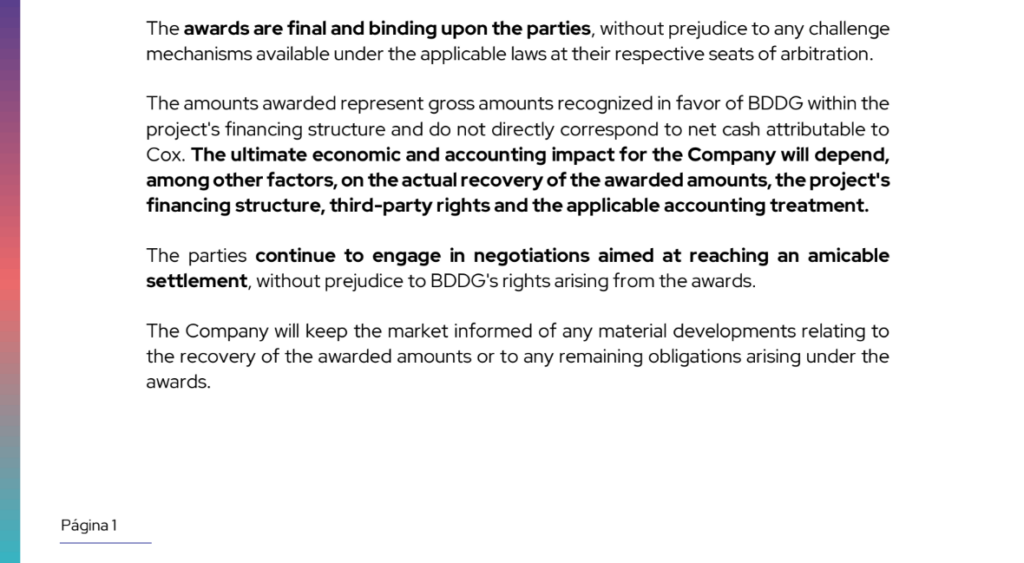
Cox’s notice to the market ends on a line worth reading twice. “The parties continue to engage in negotiations aimed at reaching an amicable settlement, without prejudice to BDDG’s rights arising from the awards.”
The negotiations the minister described in March are still running. What has changed is that one side now holds two final awards and a sovereign guarantee, and the other is the Republic of Ghana.