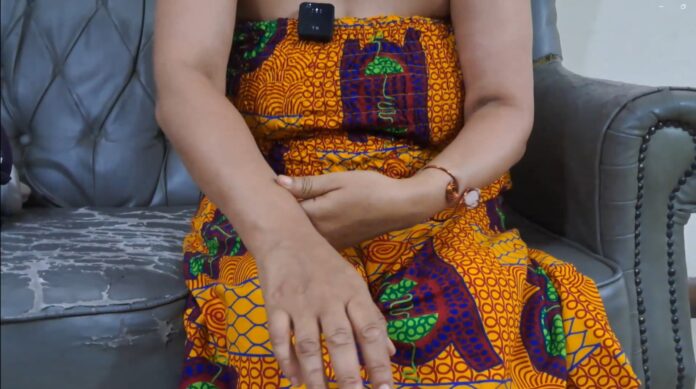

“I’ve managed to find a voice, and it was not easy. I had to suffer,” Ms. Kesse-Amponsah opened up.
In a harrowing account of survival and a demand for systemic change, 54-year-old Afua Kesse-Amponsah has revealed decades of “systematic abuse” she endured at the hands of her father.
The man, who later became a prominent church pastor, was allegedly motivated by the desire to secure a passport and social benefits and took custody of her despite a known dislike for children.
She claims to have been subjected to ‘constant, severe, chronic violence’ as her father systematically broke the bones on the left side of her body in a forced attempt to make her right-handed.
Born in 1971 to an Irish mother and a Ghanaian father, Afua Kesse-Amponsah’s life took a dark turn at age two.
“So he started to beat me because he was trying to get me to change from left-handed to right-handed. Akan people don’t like using their left hand. Am I lying? It’s all built into you from childhood. And so for him, it was a crime. One that he was determined to fix. It was a fault. And he broke my left hand first to try and persuade me to use it.”
After suffering multiple abuses by her father, she was later diagnosed with multiple skull fractures and a fractured jaw, six cracks along her spine, and a shattered pelvis.
“He subjected me to constant, severe, chronic violence, and I had no idea of how bad it was because he fractured my skull. So I lost my memory. I had amnesia as a result. I have multiple fractures to the skull all over here, the split around my head, a broken nose, broken cheekbones, a broken jaw, six cracks along my spine, a fracture at the back by my tailbone and pelvis, and a fracture in the front. My leg came out, the thigh bone broke, the two bones here broke, and the ankle fractured. The thigh bone broke here, came out of its socket, and both bones here broke, and my sternum broke,” she recalled.
She told JoyNews that she suffered internal bleeding and ulcers caused by being forced to ingest powdered aspirin on an empty stomach to hide the swelling of her broken limbs.
“So he would feed me aspirin, which was in a powdered form in water, at night after he’d beaten me. And that would take down the inflammation, and no one would see that the bone was broken. So it burns the inside of my stomach because he was feeding it to me without me eating. I have ulcers throughout my body. Sores inside me. I’ve been bleeding internally since I was five,” she said.
The trauma resulted in a fractured skull and amnesia, which she says was enough to mute her, only for her to be diagnosed with complex post-traumatic stress disorder, a severe mental health condition arising from repeated interpersonal abuse.
“I started being treated at St. Thomas for complex post-traumatic stress disorder. And it is a lifelong condition. I suffer from flashbacks. I live in the 70s. I have no life of my own.”
According to Ms. Kesse-Amponsah, though the UK police have noted her historical allegations following a complaint from her, they are unable to prosecute, as her father is deceased.
“I did report it to the police as a historical allegation of child abuse. They told me that they couldn’t do anything because he was dead, but it is on record. And they advised me to go after the institutions that failed in their duty of care, namely school, the schools that I went to, the council that was supposed to be looking after me, and the government, basically.”
At 54, she was forced to live with severe disabilities. But despite this challenge, she is using her voice to challenge cultural norms regarding discipline, especially among Ghanaians.
“You get kids, and you’re abusing them. You’re raising your hand to them. Who are you? Look at your own life. Don’t do that spare-the-rod stuff, because we’re in 2026. Child abuse exists. That book was written 15 to 20 years ago. It does not apply to today.”
“A human being is a human being, and it has rights. No matter whether it’s a baby or an adult, we need to start treating our children with a bit more respect and a bit more restraint. Yes, you can discipline your child, but you can do that without beating them. You’re treating them as you would treat dogs, and the way you treat dogs is not acceptable either. You’re too violent against things that are smaller than you that can’t fight back,” she added.
Ms. Kesse-Amponsah is now focusing her efforts on holding the schools and public institutions accountable for their “failure in duty of care,” as a significant portion of her testimony highlights the failure of the “safety nets.”