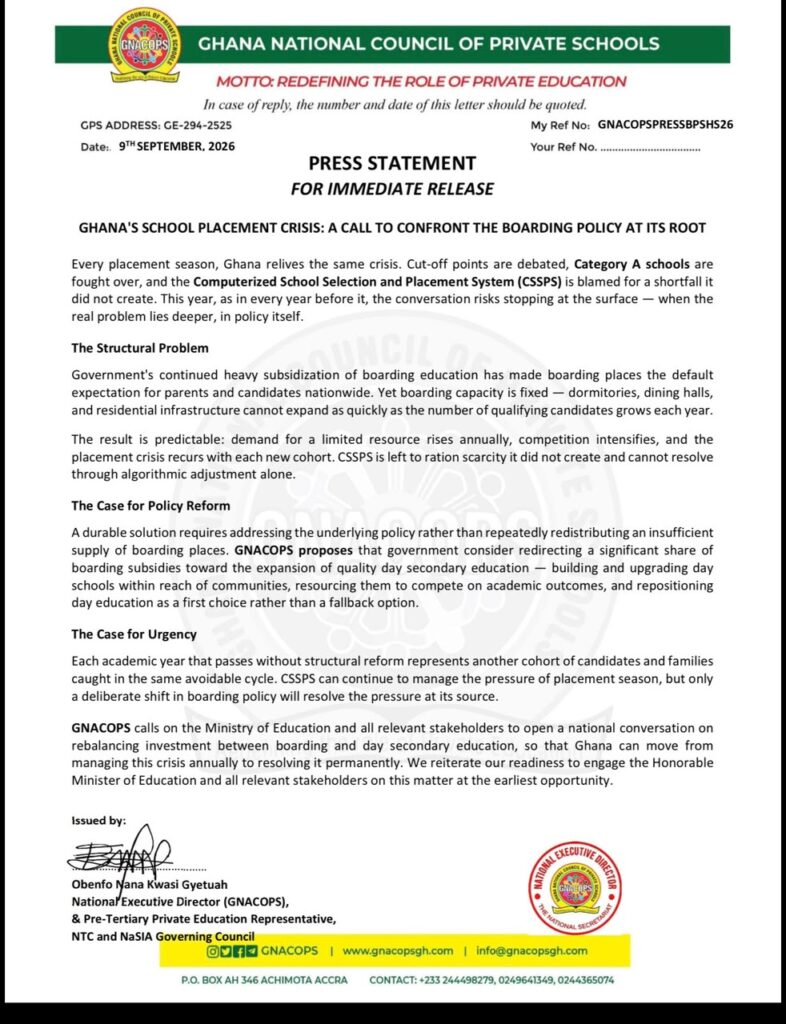

The Ghana National Council of Private Schools (GNACOPS) has called for a review of the country’s approach to boarding education, arguing that the policy is contributing to the recurring crisis during the Senior High School (SHS) placement season.
According to GNACOPS, the annual debate over cut-off points, Category A schools and challenges with the Computerised School Selection and Placement System (CSSPS) often focuses on the symptoms rather than the structural issue driving the problem.
In a statement, GNACOPS said the continued heavy subsidisation of boarding education has made boarding places the preferred option for many parents and candidates across the country.
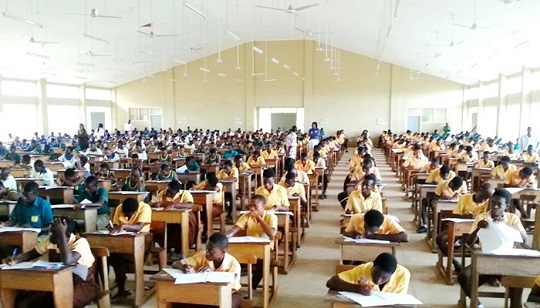
It noted that while the number of qualified candidates continues to increase, boarding infrastructure—including dormitories, dining halls and other residential facilities—cannot expand at the same pace.
This, it said, creates a situation where demand for boarding places consistently exceeds available capacity.
“The result is predictable: demand for a limited resource rises annually, competition intensifies, and the placement crisis recurs with each new cohort.”
GNACOPS argued that the CSSPS is consequently left to allocate scarce boarding spaces, despite having no control over the underlying capacity constraints.
The Council is proposing a shift in government’s investment priorities, with a significant portion of resources currently supporting boarding education redirected towards expanding and improving quality day secondary education.
Under the proposal, government would build and upgrade day schools in communities and equip them with the facilities and resources required to deliver competitive academic outcomes.
GNACOPS believes this would help change the perception of day schools as merely an alternative for students who fail to secure boarding places.
The Council wants day education to become a first-choice option for families rather than a fallback arrangement following unsuccessful placement into boarding schools.
GNACOPS maintained that adjustments to the CSSPS alone cannot permanently resolve the placement challenge because the system is essentially managing a shortage of available spaces.
It said the recurring nature of the problem demonstrates the need for policymakers to examine the structure of secondary education and how public resources are allocated between boarding and day institutions.
According to the Council, continuing with the current approach means successive cohorts of students and their families will face similar challenges every placement season.
GNACOPS is therefore urging the Ministry of Education and other stakeholders to begin a national conversation on rebalancing investment between boarding and day secondary education.
The Council said such a discussion should focus on expanding access to quality secondary education closer to where students live while ensuring that day schools receive the infrastructure, teaching resources and support necessary to compete academically.
“Each academic year that passes without structural reform represents another cohort of candidates and families caught in the same avoidable cycle.”
The Council stressed that its proposal is aimed at finding a long-term solution rather than simply managing the placement difficulties that emerge each year.
It said government must move beyond addressing the immediate pressures of placement season and confront what it considers to be the policy choices contributing to the persistent imbalance between demand.