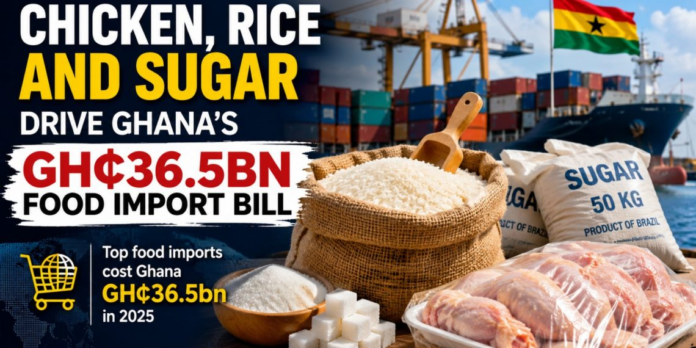

Ghana spent more than GH¢36.5 billion on food imports in 2025, with cereal grains, frozen chicken and animal products accounting for a significant portion of the country’s food import expenditure.
The latest Annual International Merchandise Trade Statistics Report by the Ghana Statistical Service (GSS) indicates that the total value of food imports stood at GH¢36.46 billion, reflecting Ghana’s continued reliance on external markets to meet demand for key food commodities.
Processed cereal grains emerged as the country’s largest food import category, valued at GH¢2.94 billion and representing 8.1 percent of total food imports.
Frozen chicken followed closely with imports worth GH¢2.84 billion, while animal guts, bladders and stomachs ranked third at GH¢2.72 billion.
Rice also remained a major component of Ghana’s food import bill, appearing twice among the top imported food products. Semi-milled or wholly milled rice was valued at GH¢2.39 billion, while broken rice accounted for GH¢1.19 billion.
Other notable food imports included sugar, frozen fish, palm oil, mangoes and shea nuts.
The report shows that the four leading food import categories — processed cereal grains, frozen chicken, animal products and rice — collectively accounted for about 30 percent of Ghana’s total food import bill.
The figures highlight the country’s continued dependence on imported food products despite ongoing efforts to boost domestic agricultural production and promote import substitution.
Meanwhile, Ghana’s food exports continue to show growth potential, with value-added agricultural products such as processed cocoa products, cashew nuts, tuna and shea-based products contributing significantly to the country’s export earnings.
The data reflects both the opportunities and challenges within Ghana’s agricultural sector, as the country continues to benefit from exports of commodities such as cocoa and cashew while relying heavily on foreign supplies for some essential food items.
The Ghana Statistical Service noted that increasing domestic production, expanding agro-processing and promoting value addition will be key to reducing food import dependence and strengthening the resilience of the agricultural economy.
READ:
Ghana’s cocoa production is expected to fall 16% next season