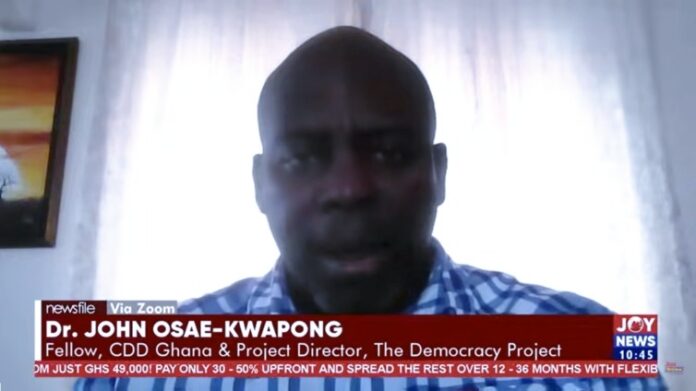

Democracy and development fellow at the Centre for Democratic Development, Ghana (CDD-Ghana), Professor John Osae‑Kwapong, says that Ghana’s democratic journey remains unfinished and must not be taken for granted, despite the country’s record of relatively peaceful elections and transfers of power.
Speaking on AM Show on Joy News, Prof Osae-Kwapong urged citizens and political leaders to remain vigilant in strengthening democratic institutions as Ghana marks 69 years of independence and 33 years of uninterrupted multi-party governance under the Fourth Republic of Ghana.
According to the governance expert, Ghana’s democratic progress should not lead to complacency.
“Democracy is like searching for that one true love of your life. You don’t try once and stop because you got a broken heart. You have to keep at it and keep trying,” he said.
Prof Osae-Kwapong noted that Ghana has held nine generally successful national elections since the start of the Fourth Republic in 1992, with four peaceful transfers of power between political parties — a record that has often been cited as a sign of democratic maturity in the region.
However, he stressed that these achievements should not create the impression that Ghana’s democratic system has fully matured.
“The one thing I hope we would guard against is that because we’ve had 33 years of uninterrupted multi-party democracy, we don’t become complacent,” he said.
“Because we’ve had nine generally successful elections, four of which have resulted in political party turnover, we don’t rest on our laurels and think this is a done deal — because it’s not.”
His comments come as the country commemorates the anniversary of independence on March 6, marking Ghana’s break from British colonial rule in 1957.
Reflecting on the country’s democratic evolution, he described Ghana’s democratic trajectory as a continuous process that requires reforms and adaptation to new challenges.
He acknowledged that while democracy in Ghana may not have delivered all the expectations of citizens, abandoning it would not be the solution.
Instead, he expressed hope that the country would continue refining its institutions and shaping them to fit Ghana’s unique political and cultural context.
ALSO READ: