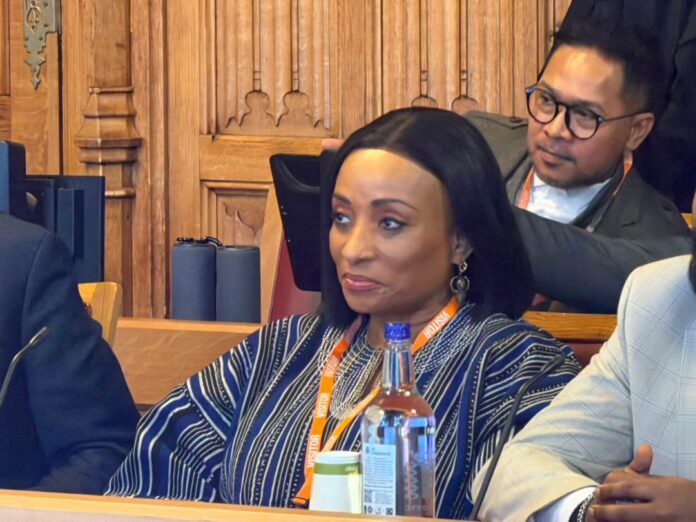

Ghana’s High Commissioner to the United Kingdom and Ireland, Sabah Zita Benson, has reaffirmed the country’s commitment to inclusive multilingual policies during a commemorative event marking International Mother Language Day 2026 at the UK Parliament in London.
The event, hosted by the Bangladesh High Commission, brought together diplomats, Members of Parliament, and cultural stakeholders to celebrate linguistic diversity and its central role in sustainable development.
Addressing the gathering, the High Commissioner described the occasion as “a profound honour” and highlighted the intrinsic connection between language, identity, dignity, and development.
She paid tribute to Bangladesh’s historic leadership in championing linguistic rights, noting that it was through Bangladesh’s initiative that UNESCO proclaimed 21 February as International Mother Language Day in 1999—a decision later endorsed by the United Nations General Assembly.
“This act transformed a national historical experience into a global commitment to linguistic rights and cultural preservation,” she said, commending Bangladesh for elevating the cause internationally.
Citing UNESCO estimates, she noted that approximately 7,000 languages are spoken worldwide, with nearly 40 per cent at risk of disappearing. “When a language vanishes, humanity loses irreplaceable cultural knowledge, oral traditions, and intellectual heritage that cannot be replicated,” she warned.
The High Commissioner further emphasized that research shows children who begin their education in their mother tongue achieve stronger literacy outcomes and improved cognitive development compared to those taught exclusively in a second language, linking mother-tongue-based multilingual education to Sustainable Development Goal 4 on quality education.
Turning to Ghana’s experience, she highlighted that the country is home to over 80 indigenous languages, forming a vibrant mosaic of traditions and social systems. Languages such as Akan, Ewe, Ga, and Dagbani, she explained, are essential for community cohesion, local governance, and intergenerational knowledge transfer.
Ghana’s language-in-education policy promotes the use of Ghanaian languages in the early years of basic education, with a gradual transition to English. “These efforts ensure that access to quality education is equitable and inclusive, particularly for children in rural and linguistically diverse communities,” she stated.
She concluded by reaffirming Ghana’s commitment to advancing inclusive multilingual policies and strengthening international partnerships.
“Linguistic diversity is not a barrier to national unity; rather, it is a source of strength,” she said, pledging continued collaboration with Bangladesh and the wider international community to ensure that “no language, and no community, is left behind.”
READ ALSO: