
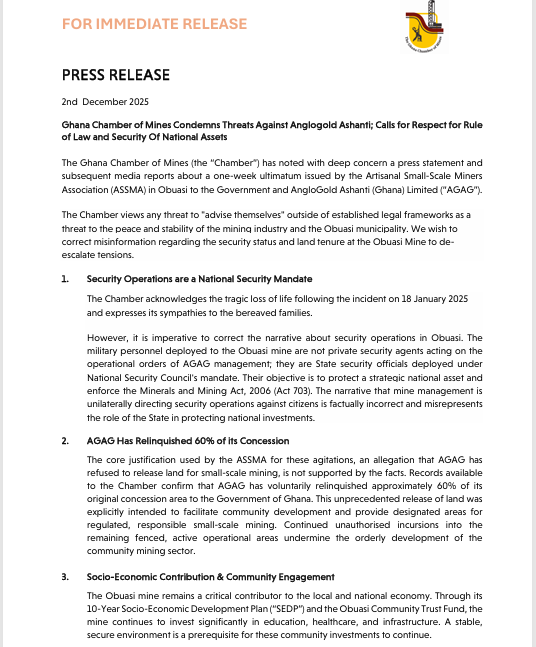
The Ghana Chamber of Mines has strongly condemned threats issued by the Artisanal Small-Scale Miners Association (ASSMA) in Obuasi, describing their one-week ultimatum to the government and AngloGold Ashanti Ghana (AGAG) as a threat to peace, stability, and lawful mining operations in the municipality.
In a statement dated December 2, 2025, the Chamber warned that any attempt by groups to “advise themselves” outside legal frameworks poses a serious security risk. It also sought to correct what it called misinformation surrounding security operations and land ownership at the Obuasi mine.
The Chamber clarified that military officers deployed to Obuasi are state security personnel acting under the mandate of the National Security Council, not private agents of AGAG. Their role is to protect a strategic national asset and enforce the Minerals and Mining Act, 2006 (Act 703).
Addressing claims that AGAG has refused to release land to small-scale miners, the Chamber stated that the company has already relinquished about 60% of its original concession to the government, a significant move to support regulated community mining. Unauthorized entry into the remaining fenced operational areas, it said, undermines these efforts.
The statement highlighted AGAG’s continued socio-economic contributions through its 10-Year Socio-Economic Development Plan and the Obuasi Community Trust Fund, stressing that stability is crucial for sustained development.
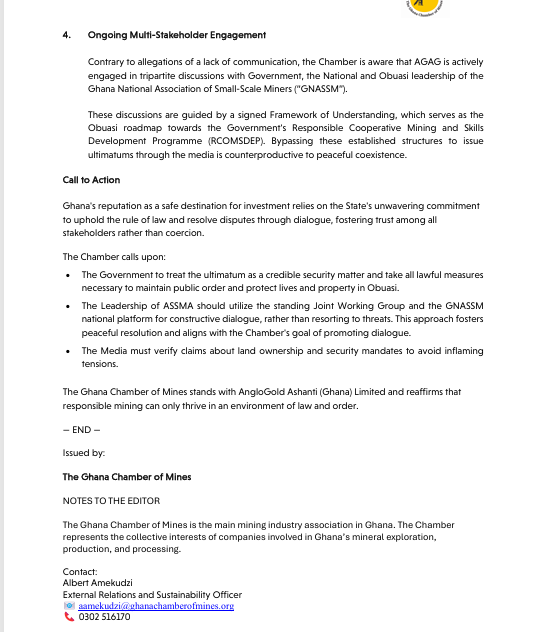
Contrary to accusations of poor communication, the Chamber said AGAG actively engages in tripartite meetings with the government and the leadership of the Ghana National Association of Small-Scale Miners, guided by a Framework of Understanding aligned with the Responsible Cooperative Mining and Skills Development Programme.
The Chamber urged the government to treat the ultimatum as a serious security concern and called on ASSMA to engage through established dialogue platforms instead of issuing threats. It further encouraged the media to verify claims related to land and security to prevent escalation.
READ ALSO: