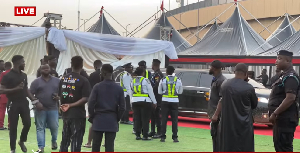

The nation stands still today, Saturday, December 13, as Ghana bids a final and long-delayed farewell to legendary highlife musician Charles Kwadwo Fosu, popularly known as Daddy Lumba (DL).
The burial service is being held at the Baba Yara Sports Stadium in Kumasi, bringing to an end months of uncertainty marked by bitter legal disputes, deep-seated family disagreements and last-minute court injunctions that repeatedly stalled preparations for his final rites.
The ceremony, described as one of the largest state-assisted funerals for an artiste in recent Ghanaian history, has drawn thousands of mourners. Among them are the President, senior government officials, leading political figures, key stakeholders in the Ghanaian music industry and devoted fans from across the country.
Months of Legal Battles and Family Tensions
Daddy Lumba’s death, though widely mourned, quickly sparked a succession crisis that plunged his funeral arrangements into prolonged controversy.
Several court actions were filed over competing claims to his estate and the right to organise his burial, with multiple women asserting recognition as his lawful wife or partner. These disputes led to a series of injunctions that were alternately imposed and lifted, delaying the funeral for months.
As tensions escalated, traditional leaders and respected dignitaries, particularly from the Asante Royal Palace, were reportedly compelled to intervene to mediate between feuding family factions, highlighting the scale of the crisis surrounding the highlife icon.
Uncertainty lingered until the final hours, with legal teams said to have held emergency meetings less than 48 hours before the service to resolve outstanding issues, including the programme and the roles family members would play during the ceremony.
A Colossal Musical Legacy
Born Charles Kwadwo Fosu, Daddy Lumba rose to prominence in the late 1980s, breaking into the national spotlight with his debut album Yɛyɛ Aka Akwantuo Mu in 1989.
Across a career spanning more than three decades, he released over 30 albums, cementing his status as one of Ghana’s most prolific, influential and celebrated musicians.
He was widely credited with redefining modern highlife by blending traditional Ghanaian rhythms with synthesiser-driven sounds and contemporary Afropop influences. His music spoke to every facet of life, from spirituality and social reflection to love, heartbreak and personal struggle.
Songs such as Asem Pa and Aben Wo Aha showcased his lyrical depth and emotional range, while his distinctive vocal delivery and spoken-word inflections set him apart from his peers.
His impact was recognised through numerous honours, including multiple Ghana Music Awards Artist of the Year accolades, and his influence continues to resonate with generations of musicians across Ghana and beyond.
The Final Journey
The Baba Yara Sports Stadium, usually reserved for major national football matches, was selected to accommodate the unprecedented public interest in Daddy Lumba’s final farewell.
After the public service and tributes, his remains are expected to be conveyed to his hometown for a strictly private traditional burial, finally closing a dramatic chapter in the life and death of one of Ghana’s greatest musical icons.
May the soul of Charles Kwadwo Fosu rest in perfect peace.
Court clears way for Daddy Lumba’s funeral on Saturday after applicants…
Unemployed teachers cry foul over alleged secret GES recruitment; appointment letters…