
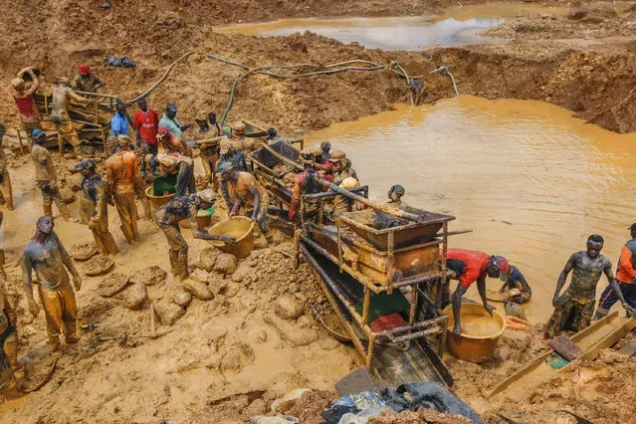

Convener, OneGhana Movement and Trustee of Ghana Coalition Against Galamsey, Senyo Hosi, has warned that Ghana must confront the hard truth that illegal mining (galamsey) cannot simply be eradicated, urging a shift toward regulation, technology, and pragmatic policy solutions.
According to him, efforts to eliminate galamsey outright are unrealistic given the powerful economic and political forces sustaining it.
“We have to get the reality that Galamsey is not going anywhere. That is what I see. We have to find a way to correct the externalities around that,” he stated in an interview on JoyNews’ Newsfile on Saturday, March 21.
He explained that the sector has become deeply embedded in Ghana’s socio-economic structure, providing livelihoods for thousands, while also feeding into political financing and broader economic stability.https://www.youtube.com/embed/yrmf5546Msk?si=zkdbaoKRzz3NkQlx
Mr. Hosi noted that even government faces a dilemma, as slowing gold production could trigger macroeconomic consequences.
“Gold production drops, and then you’re dealing with macroeconomic problems. Politicians are also being funded by actors within this space,” he added.
Shift From Elimination to Control
Rather than continued crackdowns, Mr. Hosi is proposing a strategic pivot—one that focuses on managing and formalising the sector. He argued that the current approach risks failure because it ignores the economic incentives driving participation in illegal mining.
“There’s no going back. The question is: how do we rationalise what is happening?” he asked.
Low Recovery, High Losses
A key concern he raised is inefficiency in current small-scale mining operations. According to him, galamsey activities are only yielding about 30% gold recovery, meaning the country is losing significant value from its natural resources.
By contrast, large-scale mining operations achieve 85% to 95% recovery rates.
Technology as the Game-Changer
Mr. Hosi believes technology holds the key to transforming the sector. He proposed deploying modern mining techniques to: Improve recovery rates, reduce environmental damage and increase state revenue.
“Can we use technology to correct the losses and move closer to large-scale recovery levels?” he suggested.
Formalisation Over Criminalisation
Beyond technology, he is calling for the full regularisation of artisanal and small-scale mining (ASM). This would involve: Making operators compliant with regulations, providing structured support and oversight and integrating them into the formal economy.
According to him, this approach allows government to maintain control while preserving livelihoods.
“Let it be fully compliant, supported with technology, so government can guide the sector while people do it properly,” he said.
Environmental Concerns Still Critical
While acknowledging that solutions like water-cleaning technologies may help, Mr. Hosi stressed they are not sufficient on their own. He warned that harmful practices, including the use of chemicals like cyanide, must be better regulated—not ignored.
A Call for Policy Realism
Mr. Hosi concluded that Ghana must abandon idealistic approaches and adopt realistic, balanced strategies that align policy with on-the-ground realities. “Technology and policy must be brought together to correct this. Doing nothing is not going to help anybody,” he cautioned.
