
A leading academic has called for urgent reforms to Ghana’s language, justice, and civic education systems, warning that democratic participation remains deeply uneven due to language barriers.
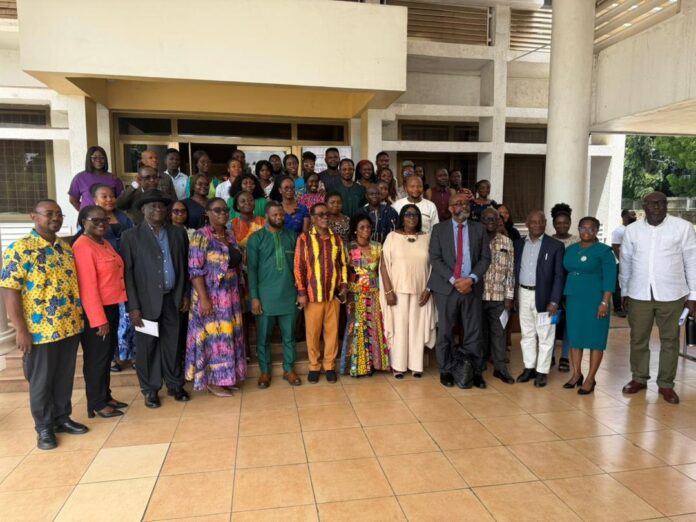
Speaking at an interdisciplinary symposium on “Access to Justice and Democratic Participation: The Role of Language” at the GAAS Main Auditorium, Professor Joseph Awetori Yaro, Provost of the College of Humanities, said language in governance is not merely a tool for communication but a structure of power that determines who can access rights and who is excluded from them.
He noted that although Ghana’s Fourth Republic is widely regarded as one of Africa’s most stable democracies, a contradiction persists: English remains the official language of state administration, yet only about 20 to 25 percent of the population is proficient in it.
This, he argued, leaves a large majority of citizens unable to fully engage with courts, parliament, civic education programmes, and other key democratic institutions.
“Language is not a neutral instrument,” he said. “It determines who can claim rights, who is heard, and whose voice is recognized in the public sphere.”
Professor Yaro described this situation as creating a hierarchy of citizenship in which constitutional rights exist on paper but are unevenly accessible in practice due to linguistic exclusion.
He pointed to civic education delivery as a key concern, noting that the National Commission for Civic Education (NCCE) often relies heavily on English, limiting effective outreach to rural communities and informal sector workers.
The symposium also examined how political language shapes development narratives, with presentations showing how political actors use rhetorical framing to construct visions of national transformation and economic policy direction. Scholars discussed how such language can both inspire collective ambition and reinforce political divisions.
A comparative discussion on political thought highlighted differences in how freedom is framed across contexts, with “negative liberty” emphasising freedom from state interference in some Western political discourse, while Ghanaian debates more often reflect “positive liberty,” centred on collective empowerment and socio-economic self-determination.
Speakers stressed that such forms of empowerment cannot be realised without inclusive civic education delivered in languages citizens understand.
Indigenous languages such as Twi, Ga, Ewe, and Dagbani were described as essential to grassroots participation, particularly through radio, community engagement, and digital platforms. However, participants warned that formal state communication has not kept pace with this linguistic reality.
Attention also turned to the justice system, where court proceedings are conducted in English with interpretation support for non-English speakers. Professor Yaro cautioned that court interpreters play a decisive role in shaping legal meaning, especially in tonal languages where subtle variations can alter meaning significantly.
He warned that weak regulation and limited professionalisation of interpretation services pose risks to fairness in judicial outcomes, particularly when testimonies are filtered through translation.
The symposium further raised concerns about emerging digital inequalities, noting that artificial intelligence and translation systems often simplify or distort African linguistic expressions, leading to what speakers described as a form of cultural and epistemic loss in digital communication.
Professor Yaro called for a series of reforms, including expanded use of indigenous languages in civic education, professional certification of court interpreters, integration of local languages into education systems, stronger support for language institutions, and investment in technology that better reflects African linguistic realities.
He concluded that language should be understood not as a barrier but as the foundation of democratic citizenship.
“Without inclusive communication,” he said, “democracy remains incomplete.”
The symposium brought together scholars from law, linguistics, political science, anthropology, and media studies, underscoring growing concern over the role of language in shaping access to justice and democratic participation in Ghana.