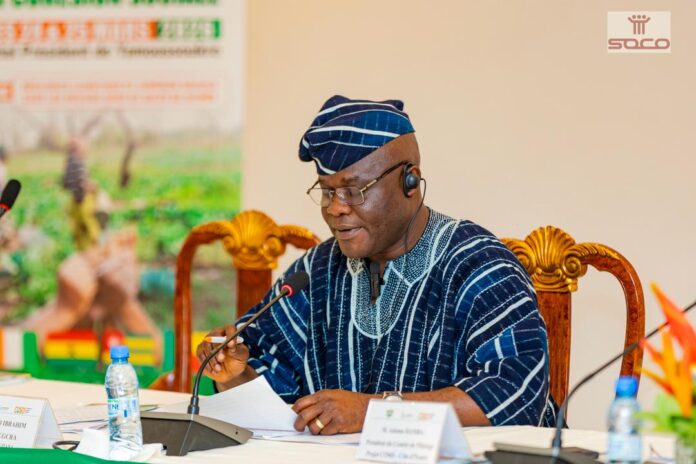

COLLEAGUE HONOURABLE MINISTERS,
DISTINGUISHED DELEGATES FROM THE IMPLEMENTING COUNTRIES, REPRESENTATIVES FROM THE WORLD BANK AND OTHER DEVELOPMENT PARTNERS,
DISTINGUISHED INVITED GUESTS,
LADIES AND GENTLEMEN;
Good morning!
I am delighted to join you at this important Regional Conference on SOCO. On behalf of His Excellency John Dramani Mahama, President of the Republic of Ghana, and the Ministry of Local Government, Chieftaincy and Religious Affairs, I extend to you warm greetings from the people and government of Ghana.
I also wish to express my profound appreciation to our host, the government of Cote D’Ivoire for the warm reception we received on arrival in this country.
Distinguished Ladies and Gentlemen,
This gathering comes at an important time for our region. Across the northern corridor of the Gulf of Guinea, our countries continue to face shared challenges that affect the stability of our border communities.
Climate pressures, movement of people across borders, limited economic opportunities, and growing insecurity in parts of the Sahel continue to strain communities that depend largely on agriculture, cross border trade, and local economic activities for survival.
These challenges remind us that development and security are closely linked. When communities lack access to services, livelihoods, and opportunity, vulnerability increases. Social cohesion, therefore, becomes essential not only for development but for peace and stability within our borders.
Distinguished Ladies and Gentlemen,
Recent events in our sub‑region illustrate this vividly. Ghanaian tomato traders travelling to Burkina Faso in search of livelihood opportunities were tragically caught in a terrorist attack. These are ordinary citizens whose daily economic activities connect our markets and sustain families.
Their experience serves as a reminder that insecurity in one country does not remain contained; it reverberates across borders, affecting communities whose lives depend on movement and trade. No nation can confront these risks alone. Our collective safety rests on cooperation, shared responsibility, and coordinated regional action.
In many of our border areas, young people face limited employment opportunities. Where livelihoods are uncertain, and hope becomes fragile, extremist groups find space to recruit and influence vulnerable youth.
Addressing insecurity, therefore, goes beyond security operations. It requires investment in people, jobs, and functioning local systems that give young people a reason to remain engaged in their communities.
Colleague Ministers and Development Partners,
Climate change is further complicating this situation. Changing rainfall patterns, declining soil productivity, and pressure on water resources continue to affect livelihoods across northern Ghana and the wider Sahel region. Women and girls often carry the greatest burden when livelihoods are disrupted, yet they remain central to household survival and community stability. For this reason, climate adaptation efforts must deliberately consider gender inequality and ensure that women and youth remain part of economic and decision-making processes.
In Ghana, the SOCO Project has shown that early investment in communities can reduce vulnerability and support stability. Since its inception, SOCO interventions have reached an estimated 1.5 million people across 48 districts in 6 northern regions, covering about 1,700 communities organised into clusters.
Across these communities, access to schools, health facilities, water systems, sanitation services, and local markets has improved everyday living conditions. These investments help restore confidence in local governance and promote peaceful coexistence among communities.
As of January 2026, Ghana has completed 950 infrastructure subprojects, covering social infrastructure, water and sanitation facilities, connectivity, energy access, and climate adaptation interventions across the border and vulnerable communities.
Equally important is the Local Economic Development component of the project. Through this intervention, 1,554 Common Interest Groups have received support, reaching over 46,000 beneficiaries, with nearly 80 percent being women and youth. These groups are engaged in farming, agro-processing, and income-generating activities that provide practical alternatives to unemployment and economic exclusion.
The experience from Ghana is clear. When communities see development around them, when young people have work, and when women participate actively in decision making and local economies, tensions decrease and cooperation improves
Distinguished Ladies and Gentlemen,
But for interventions such as the SOCO Project, many vulnerable border communities could easily face increasing pressure from unemployment, migration, communal tensions, and exposure to extremist influence. Instead, communities are finding stability through opportunity and shared progress.
Our collective task as we advance is to deepen cross border cooperation. The challenges confronting us, insecurity, climate stress, transhumance pressures, and livelihood disruptions, are shared challenges. Platforms such as this Regional Conference allow us to exchange lessons, coordinate responses, and support communities before vulnerabilities grow into conflict.
Ghana remains committed to working alongside sister countries and development partners to promote social cohesion, support resilient communities, and safeguard peace across the Gulf of Guinea region.
Together, through cooperation, inclusion, and sustained investment in our people, we can ensure that our border communities become zones of opportunity rather than zones of vulnerability.
Distinguished Delegates,
As we proceed, it is my expectation that this Regional engagement will provide the opportunity to share our experiences and deepen our collaboration and partnership for the collective good of our people, particularly in the border regions of our countries.
On this note, on behalf of the government and people of Ghana, I once again wish to express our gratitude to the World Bank and partners countries, Cote D’Ivoire, Togo and Benin for this important partnership and joint collaboration under the Gulf of Guinea Northern Regions Social Cohesion Project (SOCO).
Thank you and wishing all fruitful deliberations.