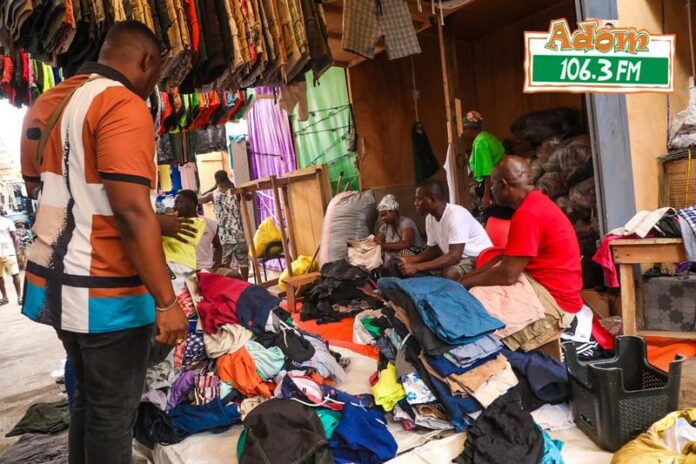

On any given market day in Accra, Kumasi, or Takoradi, bales of secondhand clothing are slit open like treasure chests. Traders gather.
Hands dive in. A designer jacket, barely worn jeans, vintage tees — opportunity spills onto the pavement.
In Ghana, obroni wawu is not just clothing. It is commerce. It is culture. It is survival. But beneath the color and energy lies a harder question: What happens to the clothes that don’t sell? The torn seams. The stained shirts. The synthetic fabrics no one wants. Increasingly, the answer is troubling — they pile up on land, clog drains, and wash into the sea. What begins as affordable fashion can end as an environmental burden.
The secondhand clothing trade has become one of Ghana’s most visible informal economic engines. Yet its environmental afterlife is shaping a new conversation — one that links fashion waste to climate change, marine pollution, and urban resilience. This is not a story of villains. It is a story of systems.
Ghana is widely recognized as one of the largest importers of secondhand clothing in West Africa. Containers arrive regularly at Tema Port, packed with garments collected from Europe, North America, and parts of Asia. Traders purchase these bales without knowing exactly what’s inside. Some make profit. Others incur losses when too much of the content is unsellable.
The economic upside is undeniable. Thousands of Ghanaians — market women, head porters, tailors, resellers — depend on this ecosystem. Secondhand clothing democratizes fashion. It allows families to dress well at lower cost. It fuels entrepreneurship.
Yet estimates from market associations and environmental observers suggest a significant percentage of imported clothing — sometimes as much as 30–40 percent — is effectively waste upon arrival. These items are too damaged, too stained, too outdated, or too synthetic to resell. And Ghana does not have a comprehensive textile recycling system to absorb that volume.
When unsellable clothing accumulates, disposal options are limited. Much of it is mixed with municipal waste. Some ends up in open dumps. Some is burned. Some is abandoned in peri-urban communities. The environmental implications are layered.
Natural fibers like cotton will eventually decompose, but even that process can release methane when buried in anaerobic landfill conditions. Methane is a potent greenhouse gas — significantly more powerful than carbon dioxide over a 20-year period.
Synthetic fabrics pose a deeper problem. Polyester, nylon, and acrylic are essentially plastic-based materials derived from fossil fuels. They can take decades — sometimes centuries — to degrade. As they break down, they fragment into microplastics, contaminating soil and waterways.
In communities already grappling with waste management challenges, textile waste adds another layer of strain. Blocked drains contribute to flooding during heavy rains. Burning of synthetic fabrics releases toxic fumes. Informal disposal undermines urban planning efforts.
The climate dimension here is not abstract. It is embedded in land use, methane emissions, and fossil-fuel-derived materials accumulating in the environment.
Perhaps the most visible symbol of this crisis is along parts of Ghana’s coastline. Fishermen and environmental groups have reported clothing tangled in nets and strewn across beaches. During high tides, fabric fragments mix with plastic bottles and sachet water waste in a troubling mosaic of global consumption.
The journey is predictable: discarded clothing clogs drainage systems, is washed into streams, flows into lagoons, and eventually reaches the ocean.
Synthetic textiles shed microfibers — tiny plastic particles that enter marine ecosystems. These microplastics can be ingested by fish and shellfish, moving up the food chain and potentially into human diets. This is where the local becomes global.
Ghana is not producing these garments. It is receiving them at the end of their lifecycle. The environmental cost, however, becomes Ghana’s to manage. Coastal tourism, fishing livelihoods, and marine biodiversity all intersect at this point. Textile waste in the sea is not just aesthetic pollution. It is economic and ecological risk.
At first glance, used clothing might seem environmentally positive. Reuse extends garment life and reduces demand for new production. That is true up to a point. The complication arises when the volume of imports exceeds local reuse capacity.
Globally, the fashion industry is estimated to account for a significant share of greenhouse gas emissions due to energy-intensive production, transportation, and raw material extraction.
When garments are shipped across continents only to become waste in another country, the carbon footprint compounds: transport emissions, waste decomposition emissions, incineration emissions. In this context, Ghana becomes part of a larger climate equation — one driven by global overproduction and consumption patterns.
The uncomfortable truth is that secondhand trade sometimes functions as a pressure valve for fast fashion excess in wealthier economies. Instead of reducing production, surplus goods are redistributed. And when redistribution fails, waste is externalized.
Ghana’s waste management infrastructure was not designed to handle large volumes of textile waste. Municipal systems primarily focus on organic waste and plastics. Textiles often fall through regulatory cracks.
Moreover, traders bear disproportionate financial risk. They pay for bales upfront. When a bale contains too much waste, they absorb the loss. Disposal costs fall on individuals who have little margin. This is not merely an environmental issue. It is an economic justice issue.
Consumers can play a role by choosing durable items and properly disposing of clothing rather than discarding them into drainage systems. The objective is not to shut down the secondhand trade. It is to modernize it.
Any conversation about regulating secondhand clothing must consider livelihoods. Thousands depend on this trade. Abrupt restrictions without alternatives could disrupt incomes and deepen economic vulnerability. Therefore, reforms must be phased, consultative, and data-driven.
Climate action cannot ignore social context. Environmental sustainability must align with economic inclusion. Ghana has an opportunity to position itself as a leader in circular textile management in West Africa — turning a waste challenge into an innovation frontier.
In an era where sustainability shapes global investment decisions, environmental stewardship is part of national branding. Secondhand clothing does not have to symbolize environmental decline. With intentional policy, it can become a symbol of circular economy leadership.
The secondhand clothing trade in Ghana tells a complicated story of global inequality, local entrepreneurship, consumer aspiration, and environmental strain. The garments themselves are silent. But their afterlife speaks loudly.
If unmanaged, textile waste will continue to accumulate on land, in drains, and along coastlines. If strategically addressed, it can become a catalyst for policy reform, innovation, and climate leadership.
The question is not whether Ghanaians should wear secondhand clothes. The question is whether Ghana can redesign the system that handles them. Every shirt has a lifecycle. Every dress has an endpoint. The future will be defined by what we choose that endpoint to be — landfill, ocean, or renewal. And in that choice lies not just fashion’s fate, but a fragment of Ghana’s climate story.
The writer, Shadrach Assan, is the lead producer for Adom FM’s morning show, Dwaso Nsem.