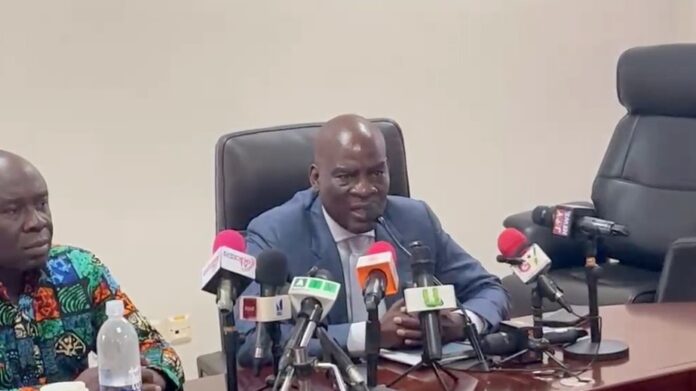

Education Minister Haruna Iddrisu has asked the Ghana Tertiary Education Commission (GTEC) to direct public universities to communicate their reopening dates by the weekend as government works to resolve the ongoing strike by the Ghana Association of University Administrators (GAUA).
He said he was hopeful that the industrial action would be suspended within days to allow administrative and academic activities to resume, with a target of restarting academic work on Monday.
Mr Iddrisu announced this on Monday, October 12, 2026, after meeting executives of GAUA and the Technical University Senior Administrators Association of Ghana (TUSAAG), alongside officials of GTEC.
The strike has affected administrative services at public universities, compelling the University of Ghana (UG) and the Kwame Nkrumah University of Science and Technology (KNUST) to postpone their planned reopening dates.
The Minister said the government was keen to prevent further disruption to the academic calendar and wanted universities to reopen before the end of the week.
“It is my expectation that the universities can reopen towards the weekend and not later than the weekend so that academic work can begin on Monday so that we don’t lose the academic calendar to the strike and its impact,” he said.
He described the current academic calendar as the best the country had experienced in five years and said the government was committed to preserving it.
“Understandably, we have never come across a good academic calendar like this in the last five years. We will do everything possible to preserve the calendar,” he added.
However, the proposed timeline remains dependent on consultations between the associations and their members. At the time of the meeting, neither GAUA nor TUSAAG had announced a decision to suspend the strike.
Mr Iddrisu explained that his involvement was to facilitate discussions on behalf of the government, rather than negotiate salaries directly.
“As I’ve indicated, the Minister for Education has no mandate for salary negotiations. I’m only facilitating on behalf of government,” he said.
He acknowledged that disagreements between government and workers were possible, even though government serves as the employer of members of both associations.
“But you have to recognize that government remains the employer of the entire membership of GAUA and TUSAAG. And therefore sometimes even the tongue and the teeth, they quarrel even though they are all in the same mouth. There can be legitimate disagreements, there can be legitimate conflicts,” he said.
The Minister appealed to GAUA’s leadership to consider the effect of the strike on students and work towards an early resolution. He said the associations would have to consult their members before making a final decision on the industrial action.
GAUA began the strike on August 10 before briefly suspending it and reactivating the action on September 15. The dispute centres on differences in the Interim Market Premium (IMP) paid to senior staff in teaching and non-teaching positions.
The association argues that a 2012 Compulsory Arbitration Award established parity at 114 per cent of basic salary. It maintains that while the market premium for members of the University Teachers Association of Ghana (UTAG) has since increased, the premium for GAUA members has remained unchanged.
READ ALSO:
GAUA’s strike is surprising because we signed an MoU – Fair Wages CEO