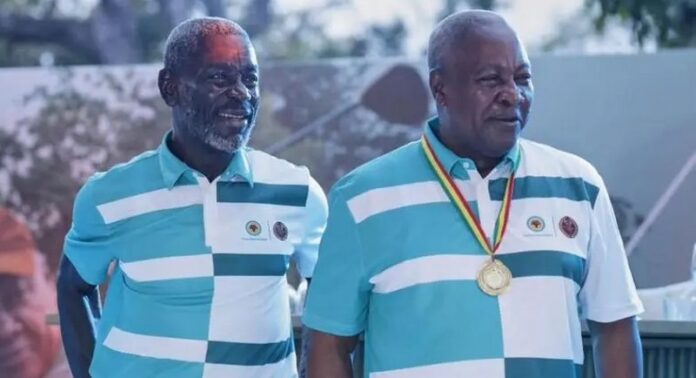

Prince Kofi Amoabeng, founder of the defunct UT Bank, has called on President John Dramani Mahama to implement a bold, non-partisan national strategy aimed at deliberately creating at least 10 Ghanaian billionaires to serve as economic pillars for the nation.
Speaking at the Fourth First National Bank (FNB) Head of State Invitational Golf Tournament at the Achimota Golf Club last Friday, Amoabeng argued that targeted government support for capable, honest entrepreneurs is essential to accelerating economic growth, reducing poverty, and projecting Ghana’s economic strength internationally.
The ‘Deliberate’ Billionaire Strategy
Amoabeng’s proposal departs from traditional economic policy by advocating that the government actively identify and support a cohort of high-potential domestic business leaders. Drawing on his own experience in the financial sector and regulatory clean-up, he stressed that such empowerment should bypass political allegiance and focus strictly on merit and compliance.
“My suggestion is that, apart from helping the poor people with employment arrangements, we should try to create at least 10 millionaires or billionaires in Ghana—deliberately,” he said.
He outlined the criteria and the government’s role in the initiative:
“You can choose young people who are honest, pay their taxes, and have businesses to stand for, and intentionally back them with grants, contracts, and support. This will enable them to grow, compete internationally, and project the name of this country.”
Amoabeng emphasized that the country must break away from the “pull-him-down syndrome” that hinders homegrown success, urging the President to identify “genuine business people” beyond party lines who can drive national economic growth.
“So, Mr President, identify not only NDC members, but genuine business people and encourage them so they will become successful for our dear country,” he added.
Praise for Economic Gains and the 24-Hour Policy
The former banker also commended the administration for fostering a “renewed national sense of hope” and cited improvements in key macroeconomic indicators, including inflation, interest rates, and the Ghana Cedi’s performance.
He lauded the 24-hour economy initiative, summarizing it practically: “When you accept you are poor, when rich people are sleeping late, you don’t sleep. That’s basically my understanding of it.”
Infrastructure and Judicial Reform: Critical Pillars
Amoabeng identified infrastructure and the legal system as major obstacles to Ghana’s economic acceleration. He backed the proposed Accra–Kumasi commercial project, highlighting the high logistics costs due to the current seven-hour road journey.
“One other thing which really concerns me is the proposed Accra commercial project. Anyone spending seven hours to get to Kumasi will want to pay even 1,000 cedis to arrive on time and conduct business efficiently,” he said.
He also called for urgent reform of the Judiciary, noting that chronic delays hinder business confidence and investment. Citing his own experience, he said:
“I personally had a debt recovery which took eight years. Somebody defaulted despite collateral, and yet it took eight years to resolve. Without judicial reform, the broader economic transformation agenda cannot achieve its maximum impact.”
Amoabeng concluded that addressing these structural challenges, alongside deliberate support for high-potential entrepreneurs, is essential for driving sustainable economic growth in Ghana.
Driver dead, 2 injured in accident at Adansi Akrokerri Junction